VEGETABLE-PARER.
A Saxon inventor replaces the American feed screw with cam, rack, and pawl
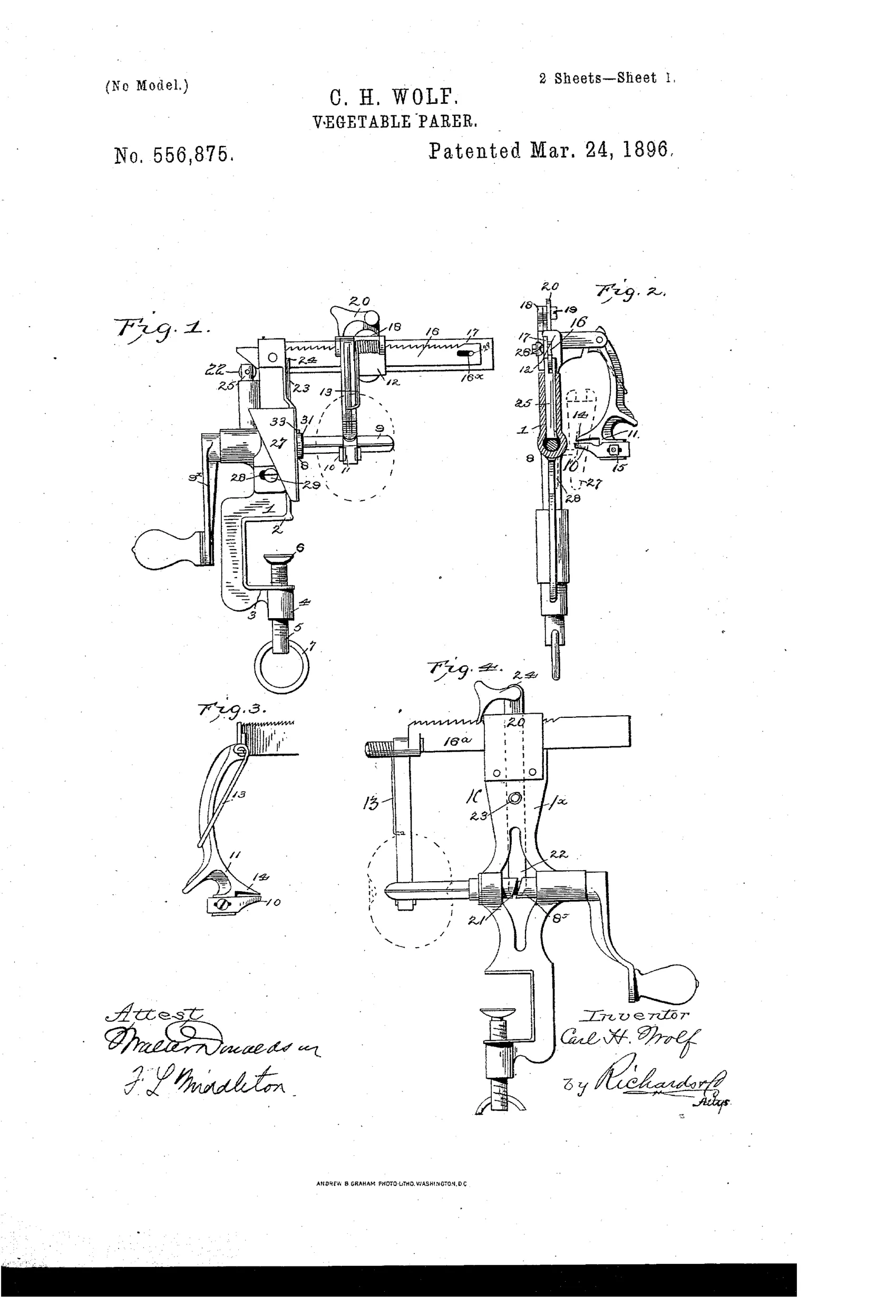
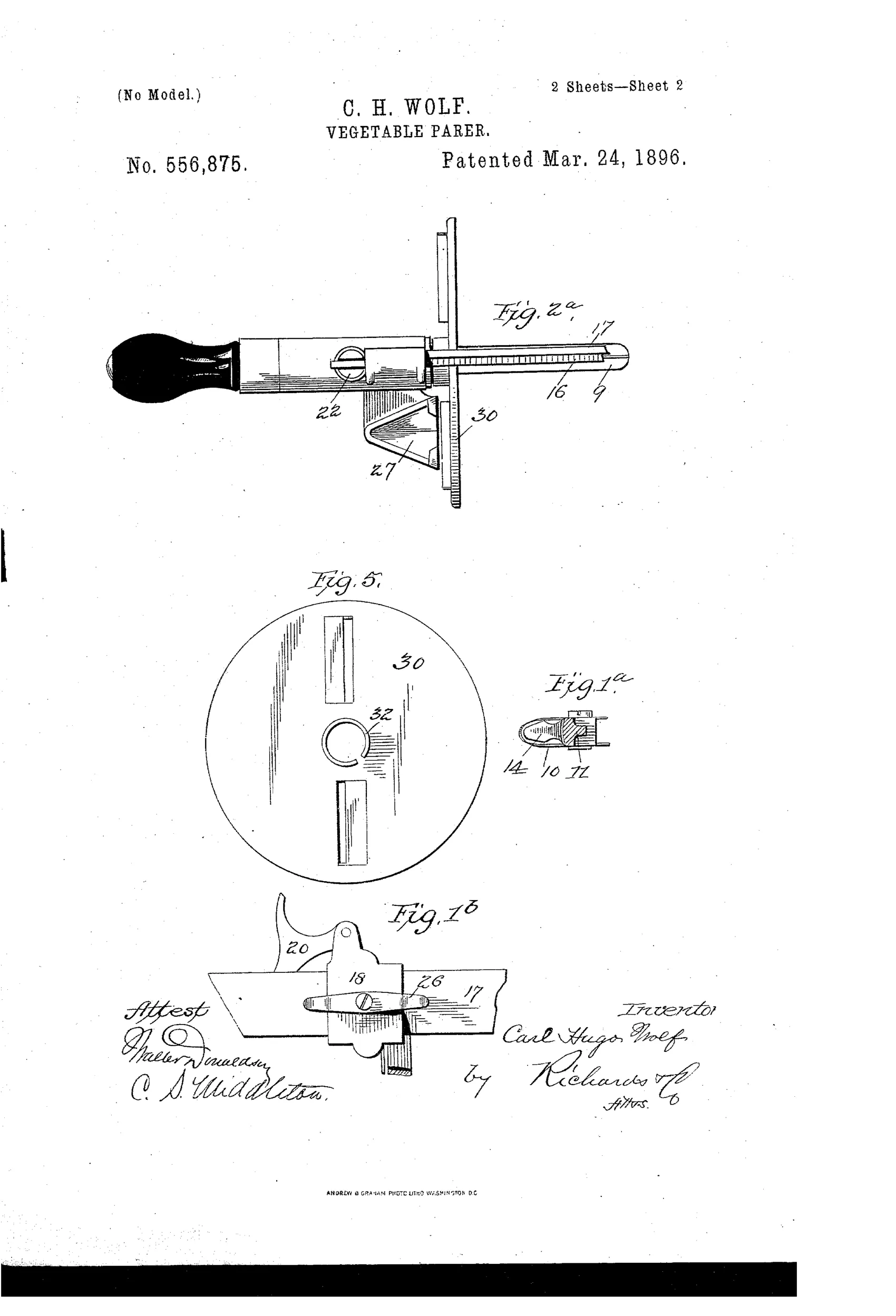
Hand-cranked mechanical vegetable and fruit parer
❧ How it works
A vertical standard clamps to a table edge and carries a rotary spindle formed of three diverging blades that pierce and hold the vegetable while a hand crank turns it. A loop-shaped paring knife is mounted on a spring-tensioned arm at the end of a reciprocating rack-bar, and a pawl-and-detent mechanism engages the rack teeth so the knife casing is fed forward step by step along a guiding-bar as the spindle rotates. A cam portion on the drive shaft actuates a vertical plunger and roller that push the rack-bar forward each revolution, while a return spring pulls it back so the detent rides over the teeth without moving the casing on the return stroke. A modified form (Figs. 3-4) instead mounts the knife arm directly on the rack-bar, operated by a cam groove, lever, and push-pawl, and a separate rotary vegetable-cutter with an open-sided hopper and diametrically arranged blades on a slotted disk can be fitted to the same spindle for cutting beans or other vegetables.
❧ What was claimed
“1. In combination, the frame, the rotary spindle for holding the fruit or vegetable to be pared, the knife, the arm carrying the same, the rack-bar and pawl and the movable bar operated from a cam portion of the spindle and extending therefrom for operating the rack, substantially as described.”
In plain English: The invention combines a frame, a rotating spindle that holds the fruit or vegetable, a knife on a movable arm, and a rack-and-pawl system driven by a cam on the spindle to automatically advance the knife across the rotating produce.
❧ In the inventor’s words
“It will be apparent from the foregoing description that the article to be pared is constantly rotated and that the knife is held in engagement therewith and fed gradually along, thus permitting every portion of said vegetable to be reached by the knife.”— Carl Hugo Wolf, from the specification
Fate unknown
No production example matching this design is documented in DATAMP or the collector literature; a marked German-made specimen would settle it.
❧ Commentary
Carl Hugo Wolf of Zwickau attacks the same problem the American lathe-parer men had been solving since the 1850s — how to walk a knife steadily along a spinning fruit — but with a distinctly machine-shop answer. Where a Reading or Goodell parer uses a screw thread or geared arc to feed the blade, Wolf puts a cam on the crank spindle that drives a plunger and roller, shoving a toothed rack-bar forward one notch per revolution while a detent holds the gain and a return spring resets the plunger. It is an escapement, essentially: the knife advances in discrete steps, once per turn, so the paring spiral has a fixed pitch regardless of how fast you crank.
Two other details reward a close look at the sheet. The holding fork is not the familiar three-tine American fork but three diverging blades forming the spindle itself — better suited to potatoes and beets than apples. And Figure 5 shows a bolt-on rotary disk cutter with an open hopper for slicing beans on the same clamp and crank, making this a modular kitchen machine rather than a single-purpose parer.
Would it work? Probably, though the pawl train is a lot of parts doing what a coarse screw does with one. That parts count is likely why nothing like it turns up on collectors' shelves; the field was already crowded with simpler machines that fed just as well.
Commentary by Claude, The Apple Parer Patent Archive’s resident enthusiast