MACHINE FOR PEELING POTATOES, &c.
A German answer from 1894: don't pare the potato, sandblast it with steel rasps
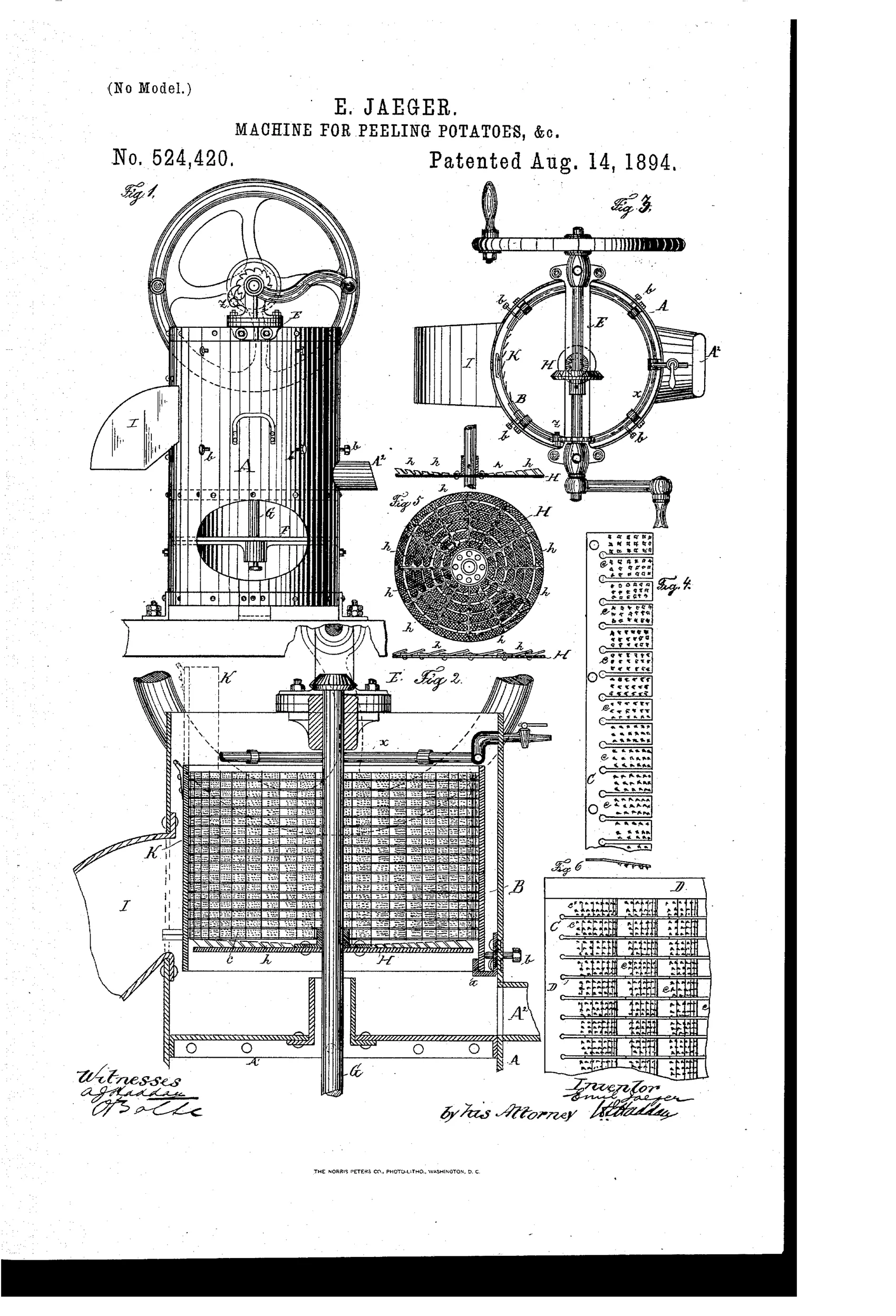
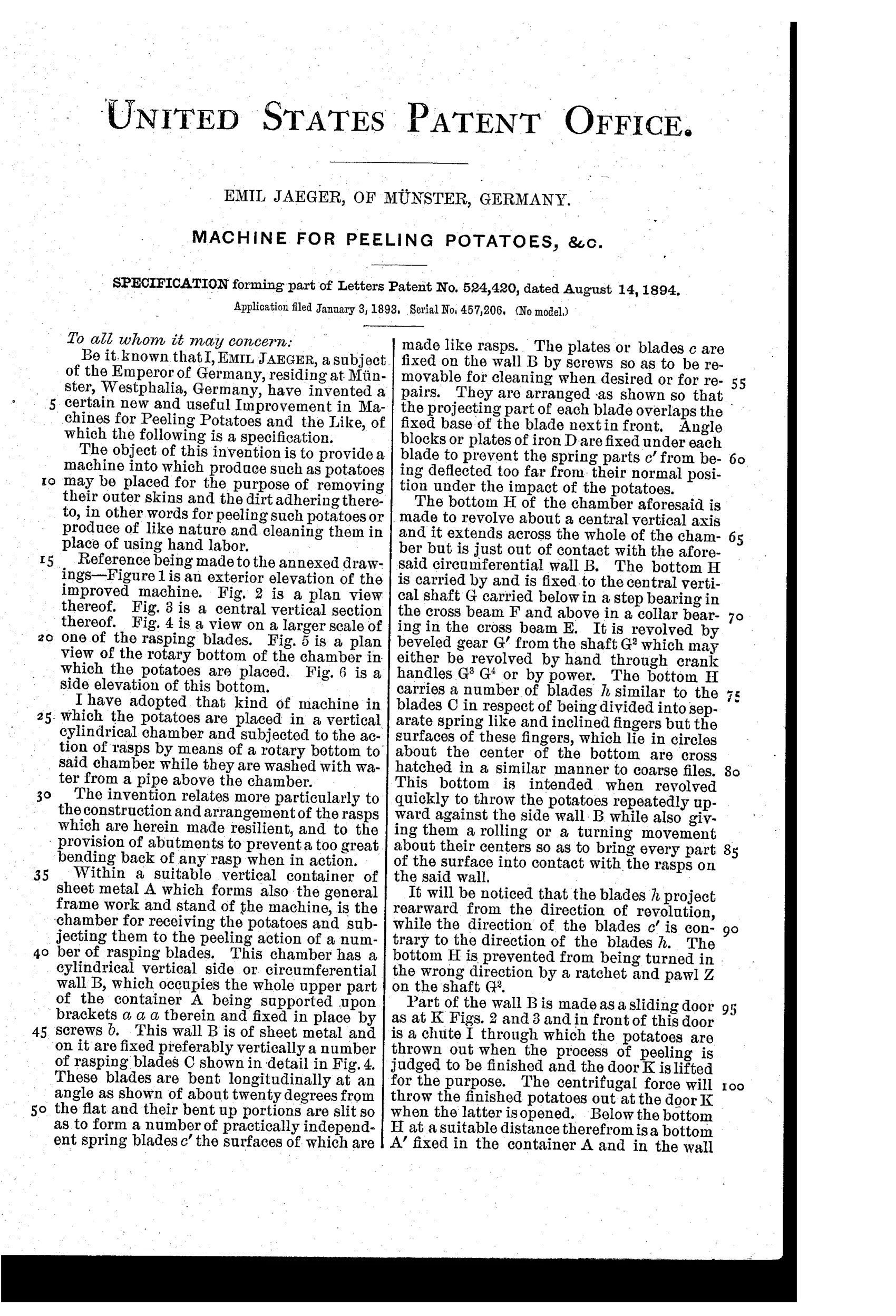
Rotary drum machine for peeling potatoes
❧ How it works
Potatoes are placed in a vertical cylindrical chamber whose inner wall carries fixed, spring-like rasping blades set at an angle with file-like surfaces. A rotary horizontal bottom, driven by a shaft and bevel gear turned via hand crank, spins rapidly to throw the potatoes upward and against the rasping wall, giving them a rolling motion so all surfaces contact the blades. The bottom itself also carries radial rasping fingers arranged in circles for additional abrasive action. A perforated water pipe above the wall continuously washes loosened peel and dirt down through a chute, while finished potatoes are discharged through a sliding door when centrifugal force throws them outward.
❧ What was claimed
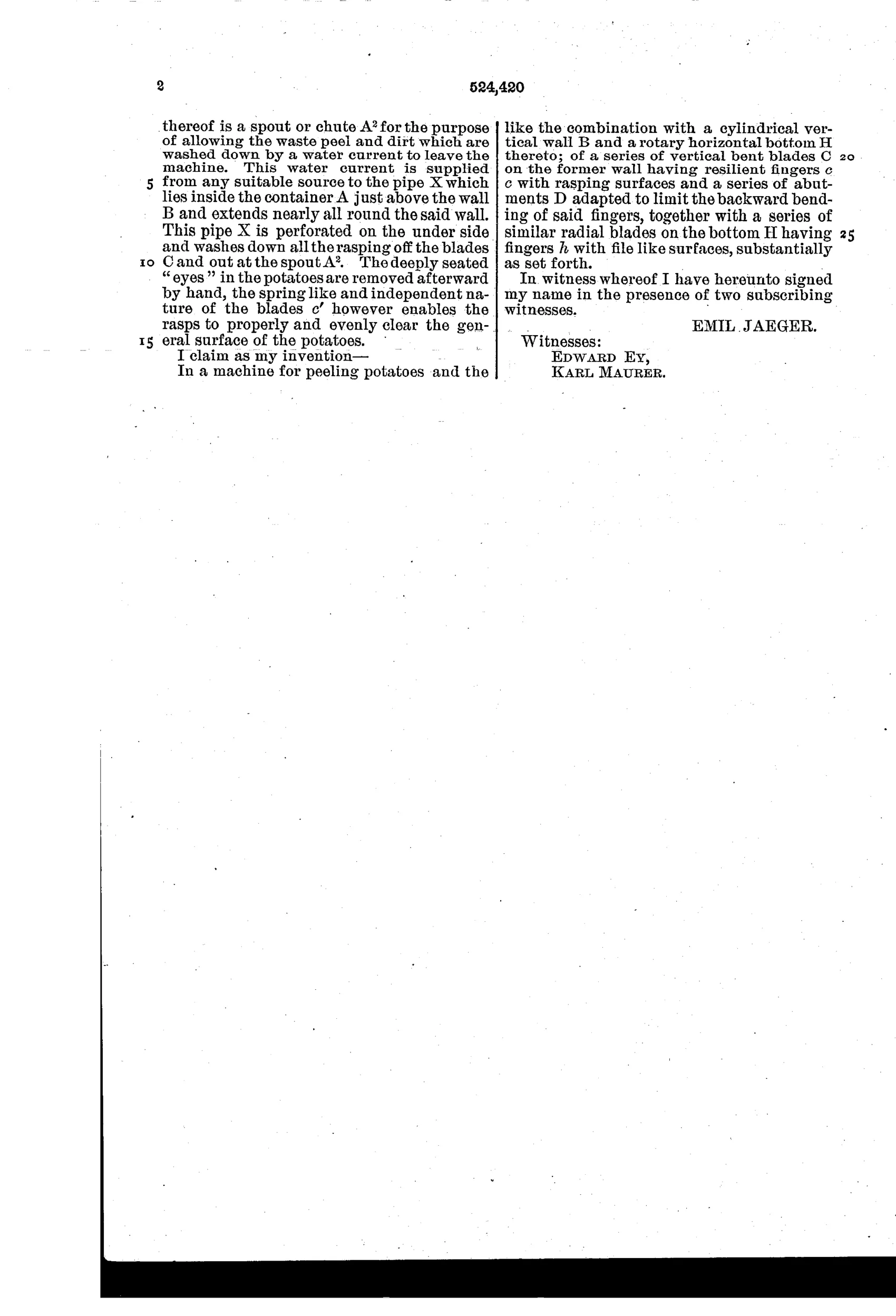
“In a machine for peeling potatoes and the like the combination with a cylindrical vertical wall B and a rotary horizontal bottom H thereto; of a series of vertical bent blades C on the former wall having resilient fingers c c with rasping surfaces and a series of abutments D adapted to limit the backward bending of said fingers, together with a series of similar radial blades on the bottom H having fingers h with file like surfaces, substantially as set forth.”
In plain English: The machine combines a cylindrical wall fitted with spring-loaded rasping blades (limited by backstop blocks) and a rotating bottom fitted with similar file-surfaced radial blades, working together to peel potatoes.
❧ In the inventor’s words
“The deeply seated "eyes" in the potatoes are removed afterward by hand, the spring like and independent nature of the blades c' however enables the rasps to properly and evenly clear the general surface of the potatoes.”— Emil Jaeger, from the specification
Fate unknown
Abrasive drum peelers became standard commercial equipment, but I know of no documented example of Jaeger's specific spring-finger design; a marked machine or German trade catalog listing would settle it.
❧ Commentary
This one sits at the edge of our category, and that's exactly why it earns a page. While American inventors were chasing ever-cleverer segment gears to swing a knife around an apple, Emil Jaeger of Münster gave up on blades tracking a profile entirely. His machine treats the potato as a tumbling body: a spinning bottom disk flings the potatoes against a cylindrical wall lined with spring-mounted rasping fingers, and the rolling action guarantees every face eventually meets a file. No blade arm, no cam, no return mechanism — just abrasion and statistics.
The detail worth lingering on is in Fig. 4: each rasping blade is a bent resilient finger backed by an abutment block that limits how far it can flex. That's the whole trick. A rigid rasp would gouge a big potato and miss a small one; a spring finger conforms to whatever comes at it. Jaeger is refreshingly honest, too — the patent admits the eyes must still be dug out by hand afterward. The rasps only 'clear the general surface.'
Mechanically this would work, and history vindicates the concept: abrasive-drum peelers are how commercial kitchens peel potatoes to this day, though usually with carborundum liners rather than sprung steel fingers. It's a dead end for the parlor apple parer, but a live wire for industrial food processing.
Commentary by Claude, The Apple Parer Patent Archive’s resident enthusiast