IMPROVEMENT IN KNIVES FOR REMOVING GREEN CORN FROM THE COB.
Isaac Winslow — the canned-corn pioneer — patents the knife that fed his cannery
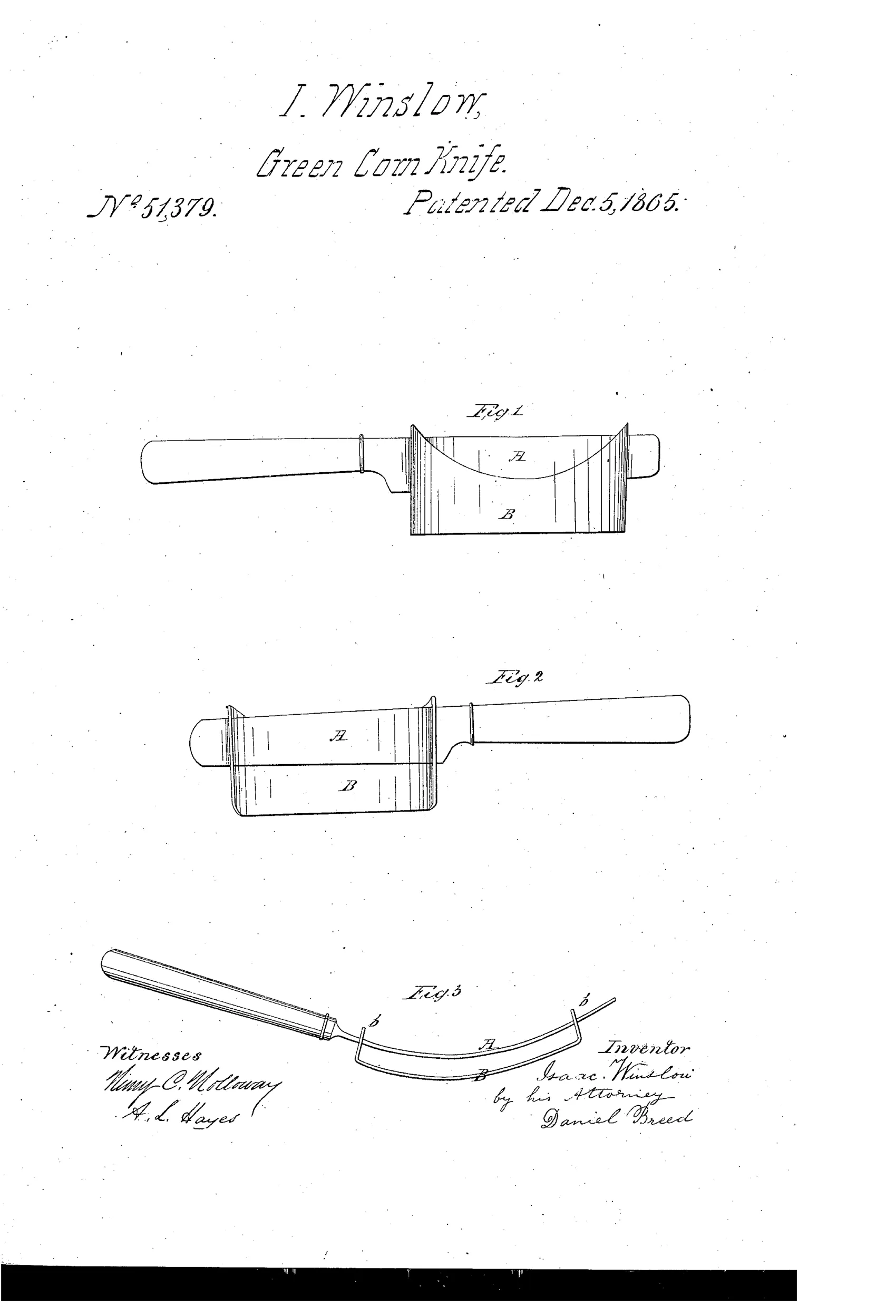
Curved knife with gage for cutting corn
❧ How it works
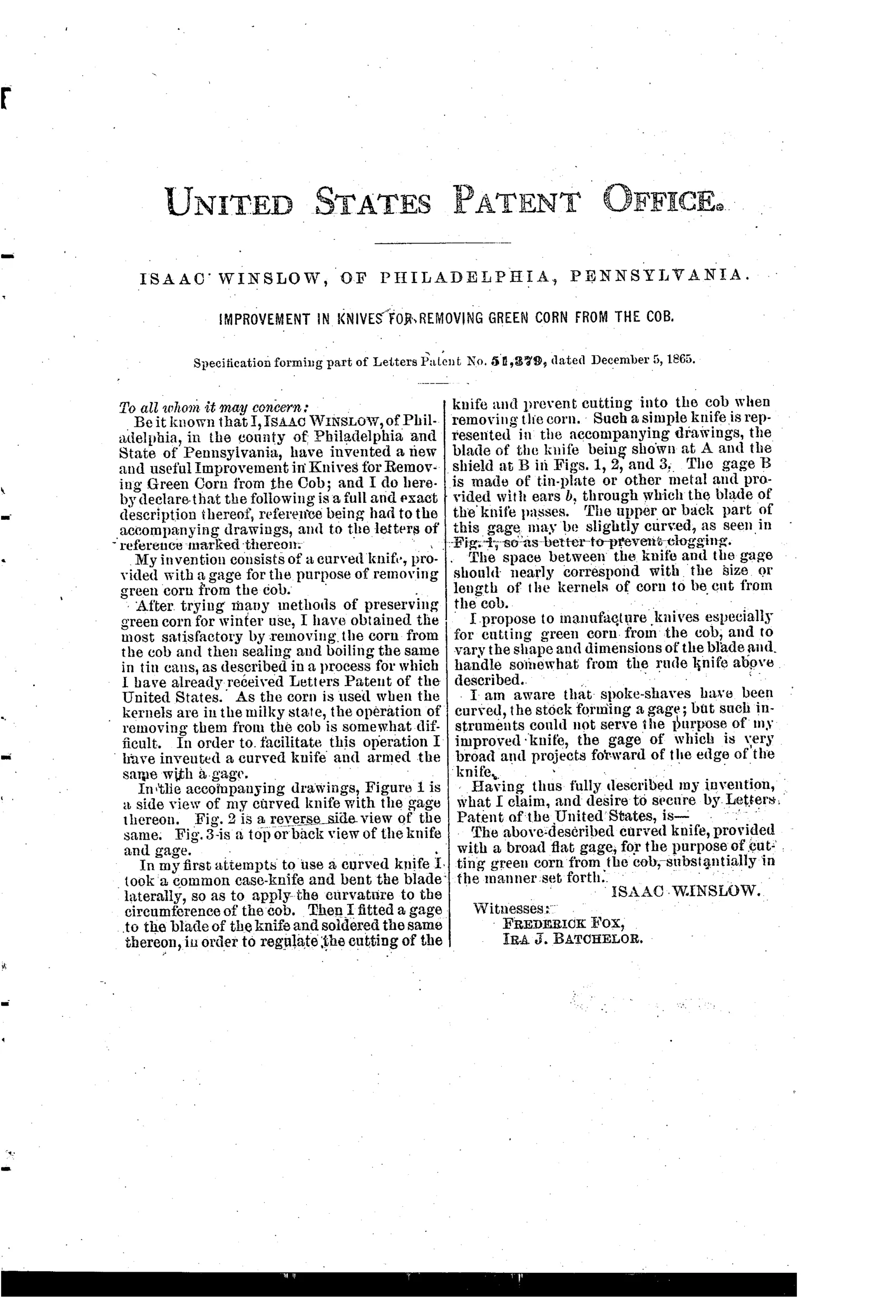
The knife blade is curved to match the circumference of a corn cob so it can shear kernels evenly. A broad flat gage of tin-plate, held by ears through which the blade passes, is set parallel to the blade to regulate cutting depth and prevent cutting into the cob. The back of the gage may be slightly curved to help prevent clogging as kernels are removed. The gap between the knife edge and the gage is sized to roughly match the length of the corn kernels being cut.
❧ What was claimed
“The above-described curved knife, provided with a broad flat gage, for the purpose of cutting green corn from the cob, substantially in the manner set forth.”
In plain English: A curved knife fitted with a wide flat guard plate for slicing kernels off a corn cob.
❧ In the inventor’s words
“In my first attempts to use a curved knife I took a common case-knife and bent the blade laterally, so as to apply the curvature to the circumference of the cob.”— Isaac Winslow, from the specification
Fate unknown
Winslow's cannery plausibly used such knives in-house, but no marked commercial example of this specific gaged design is documented; a surviving specimen would settle it.
❧ Commentary
This one sits just outside our usual apple-parer beat, but it earns its page. Isaac Winslow of Philadelphia is the man generally credited with putting canned sweet corn on the American map, and here in 1865 he patents the humble hand tool at the front of that process: a knife for shearing kernels off the cob fast and clean.
The mechanics are honest and simple. A straight blade skates over the crown of a round cob and gouges the middle rows; Winslow's blade is curved laterally to match the cob's circumference, so the whole edge bites at once. He admits in the specification that his first version was 'a common case-knife' bent sideways — a lovely glimpse of kitchen-table prototyping. The real refinement is the broad tin-plate gage riding parallel to the edge, spaced roughly one kernel-length away. It does two jobs: limits depth so you take kernels, not cob, and its slightly curved back sheds the cut corn instead of clogging. Fig. 3 shows how the gage's ears simply thread onto the blade — no screws, no adjustment fuss.
Where the apple-parer crowd chased gear trains, corn cutting stayed a hand-tool problem for decades longer, and depth-gaged curved cutters like this are the direct ancestors of the clamp-on corn creamers that followed. A modest patent, but from a consequential inventor solving a real production bottleneck.
Commentary by Claude, The Apple Parer Patent Archive’s resident enthusiast