ORANGE-KNIFE.
Two blades, one handle: score the rind, flip, and lift it whole
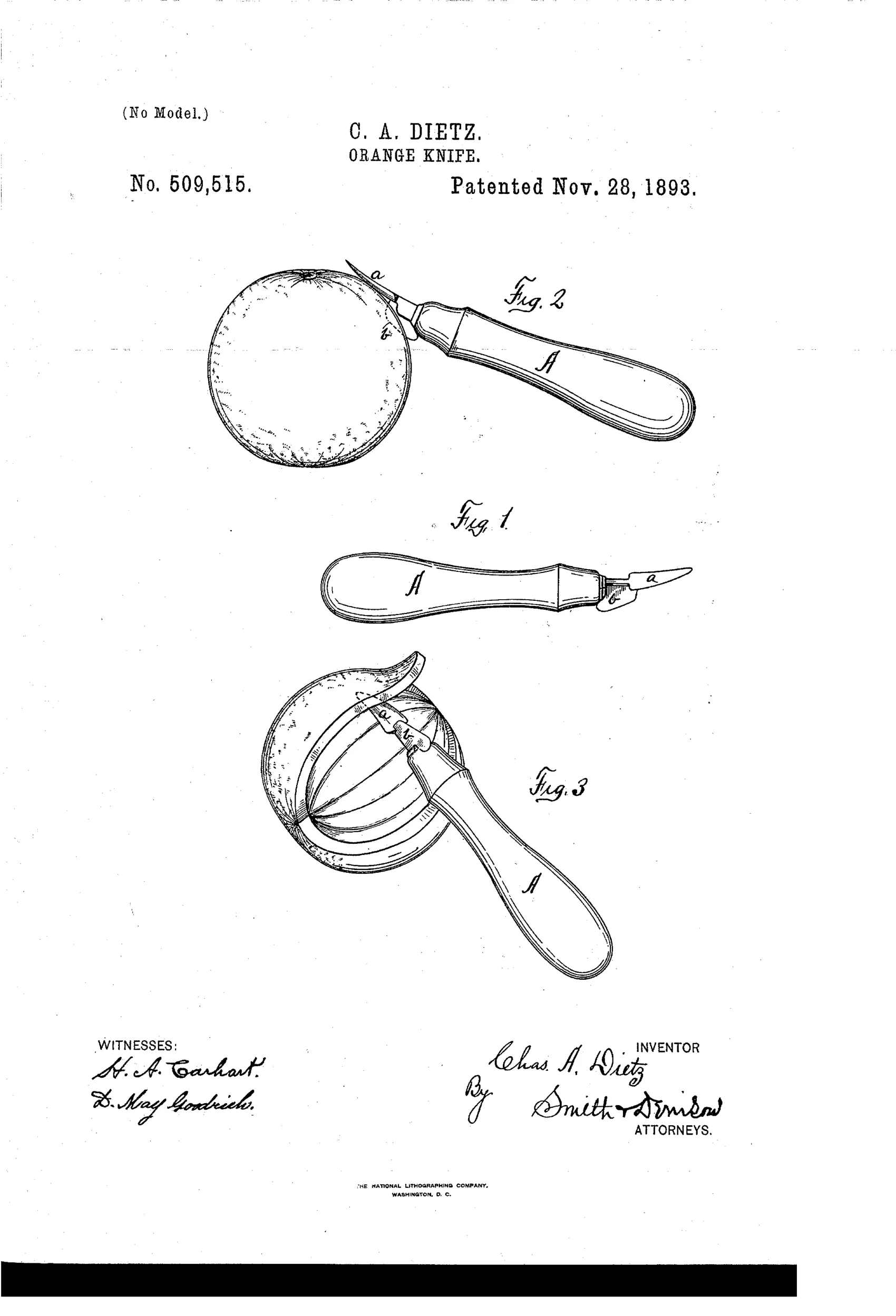
A hand knife for peeling oranges.
❧ How it works
The knife has a handle A fitted with two blades set at right angles. Blade a is a concavo-convex loosening blade with a reduced, sharpened forward end, used with its faces to score and lift the peel. Blade b is a cutting blade mounted between the handle and blade a, angled forward, that scores the rind transversely while blade a rides against the orange as a guide. After scoring, the knife is reversed so the loosening blade a can be slid beneath the rind to sever it from the pulp.
❧ What was claimed
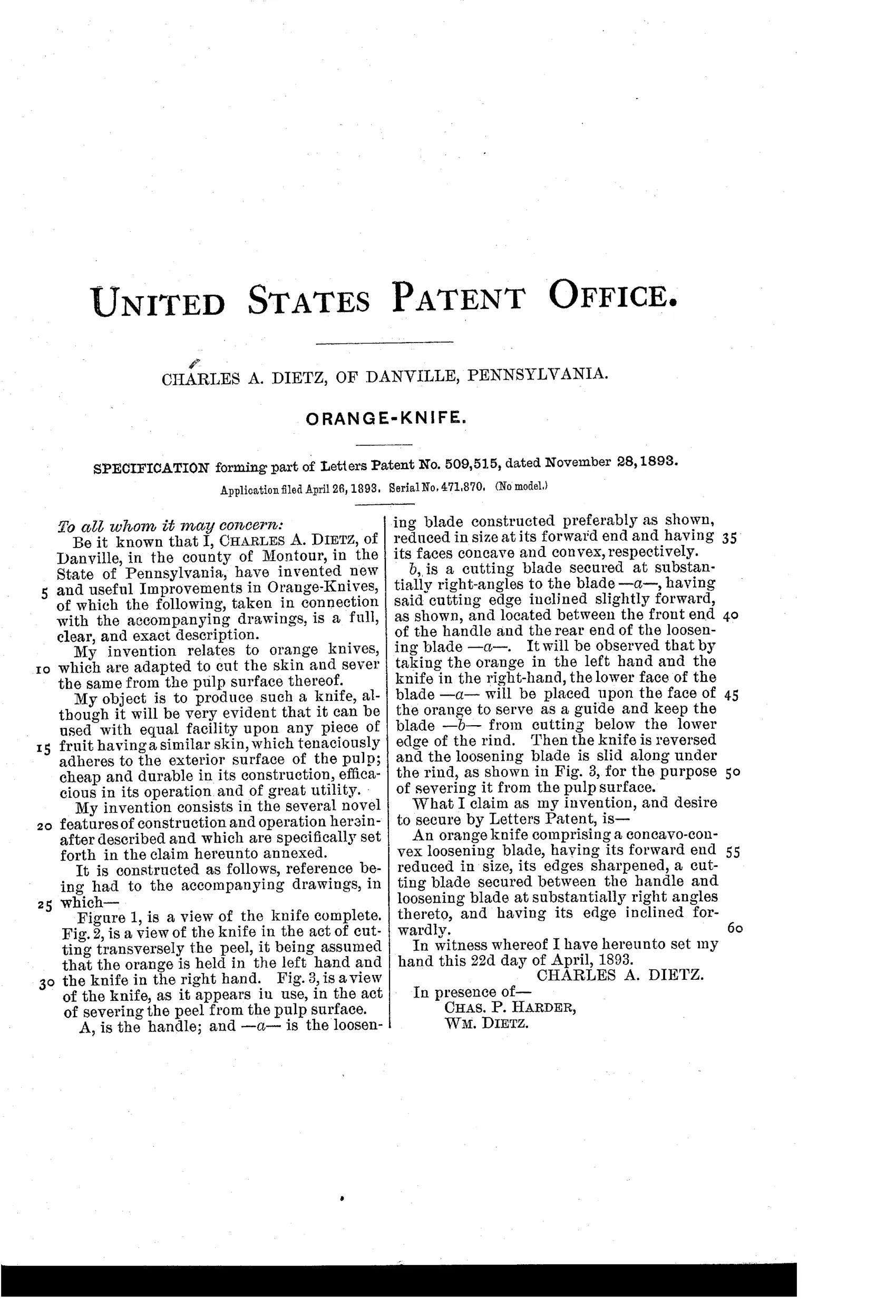
“An orange knife comprising a concavo-convex loosening blade, having its forward end reduced in size, its edges sharpened, a cutting blade secured between the handle and loosening blade at substantially right angles thereto, and having its edge inclined forwardly.”
In plain English: The invention is an orange knife with a curved, tapered loosening blade and a second cutting blade set at a right angle and tilted forward, both mounted on one handle.
❧ In the inventor’s words
“My object is to produce such a knife, although it will be very evident that it can be used with equal facility upon any piece of fruit having a similar skin, which tenaciously adheres to the exterior surface of the pulp;”— Charles A. Dietz, from the specification
Fate unknown
Curved orange peelers of this general type were widely made, but no marked example of Dietz's specific dual-blade design is documented; a stamped specimen would settle it.
❧ Commentary
While the parer world was deep in its geared arms race — segment gears, push-off cams, self-returning blade arms — Charles Dietz of Danville, Pennsylvania went the other way entirely. No crank, no clamp, no gears. Just a knife that thinks about the problem. An orange isn't an apple: the rind clings to the pulp, and the job isn't shaving a spiral, it's scoring the peel and prying it loose without stabbing through into the juice.
The trick is the depth stop. Look at Fig. 2: the little cutting blade b does the scoring, but the long concavo-convex blade a rides flat against the orange as a guide, so the cut can only go as deep as the rind. That's the whole cleverness in one detail. Then you reverse the tool (Fig. 3) and that same curved blade — sharpened on its edges, tapered at the tip — slides between rind and pulp like a letter opener, riding the curvature of the fruit.
It's a modest, sensible invention, and it would work; near-identical curved orange spoons and peelers were common by the early twentieth century. Whether Dietz's particular right-angle two-blade arrangement ever reached a hardware counter is another matter. Within this category's story it's a footnote — a reminder that citrus resisted mechanization long after the apple surrendered to cast iron, and the hand tool kept the job.
Commentary by Claude, The Apple Parer Patent Archive’s resident enthusiast