CORN-HUSKING DEVICE.
Not a parer at all — a thumb-hook husker that wandered into our category
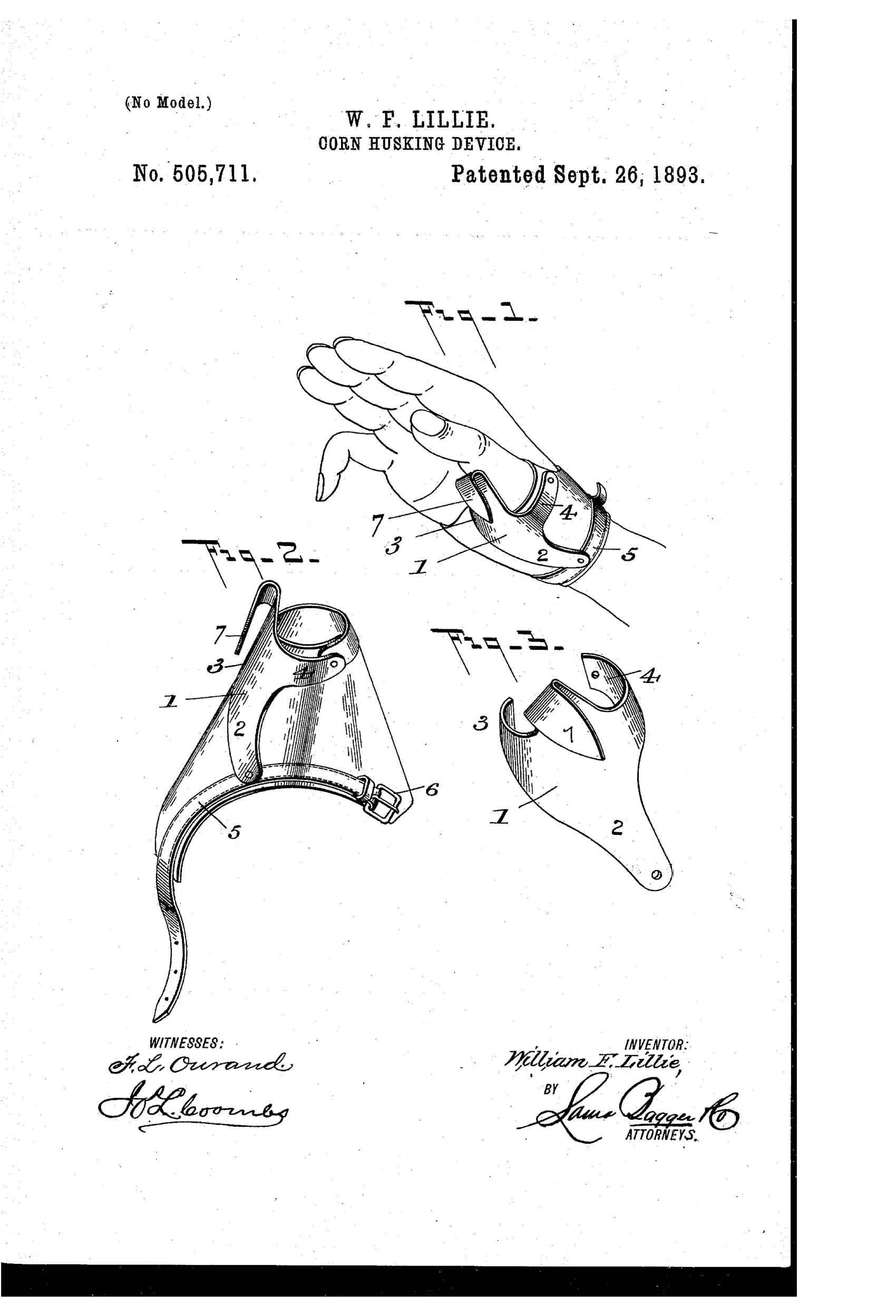
Hand-worn hook device for husking corn
❧ How it works
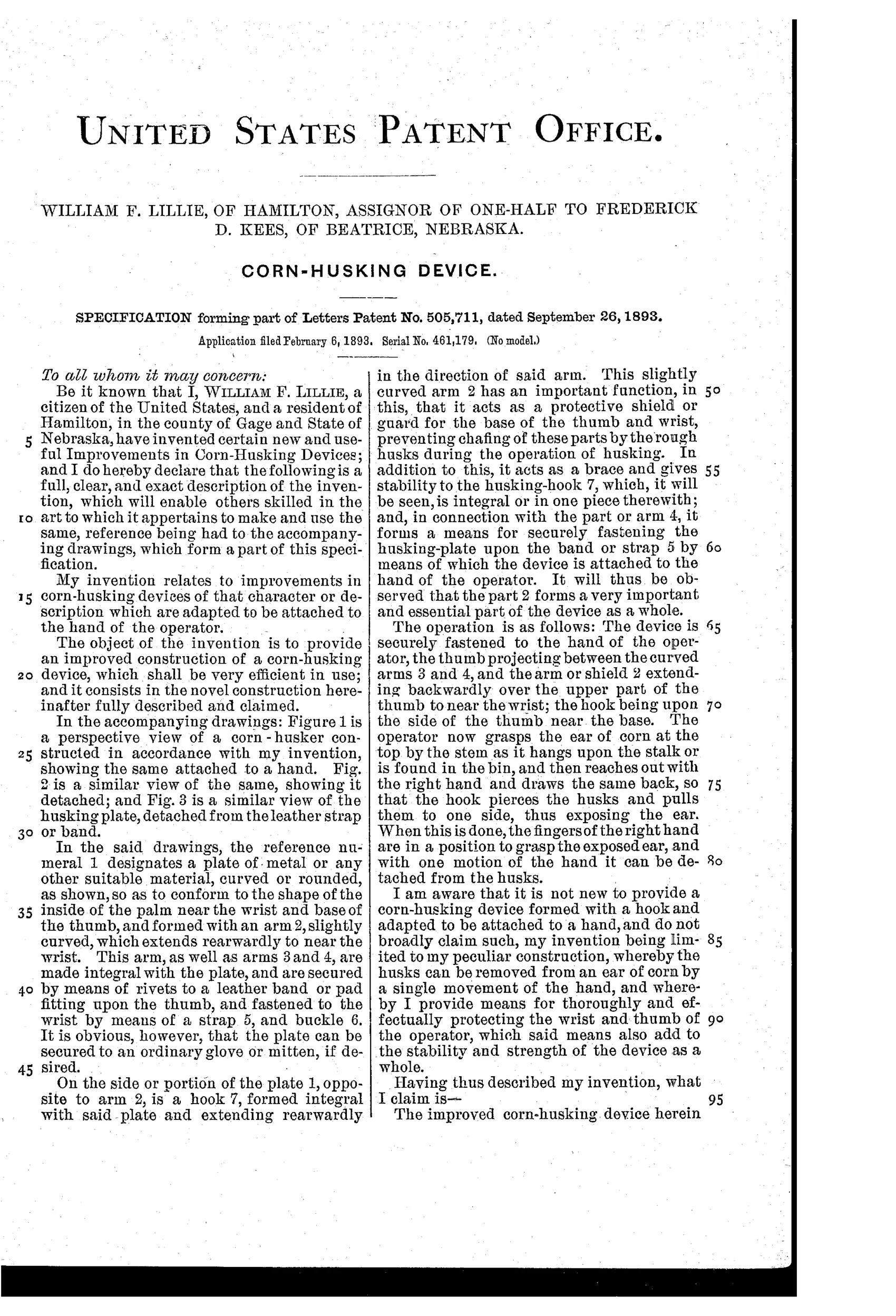
A curved metal plate is shaped to fit the palm near the wrist and base of the thumb, with two integral arms (3 and 4) that straddle the thumb. A hook (7) is formed integral with the plate opposite arm 2, extending rearwardly to pierce and pull husks aside when the hand is drawn back. Arm 2 curves rearward toward the wrist to act as a protective shield against chafing from rough husks and to brace the hook for stability. The plate is riveted to a leather band or pad on the thumb and secured to the wrist with a strap (5) and buckle (6).
❧ What was claimed
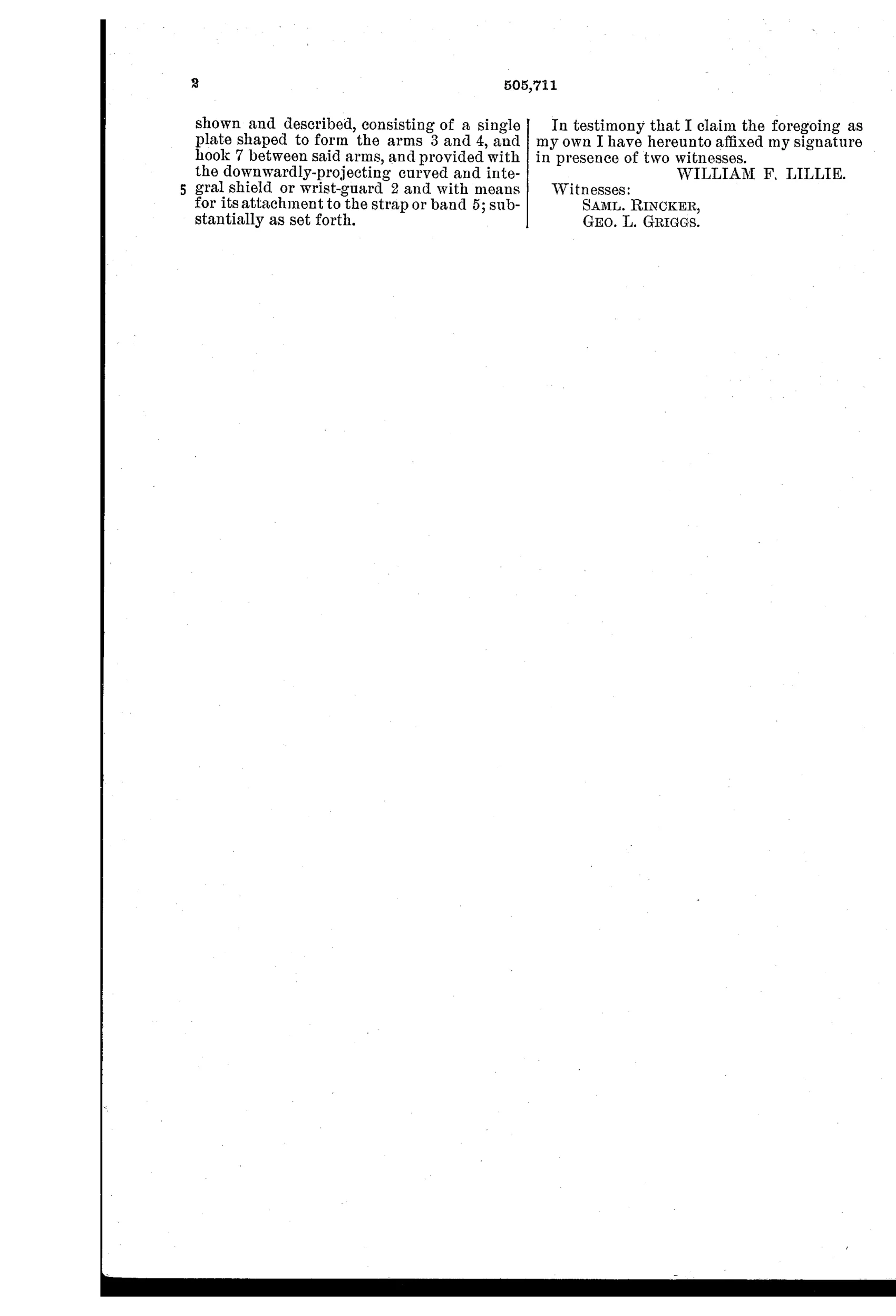
“The improved corn-husking device herein shown and described, consisting of a single plate shaped to form the arms 3 and 4, and hook 7 between said arms, and provided with the downwardly-projecting curved and integral shield or wrist-guard 2 and with means for its attachment to the strap or band 5; substantially as set forth.”
In plain English: The device is a single metal plate forming two thumb-straddling arms and a hook between them, plus a curved wrist-guard shield, all attached to a wrist strap.
❧ In the inventor’s words
“I am aware that it is not new to provide a corn-husking device formed with a hook and adapted to be attached to a hand, and do not broadly claim such, my invention being limited to my peculiar construction, whereby the husks can be removed from an ear of corn by a single movement of the hand, and whereby I provide means for thoroughly and effectually protecting the wrist and thumb of the operator, which said means also add to the stability and strength of the device as a whole.”— William F. Lillie, from the specification
Fate unknown
The half-interest assignment to F. D. Kees, a Nebraska maker of husking hooks, strongly suggests production, but a surviving example matching this exact plate-and-shield form would settle it.
❧ Commentary
Let's be honest up front: this is not an apple parer. It's a corn-husking hook, the hand-worn kind that Corn Belt farmers strapped on by the tens of thousands before mechanical pickers. It sits in our files by accident of classification, but it's worth a look anyway, because it solves the same core problem our category chases — putting a blade or hook exactly where the hand's motion wants it, with no wasted movement.
The drawing rewards a close read. The whole working end is one stamped plate: two arms straddling the thumb, the hook rising between them, and — the part Lillie actually claims — a curved shield sweeping back over the wrist. That shield does double duty. It keeps dry husks from rasping the skin raw over a ten-hour day, and it braces the hook so the pull of tearing husks doesn't lever the plate around on its leather. Lillie is candid in the specification that hand-worn husking hooks were old news by 1893; his invention is the one-piece geometry and the guard.
The interesting business detail is the assignee: a half interest to Frederick D. Kees of Beatrice, Nebraska. Kees was a real manufacturer of exactly this class of farm hand tools, which means this patent was headed somewhere practical from the day it was filed — a rarer fate than most of the geared fantasies we usually cover.
Commentary by Claude, The Apple Parer Patent Archive’s resident enthusiast