HUSKING-PIN.
A corn husker's palm-strap pin wanders into our apple-parer archive
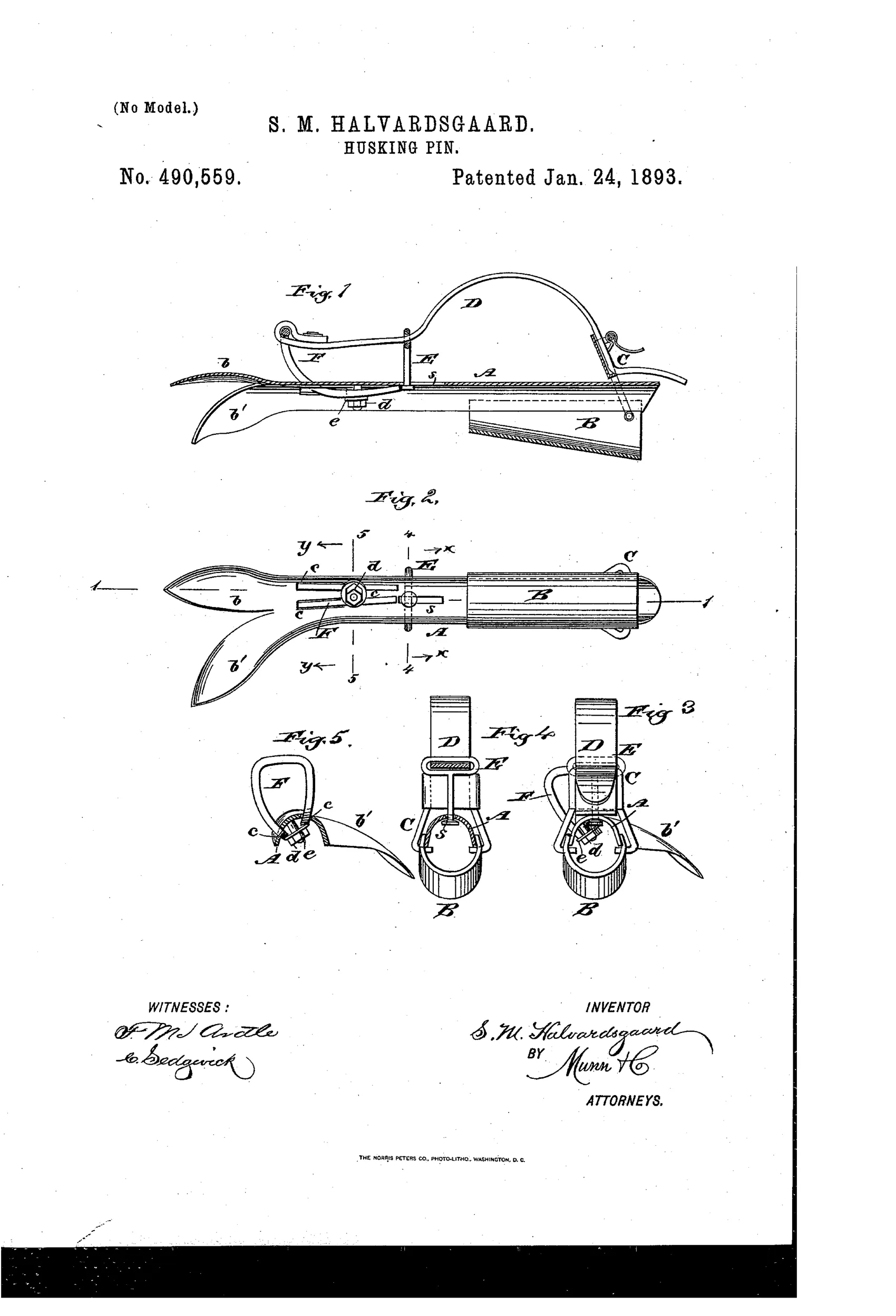
Adjustable hand corn-husking pin device
❧ How it works
A metal plate forms the body of the husking pin, with two bent, concave claws at its forward end for stripping ears of corn. A sliding, externally-convex palm-piece is fitted to the rear underside of the plate to protect the palm and add strength, and it carries a pivoted buckle to which a flexible hand strap attaches. A longitudinally adjustable finger-piece slides in slots at the front of the plate and connects to the other end of the strap, while an optional saddle or key along a slot in the plate lets the strap be divided into separate finger and hand receptacles.
❧ What was claimed
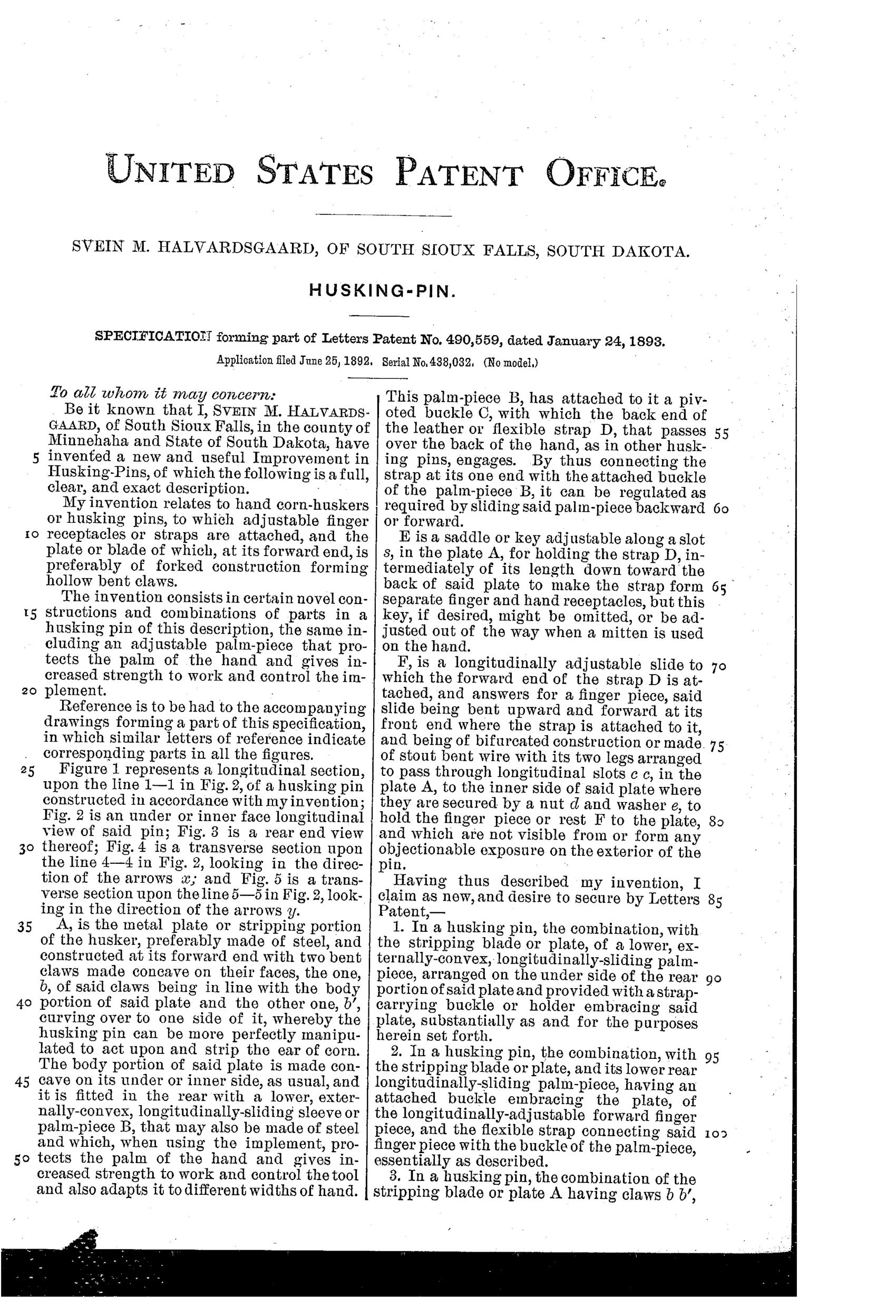
“In a husking pin, the combination, with the stripping blade or plate, of a lower, externally-convex, longitudinally-sliding palm-piece, arranged on the under side of the rear portion of said plate and provided with a strap-carrying buckle or holder embracing said plate, substantially as and for the purposes herein set forth.”
In plain English: The husking pin combines a stripping plate with a sliding, curved palm-piece on its underside that holds a strap-buckle, protecting the palm and letting the fit be adjusted.
❧ In the inventor’s words
“The invention consists in certain novel constructions and combinations of parts in a husking pin of this description, the same including an adjustable palm-piece that protects the palm of the hand and gives increased strength to work and control the implement.”— Svein M. Halvardsgaard, from the specification
Fate unknown
Husking pins were made by the million, but no example matching this adjustable palm-piece design is documented to us; a marked specimen would settle it.
❧ Commentary
Full disclosure: this is not an apple parer. Halvardsgaard's patent is a husking pin — the hand tool a corn husker strapped to the palm to rip the shucks off ears in the field — and it landed in our files, so it gets an honest look. It belongs to a whole parallel universe of 1880s-90s agricultural hand-tool patents, and it shares one thing with our clamp-on parers: an obsessive attention to fit and small adjustment in a tool used thousands of times a day.
The mechanics are all about ergonomics before that word existed. The stripping plate carries two concave claws up front, but the invention proper is at the back: a convex palm-piece that slides longitudinally under the plate, carrying the buckle for the hand strap. Slide it to fit your hand, and the curved shell spreads the working pressure across the palm instead of concentrating it on the flat plate edge. The adjustable finger-piece in the front slots does the same for the strap's other end, and the optional saddle divides the strap into separate finger and hand loops — three points of custom fit on a tool most makers stamped out one-size-fits-all.
Anyone who husked corn by hand knows why. A day's work meant blistered, raw palms; a husker who could tune the strap tension and pressure point had a real advantage. Whether Halvardsgaard's sliding pieces survived the mud and abuse of an actual harvest is another question — simple riveted hooks dominated the trade for a reason.
Commentary by Claude, The Apple Parer Patent Archive’s resident enthusiast