MACHINE FOR SKINNING VEGETABLES
An 1865 abrasion peeler — the restaurant potato rumbler, ninety years early
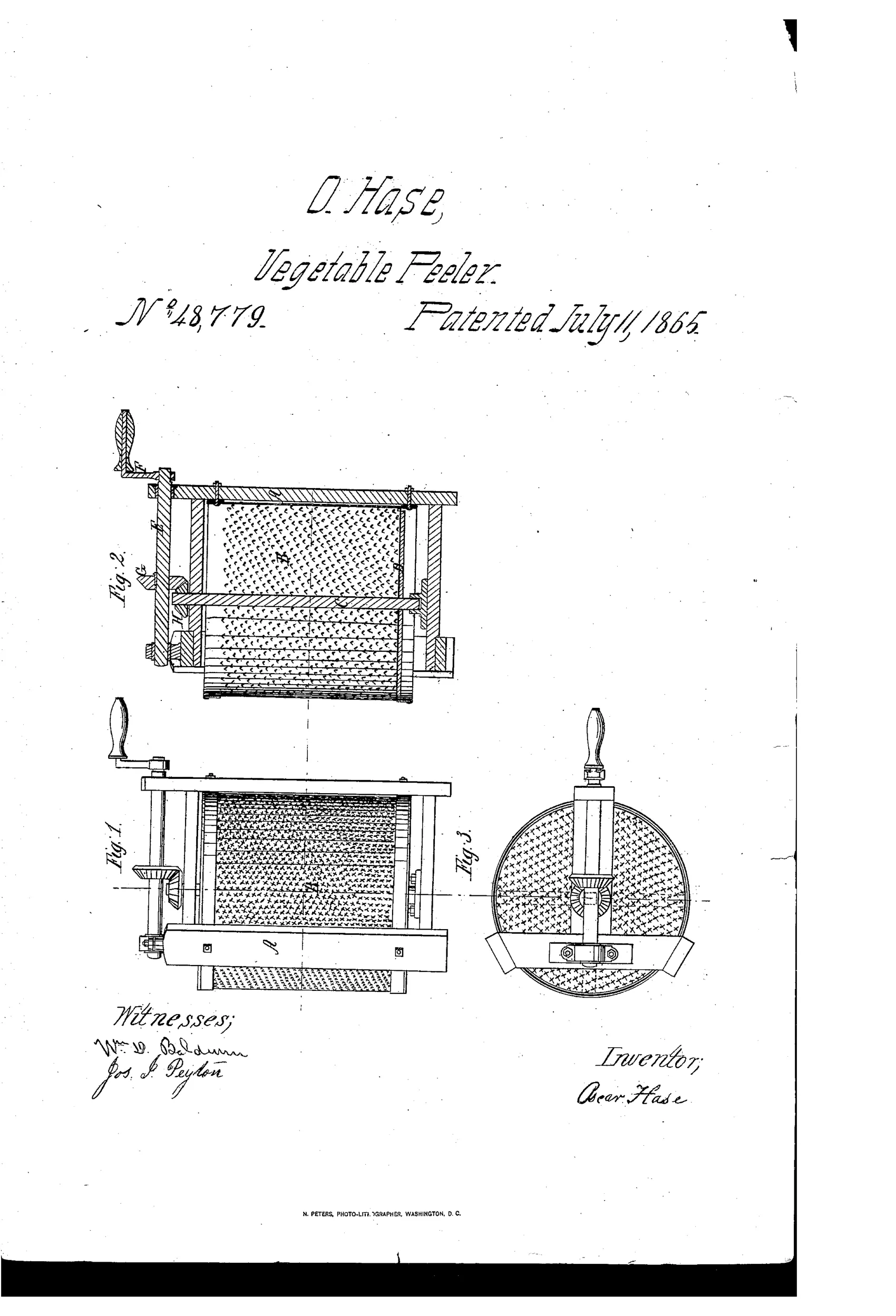
Rotary centrifugal machine for skinning vegetables and fruits
❧ How it works
A stationary vertical cylinder with numerous punched holes creates a roughened interior surface. A central rotating shaft carries a horizontal grated disk near its base that spins the vegetables via crank-handle and bevel gears. The centrifugal motion throws the vegetables repeatedly against the roughened cylinder walls, abrading off the skin while leaving the pulp intact. The shaft is turned through a horizontal crank shaft geared with bevel wheels to the vertical central shaft.
❧ What was claimed
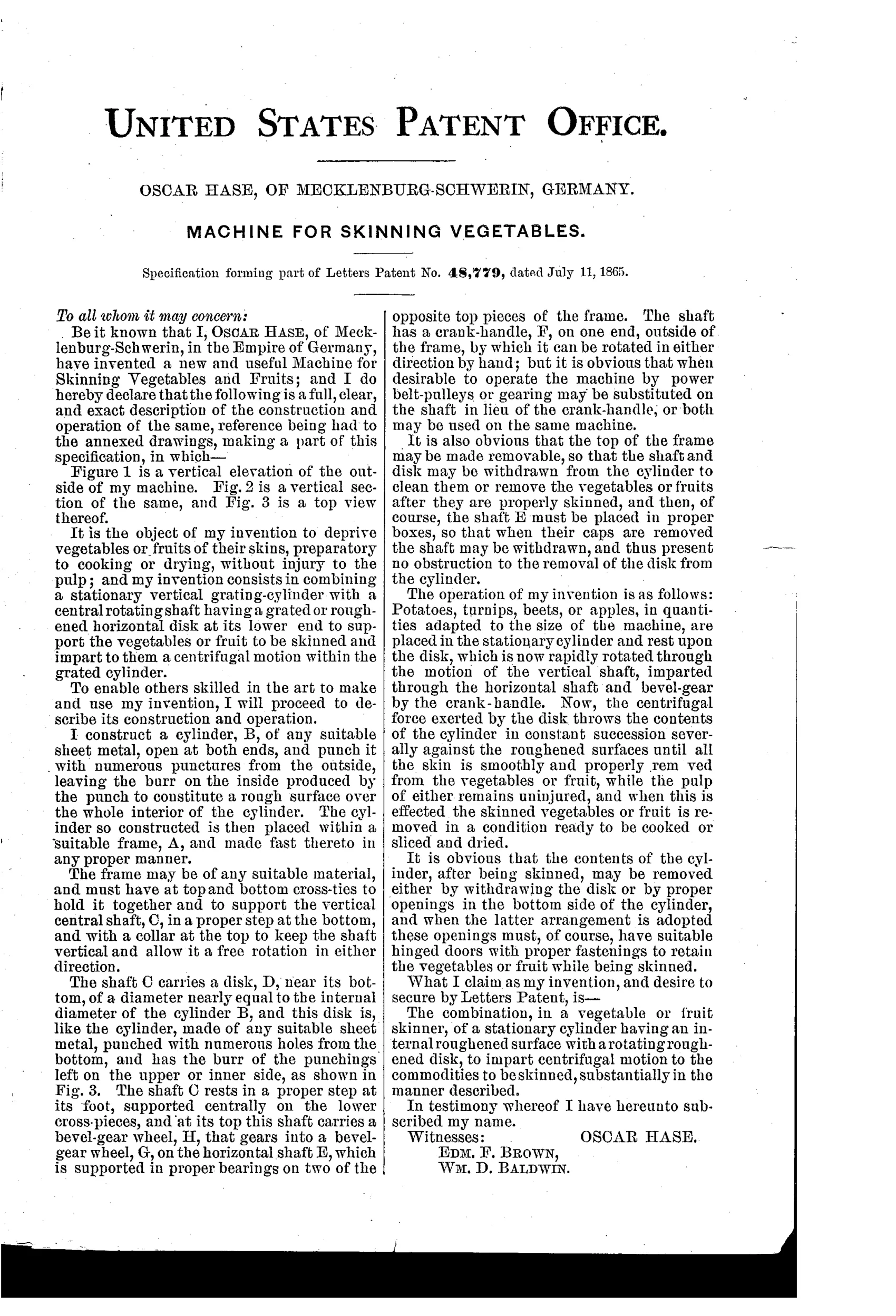
“The combination, in a vegetable or fruit skinner, of a stationary cylinder having an internal roughened surface with a rotating roughened disk, to impart centrifugal motion to the commodities to be skinned, substantially in the manner described.”
In plain English: The invention claims combining a stationary rough-surfaced cylinder with a rotating rough disk that spins vegetables against the cylinder walls to remove their skins by centrifugal force.
❧ In the inventor’s words
“Now, the centrifugal force exerted by the disk throws the contents of the cylinder in constant succession severally against the roughened surfaces until all the skin is smoothly and properly removed from the vegetables or fruit, while the pulp of either remains uninjured.”— Oscar Hase, from the specification
Fate unknown
The abrasion principle was later widely commercialized in potato peelers, but no surviving example of Hase's specific 1865 machine is documented; a marked specimen would settle it.
❧ Commentary
This one is a category outlier, and that's exactly why it earns a page. While American inventors of the 1860s were racing to perfect the geared crank-and-fork parer — a blade tracking a spinning apple — Oscar Hase of Mecklenburg-Schwerin threw the blade away entirely. His machine is an abrasion peeler: a stationary cylinder whose walls are punched into a rasp, and a rotating grated disk at the bottom that flings the vegetables against those walls until the skin scrubs off. If you've ever seen a commercial potato peeler in a restaurant kitchen — the rumbling drum with the carborundum lining — you're looking at this exact principle, patented in 1865.
The drawing rewards a close look. Fig. 2's section shows the punched cylinder walls rendered as a dense stipple — those are the burred holes, essentially a giant grater turned inside out. The bevel-gear drive at the top converts the horizontal crank to the vertical disk shaft, which means the operator cranks at a comfortable height while the tumbling happens below.
The honest mechanical critique: abrasion peeling wastes flesh on anything soft, and eats the eyes out of nothing. It suits potatoes far better than apples, which is presumably why the blade parers won the fruit trade and abrasion machines eventually won the potato trade. Hase's claim — rough stationary cylinder plus rough rotating disk — is the whole modern potato peeler in one sentence. A dead end for apples; a prophecy for spuds.
Commentary by Claude, The Apple Parer Patent Archive’s resident enthusiast