PARER AND CORER.
No gears at all: a push-through tube that pares as it cores
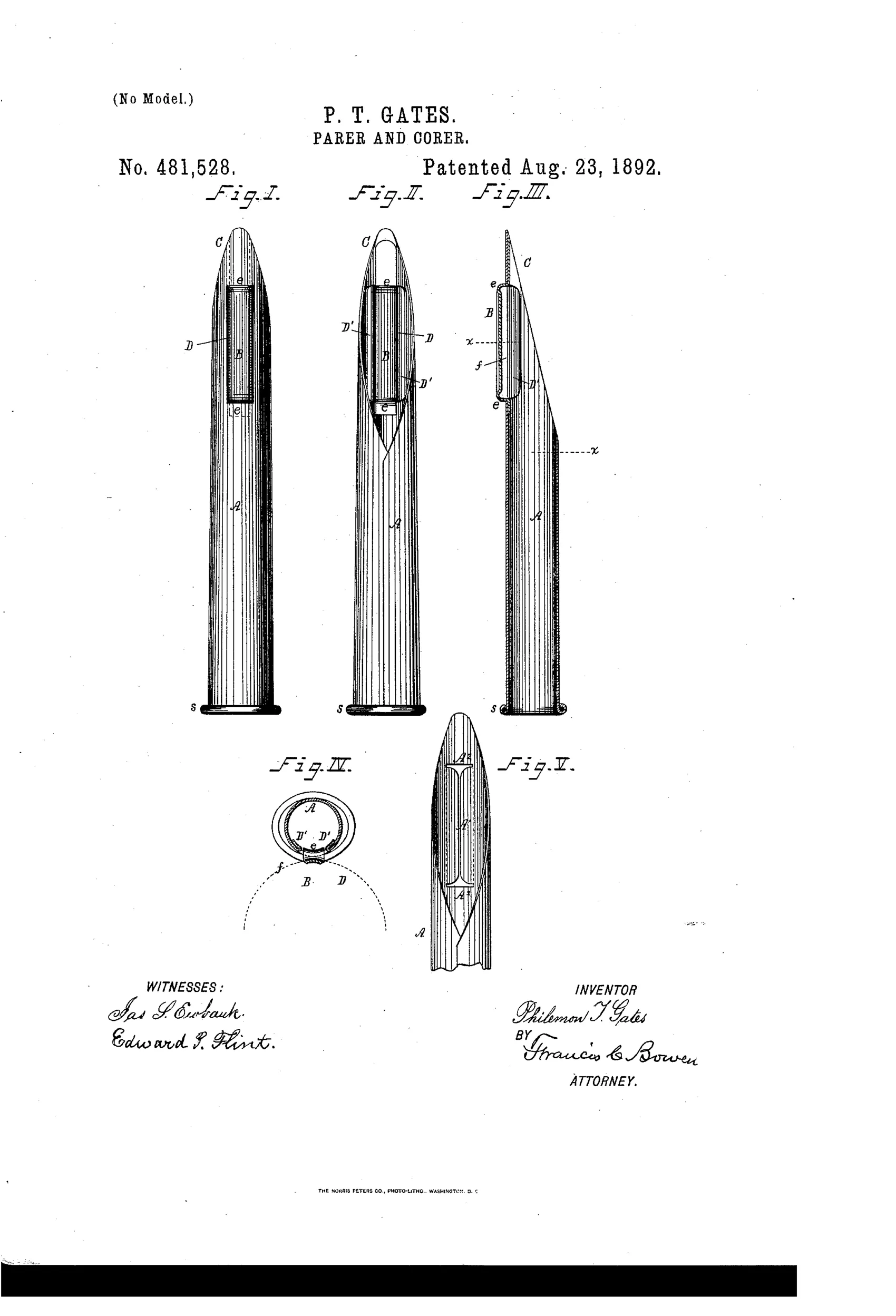
Tubular metal fruit/vegetable parer and corer
❧ How it works
The device consists of a tapered metal tube with an obliquely cut end that is pushed into a fruit to force the core through the tube while a knife-blade attached near the cut end pares the skin. The knife-blade is bent to a concavo-convex cross-section with its convexity reversed relative to the tube, stiffening the blade and letting it conform to the vegetable's outline. A longitudinal slot in the tube, formed by folding rather than cutting away metal, lets the paring escape without waste of material. The tube is cylindrical at its smaller end and elliptical at its larger end to create an oblong core-escape way, aided by a circumferential band that keeps the larger end rigid.
❧ What was claimed
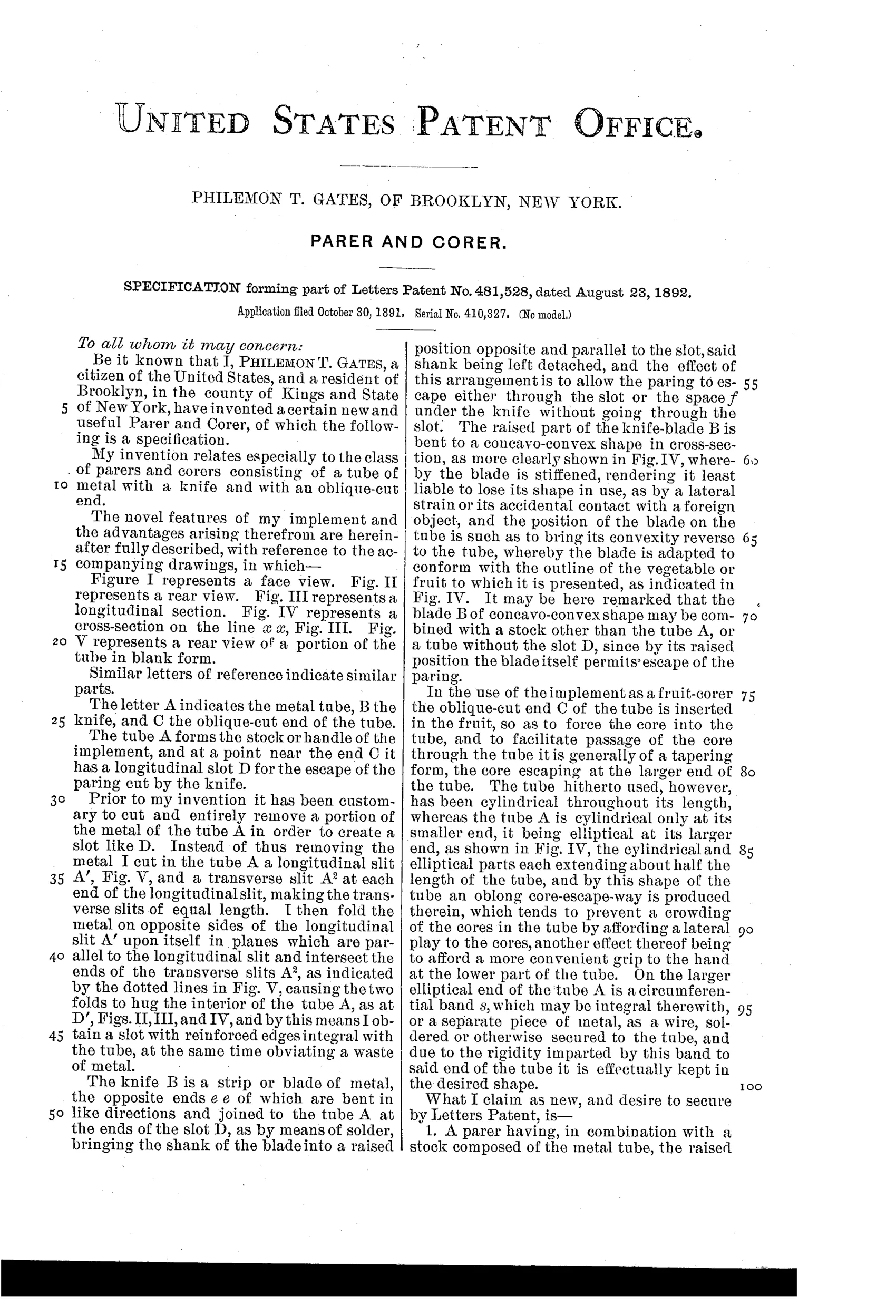
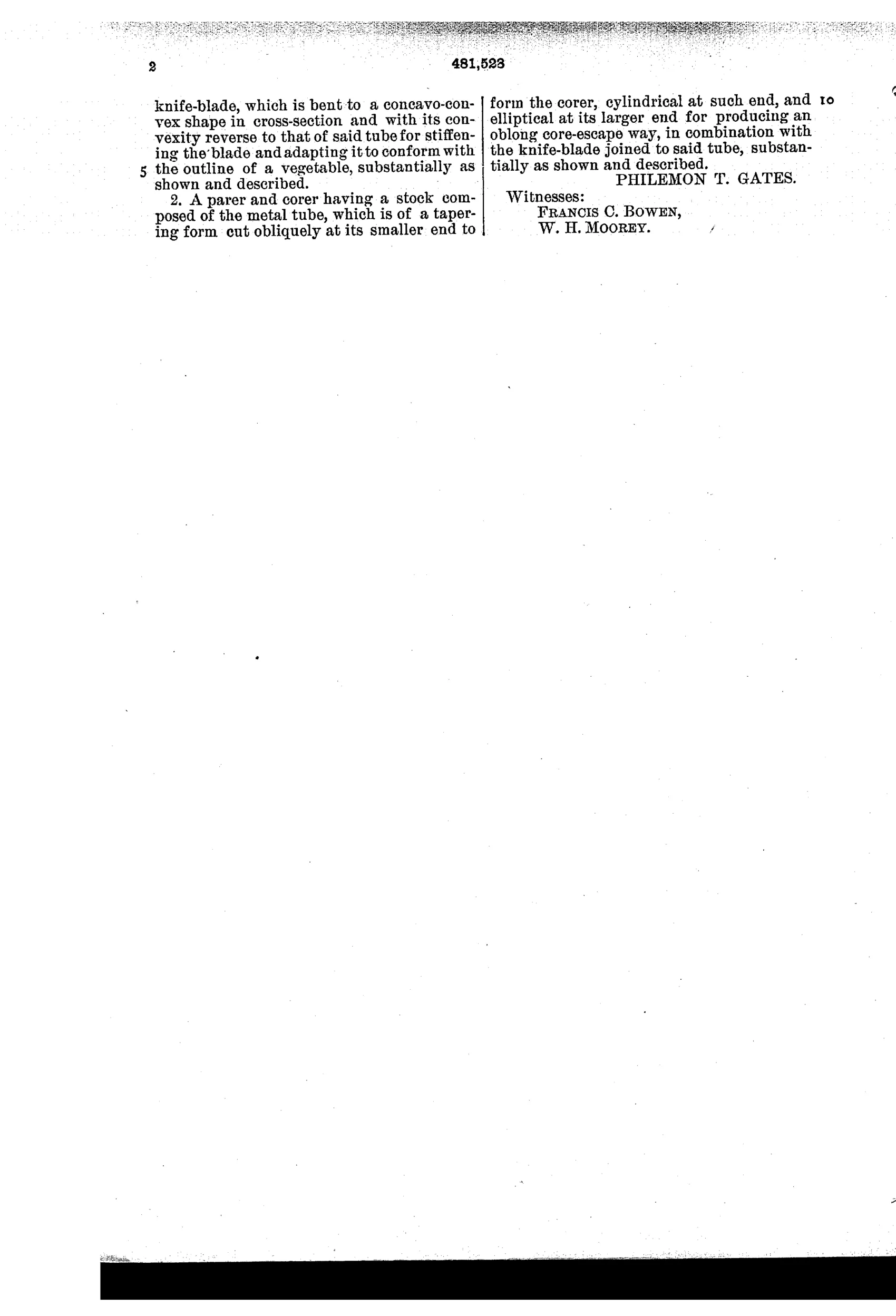
“1. A parer having, in combination with a stock composed of the metal tube, the raised knife-blade, which is bent to a concavo-convex shape in cross-section and with its convexity reverse to that of said tube for stiffening the blade and adapting it to conform with the outline of a vegetable, substantially as shown and described.”
In plain English: A parer made of a metal tube fitted with a curved (concavo-convex) knife-blade whose curve is reversed from the tube's curve, which stiffens the blade and lets it follow the shape of the vegetable being pared.
❧ In the inventor’s words
“Prior to my invention it has been customary to cut and entirely remove a portion of the metal of the tube A in order to create a slot like D. Instead of thus removing the metal I cut in the tube A a longitudinal slit A', Fig. V, and a transverse slit A2 at each end of the longitudinal slit, making the transverse slits of equal length.”— Philemon T. Gates, from the specification
Fate unknown
Simple stamped-tinware designs like this were cheap to produce, but no marked example or maker tie-in is documented; a surviving stamped specimen would settle it.
❧ Commentary
In 1892 the apple parer field was thick with cast iron — segment gears, return mechanisms, clamp screws. Gates went the other way entirely. His parer-corer is a single tapered tube with an obliquely cut tip. Push it through the fruit and the core rides out through the tube; a small knife-blade set into a slot along the barrel takes the skin off as it passes. No crank, no fork, no gear train. It's the corer-tube idea most kitchens still know, with a paring blade grafted on.
The two claims are quieter than the drawing suggests, and both are manufacturing claims as much as cutting claims. The blade is bent concavo-convex with its curve reversed against the tube's — that reversal stiffens a thin strip of sheet metal so it can hold an edge against a firm apple, and lets it ride the fruit's contour. And the slot the paring escapes through isn't cut out; look at Fig. V, the blank. Gates slits the metal and folds it, wasting nothing. That's a man thinking about sheet-metal cost per unit, not patent-office theater.
Whether it pares well is another question. A fixed blade on a straight tube can't follow an apple's shoulders the way a spring-loaded arm on a lathe parer does; you'd get a strip of peel along the push path and finish by hand. As a cheap tinware alternative to a five-dollar geared machine, though, the logic is sound. A dead end for parers, an ancestor of the modern corer drawer.
Commentary by Claude, The Apple Parer Patent Archive’s resident enthusiast