KITCHEN UTENSIL
Six tools stamped from one sheet of tin, sold at the price of one
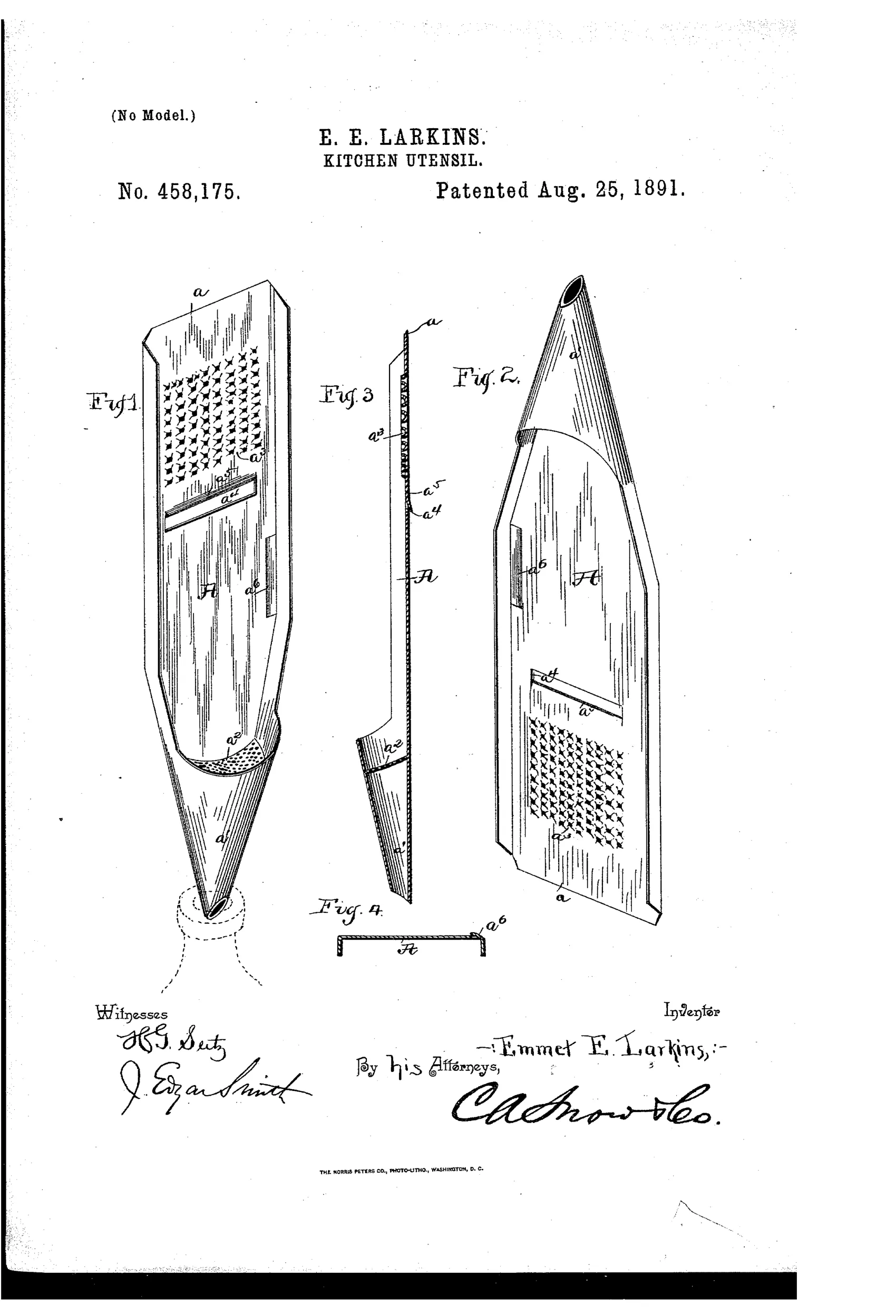
Multi-purpose stamped-metal kitchen utensil combining funnel, grater, slicer, peeler
❧ How it works
The device is a single straight stamped-metal body with flanged edges, formed at one end into a funnel with a perforated diaphragm strainer and an angled tip for coring potato eyes. Near the middle, the body is stamped into a nutmeg-grater surface, with an adjacent slot whose wall is bent outward to form a slicer blade. A vertical slit near one edge has the metal depressed to create a peeler, and the opposite end's flanges are removed and sharpened to serve as a chopping edge. The whole utensil is preferably stamped from a single piece of tinned steel, though it may be made in joined sections.
❧ What was claimed
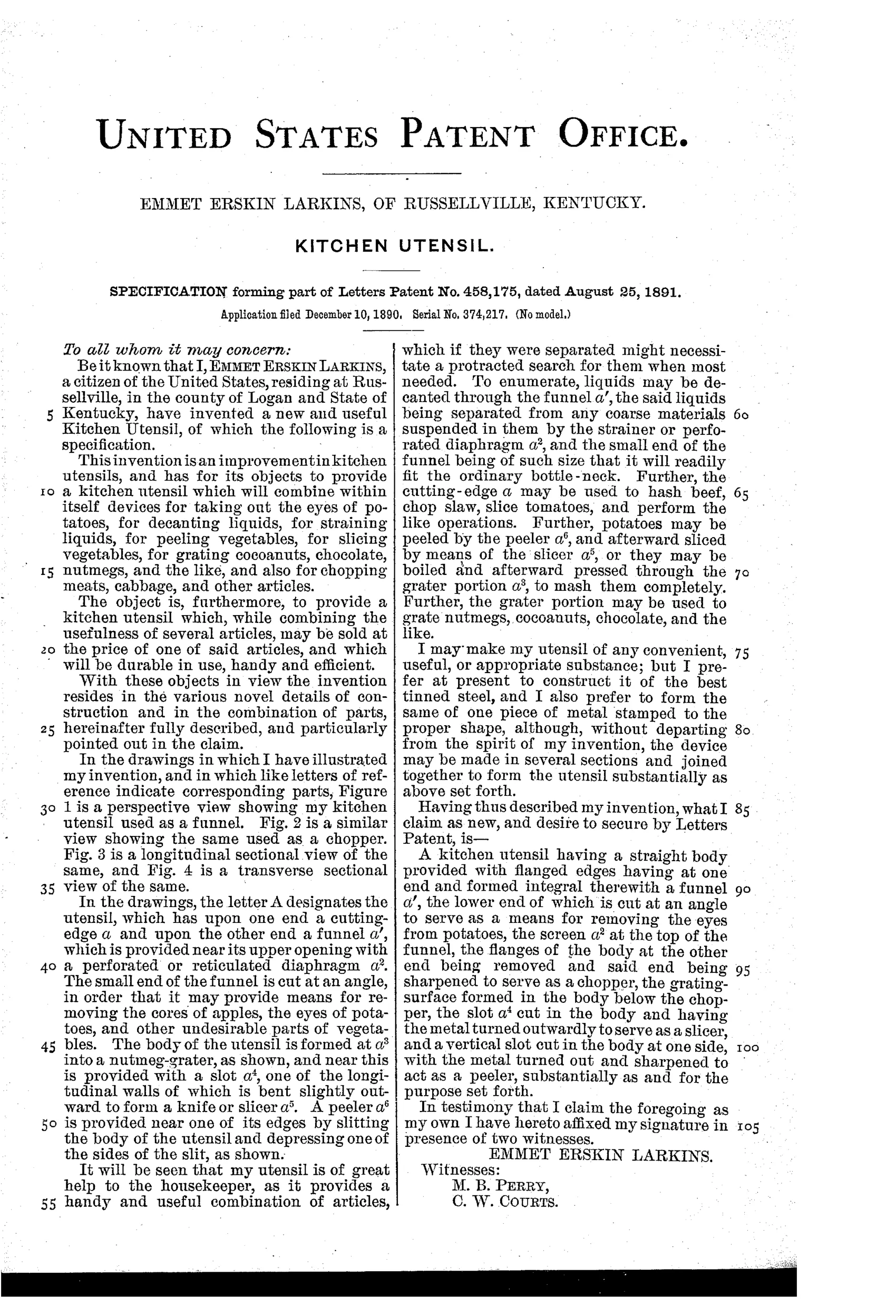
“A kitchen utensil having a straight body provided with flanged edges having at one end and formed integral therewith a funnel a', the lower end of which is cut at an angle to serve as a means for removing the eyes from potatoes, the screen a2 at the top of the funnel, the flanges of the body at the other end being removed and said end being sharpened to serve as a chopper, the grating-surface formed in the body below the chopper, the slot a4 cut in the body and having the metal turned outwardly to serve as a slicer, and a vertical slot cut in the body at one side, with the metal turned out and sharpened to act as a peeler, substantially as and for the purpose set forth.”
In plain English: A single flanged metal body that combines a funnel with a potato-eye remover and strainer screen, a sharpened chopping end, a grater surface, an outward-bent slot for slicing, and a slit-and-depressed section for peeling, all in one utensil.
❧ In the inventor’s words
“The object is, furthermore, to provide a kitchen utensil which, while combining the usefulness of several articles, may be sold at the price of one of said articles, and which will be durable in use, handy and efficient.”— Emmet Erskin Larkins, from the specification
Fate unknown
The design is cheap enough to have been made, but no marked example is documented; a surviving stamped specimen or trade-catalog listing would settle it.
❧ Commentary
This is not a geared parer at all — it comes from the opposite end of the kitchen-tool economy. While Goodell and Reading were casting iron and cutting gear segments, Emmet Larkins of Russellville, Kentucky was chasing the other prize of the era: how many functions can you get from a single die-stamping of tinned steel? His answer is six. A funnel with a strainer screen at one end (the funnel's tip cut on an angle so it doubles as a potato-eye gouge), a nutmeg grater in the body, a slot with its wall bent outward as a slicer, a slit with the metal depressed to make a peeler, and the far end sharpened into a chopper.
The drawing rewards a second look. Fig. 1 and Fig. 2 are the same object flipped end for end — funnel down, it strains and fills jars; funnel up, the funnel becomes the handle for chopping. That reversal is the whole trick, and it's genuinely tidy. The flanged edges (Fig. 4) stiffen what would otherwise be a floppy strip of tin, which shows Larkins thought about how the thing would actually feel in the hand.
The peeler here is the slit-and-burr sort — a scraping edge, not a guided blade — so it sits in the lineage of hand peelers rather than the crank machines this category celebrates. Cheap combination stampings like this flooded the 1890s trade, mostly anonymously. It's a workmanlike entry in that crowd, with one better-than-average idea in the reversible funnel-handle.
Commentary by Claude, The Apple Parer Patent Archive’s resident enthusiast