HUSKING-PIN.
A corn tool wanders in: two finger loops adjusted by one sliding strap
Adjustable strap-and-buckle husking pin for hand
❧ How it works
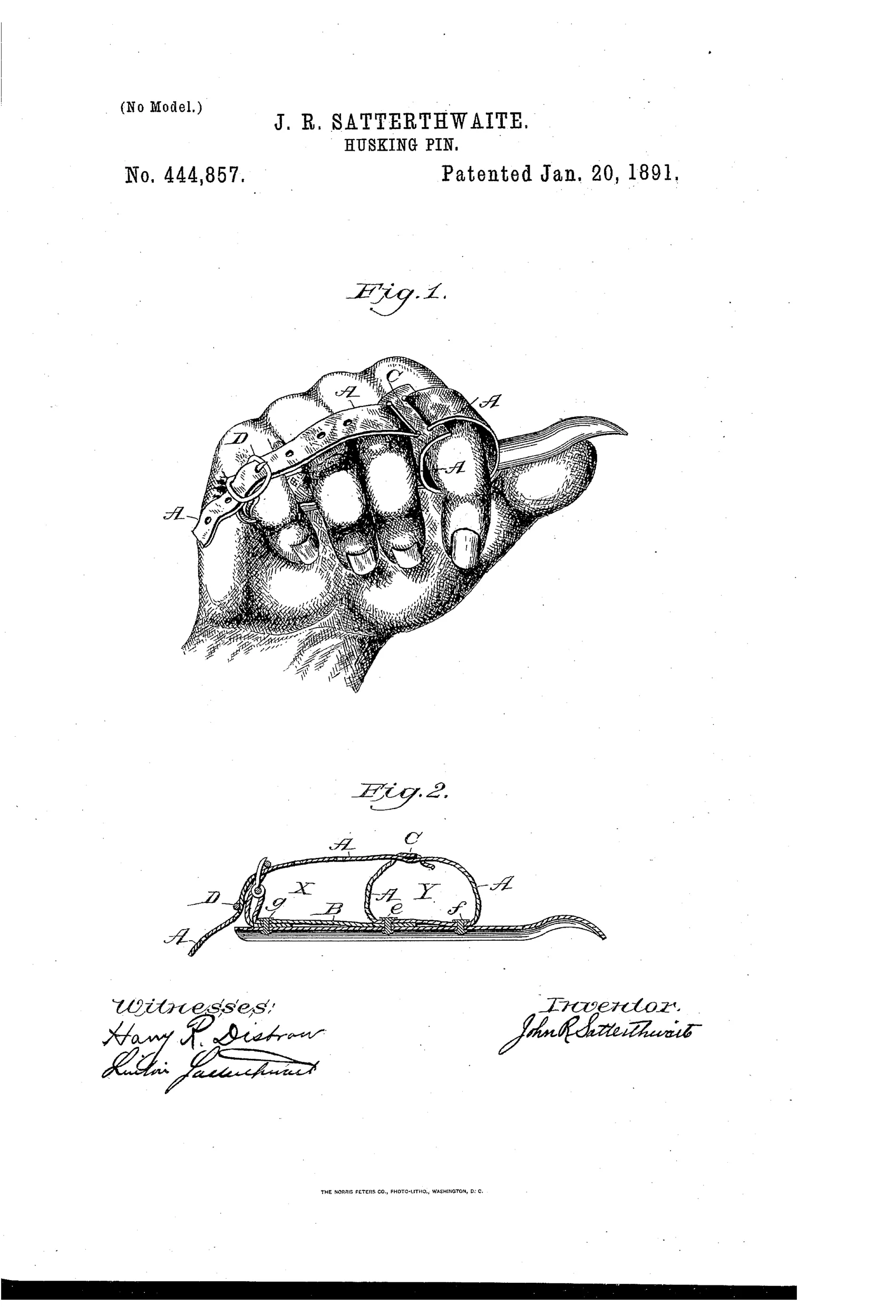
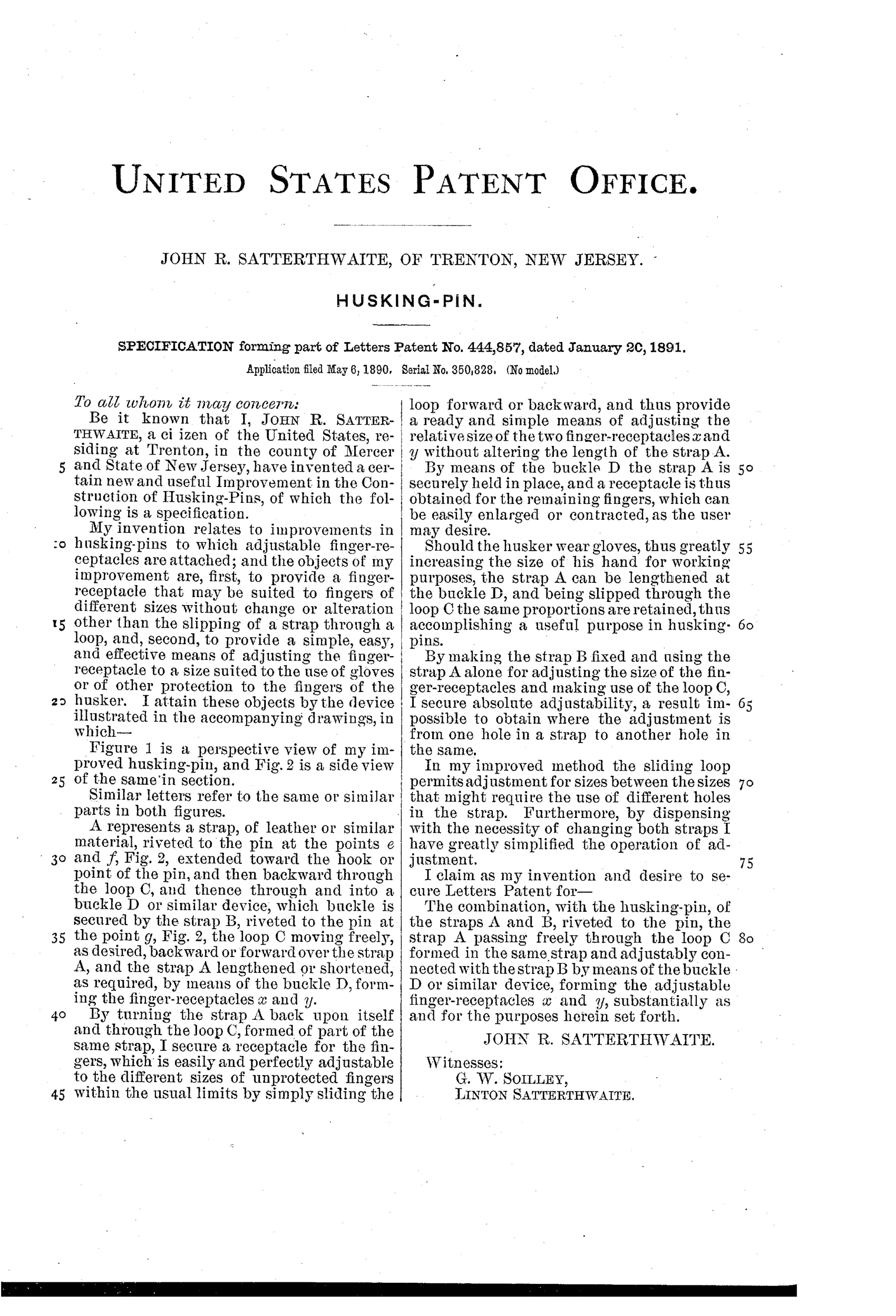
A pin worn on the hand has two leather straps, A and B, riveted to it. Strap A doubles back through a loop C formed in itself, creating an adjustable finger receptacle that slides to fit different finger sizes. Strap B is fixed and connects to a buckle D, which lets strap A be lengthened or shortened for a second, separately adjustable finger receptacle for gloved or bare hands. This dual adjustment via sliding loop and buckle allows both receptacles to be resized without moving to different holes in the strap.
❧ What was claimed
“The combination, with the husking-pin, of the straps A and B, riveted to the pin, the strap A passing freely through the loop C formed in the same strap and adjustably connected with the strap B by means of the buckle D or similar device, forming the adjustable finger-receptacles x and y, substantially as and for the purposes herein set forth.”
In plain English: The invention combines two straps riveted to a husking pin, where one strap slides through a loop in itself and is adjustably buckled to the other strap, creating two adjustable finger loops.
❧ In the inventor’s words
“In my improved method the sliding loop permits adjustment for sizes between the sizes that might require the use of different holes in the strap.”— John R. Satterthwaite, from the specification
Fate unknown
Husking pins were mass-produced, but no example matching this specific dual-adjustable strap arrangement is documented; a marked or clearly matching specimen would settle it.
❧ Commentary
Full disclosure: this is not an apple parer. It's a husking pin — the little hand-worn spike a corn husker used to rip open the shuck — and it's here as a cousin from the same world of cast-iron-and-leather farm kitchens and cribs. But it earns a look, because Satterthwaite's problem is one every strap-fitted tool of the era faced: buckle holes come in fixed increments, and hands don't.
His answer is quietly neat. Strap A is riveted to the pin, then doubles back through a loop formed in its own length, so the first finger receptacle is a running noose that slides continuously to size. The tail of that same strap then buckles to strap B, giving a second, separately sized loop. One buckle, two adjustments, and — the key claim — the sliding loop covers all the sizes between the holes. Fig. 2 is the drawing to study: what looks like a tangle of rope on the hand in Fig. 1 resolves into a clean self-threading path.
Husking pins as a class were made by the tens of thousands, most of them dirt-simple pegs with a single fixed strap. Whether anyone tooled up for this particular dual-loop refinement is another question. It's the classic 1890s move: take a commodity tool and patent the fit, not the function.
Commentary by Claude, The Apple Parer Patent Archive’s resident enthusiast