IMPROVED FRUIT-PARING MACHINE.
The Lockey & Howland double-rocking knife — a blade that gimbals in two planes
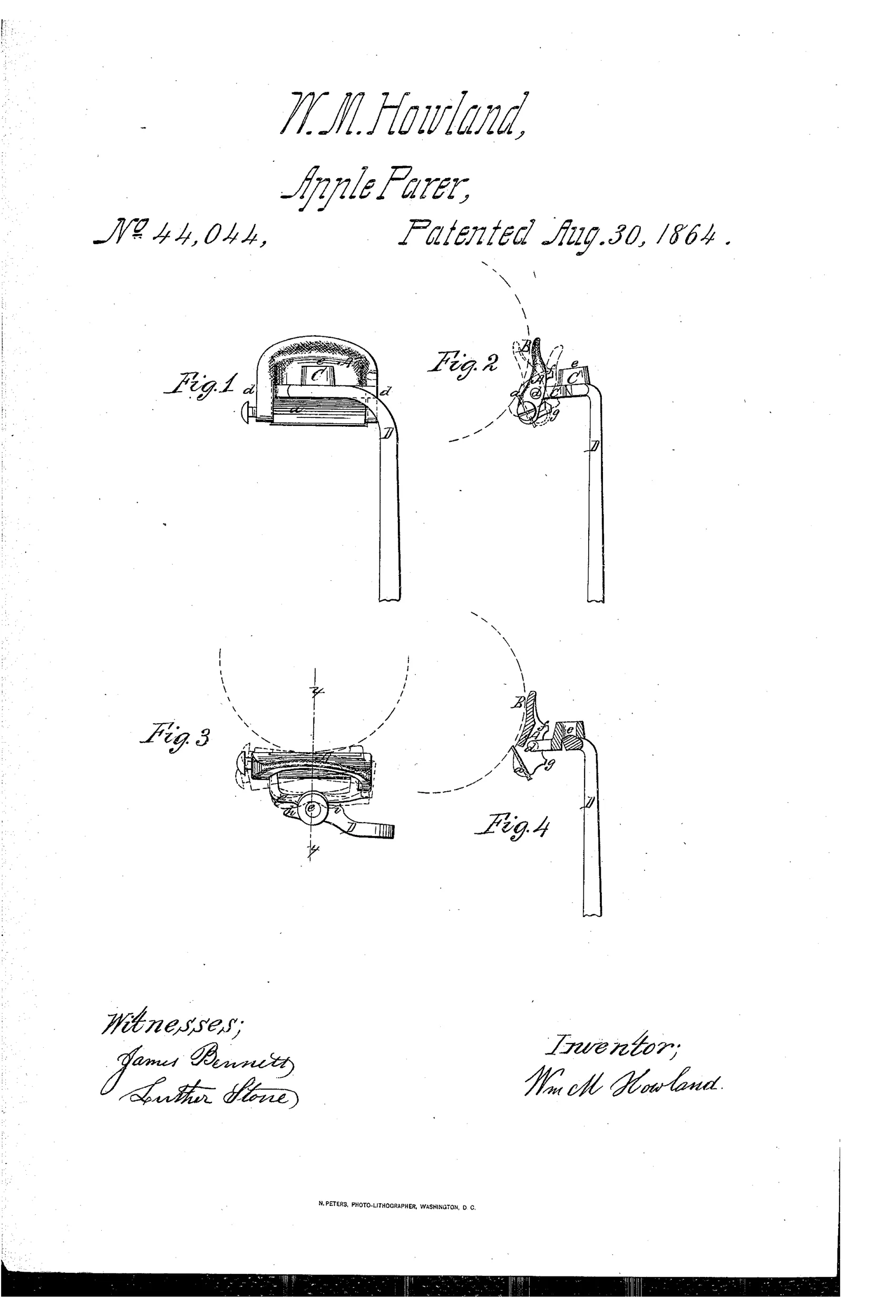
Vibrating knife-stock for a fruit-paring machine
❧ How it works
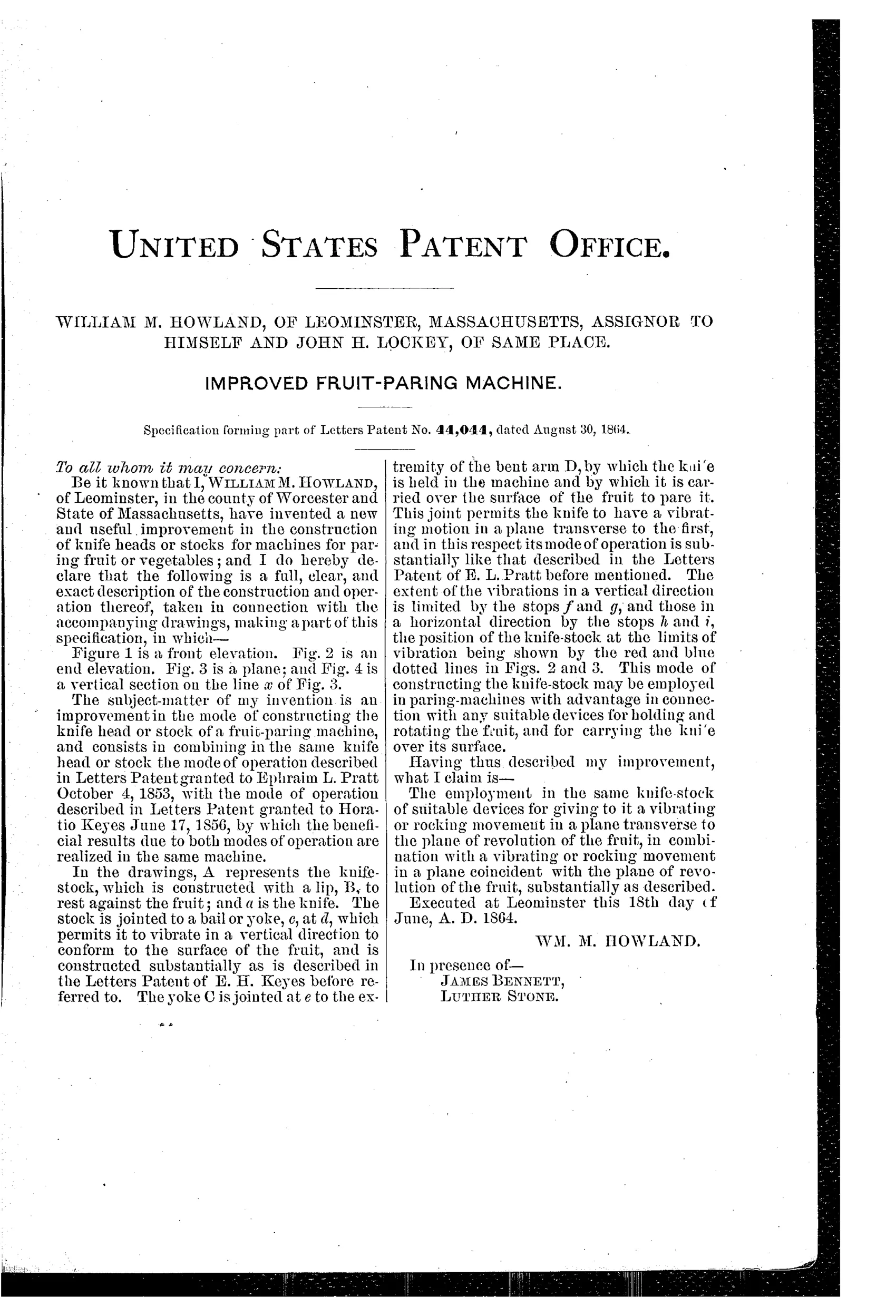
The knife-stock A carries a lipped knife a and is jointed to a bail or yoke C at d, allowing the stock to rock vertically to conform to the fruit's surface. The yoke C is itself jointed at e to the end of a bent arm D that holds and carries the knife across the fruit, allowing a second vibrating motion transverse to the first. Vertical vibration is limited by stops f and g, while horizontal vibration is limited by stops h and i. This combination of two independent rocking joints lets the knife follow irregular fruit surfaces in two planes at once.
❧ What was claimed
“The employment in the same knife-stock of suitable devices for giving to it a vibrating or rocking movement in a plane transverse to the plane of revolution of the fruit, in combination with a vibrating or rocking movement in a plane coincident with the plane of revolution of the fruit, substantially as described.”
In plain English: The invention claims a knife holder that can rock both across and along the direction the fruit turns, so the blade follows its curved surface in two directions at once.
❧ In the inventor’s words
“This mode of constructing the knife-stock may be employed in paring-machines with advantage in connection with any suitable devices for holding and rotating the fruit, and for carrying the knife over its surface.”— William M. Howland, from the specification
Manufactured and sold
Lockey & Howland of Leominster manufactured parers incorporating their patents, and surviving machines are documented by collectors on DATAMP.
❧ Commentary
Most parer knives of the 1860s rocked in one plane: a spring-loaded blade arm that rose and fell as the apple's profile passed under it. Howland's insight here is that an apple is irregular in two directions, and a knife that can only nod will dig in or skip where the surface curves sideways. His answer is essentially a gimbal — the knife-stock A pivots vertically inside the yoke C at joint d, and the yoke itself pivots at e on the bent carrying arm D, transverse to the first motion. Two independent rocking axes, each fenced in by stops (f and g vertically, h and i horizontally) so the blade can't flop out of engagement.
Notice what he doesn't claim: any gearing, fork, or frame. The patent covers only the knife-stock, and Howland says outright it can be attached to "any suitable devices" for spinning the fruit. That's a component patent, and a shrewd one — the blade head is where paring machines actually succeed or fail against a lumpy Baldwin.
The assignment tells the rest of the story. Half-assigned to John H. Lockey of the same town, this is a building block of the Lockey & Howland line of Leominster parers, one of the named production houses of the era. The self-conforming knife wasn't a fantasy on paper; it was product development.
Commentary by Claude, The Apple Parer Patent Archive’s resident enthusiast