IMPROVED APPLE-PARER
A segmental-rack parer assigned to D. H. Goodell, fourteen years before his empire
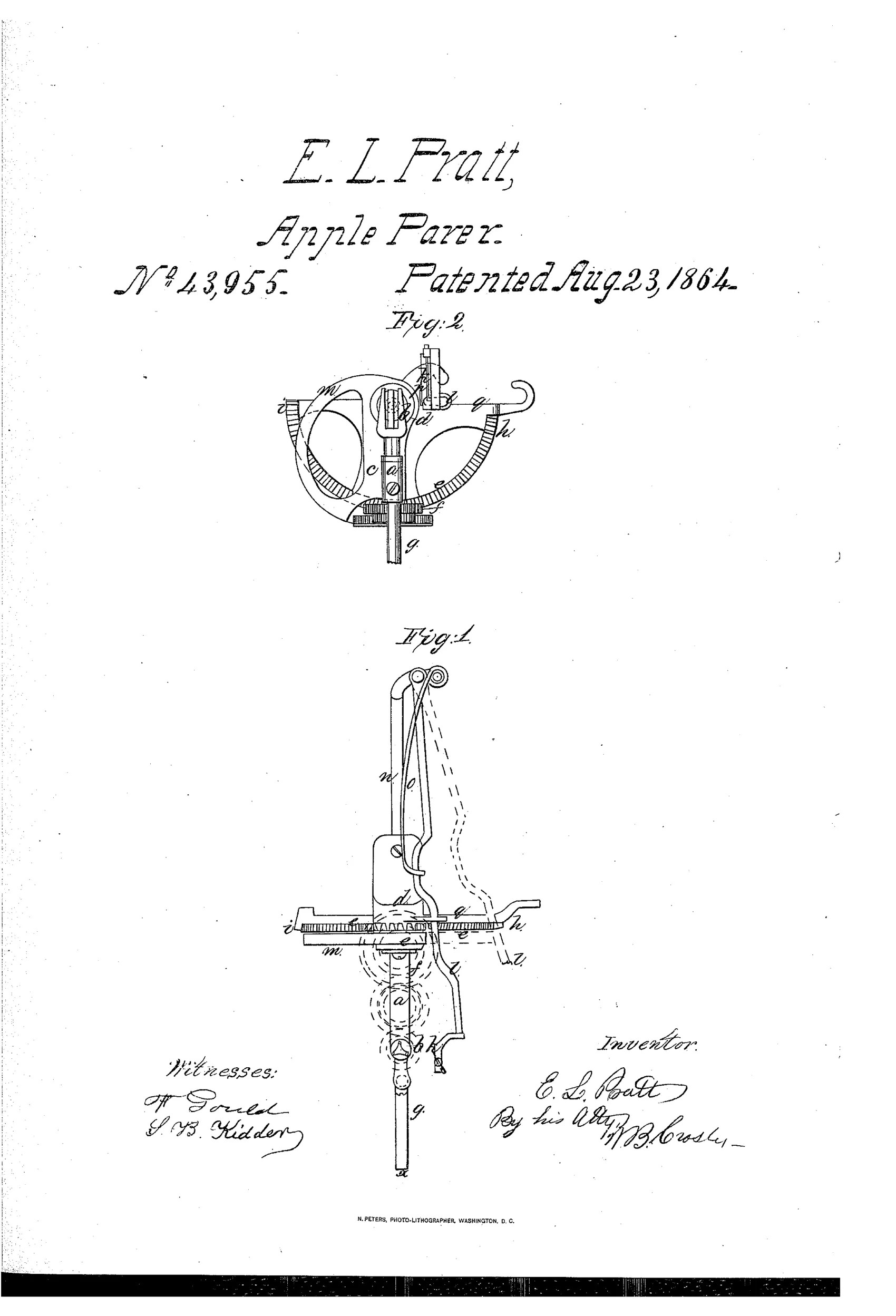
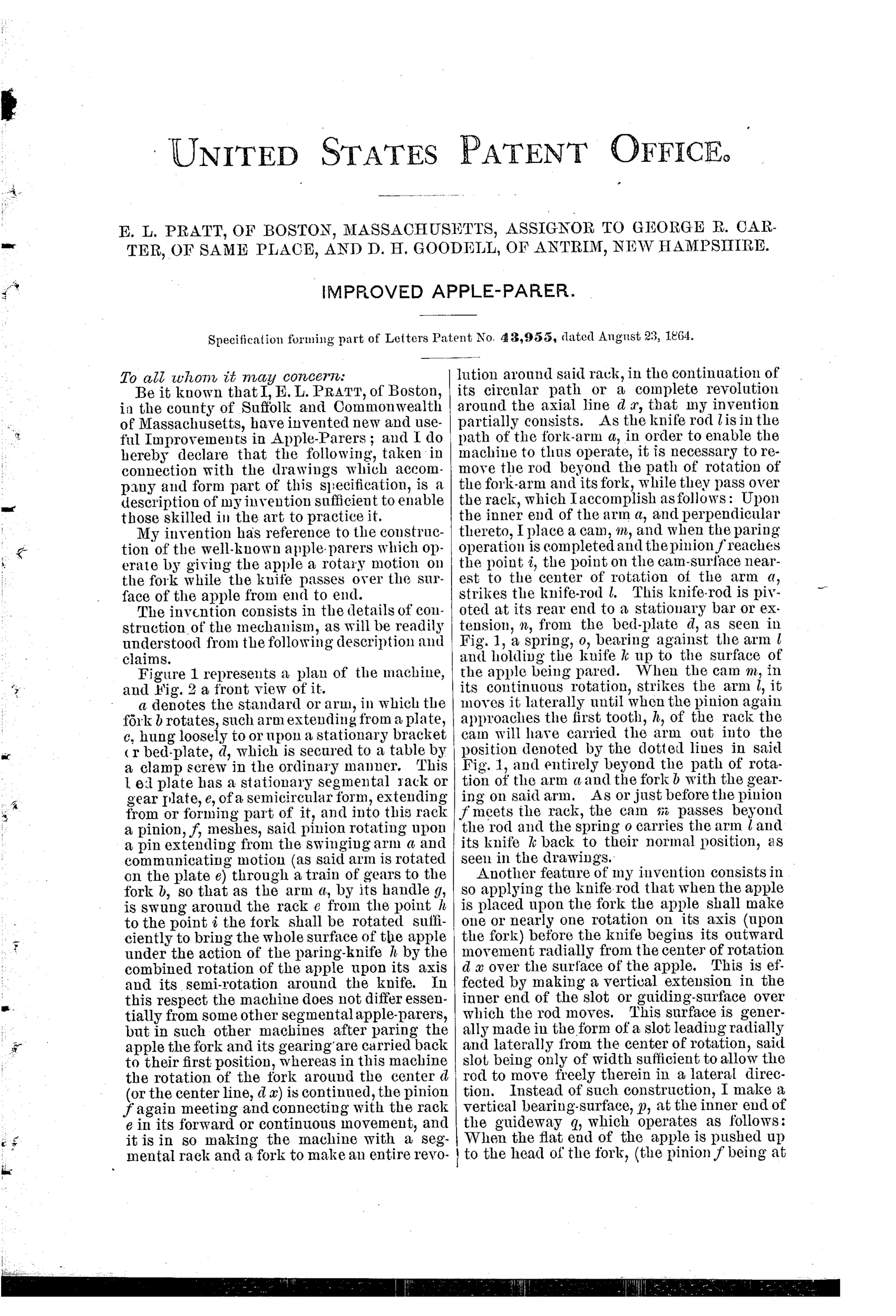
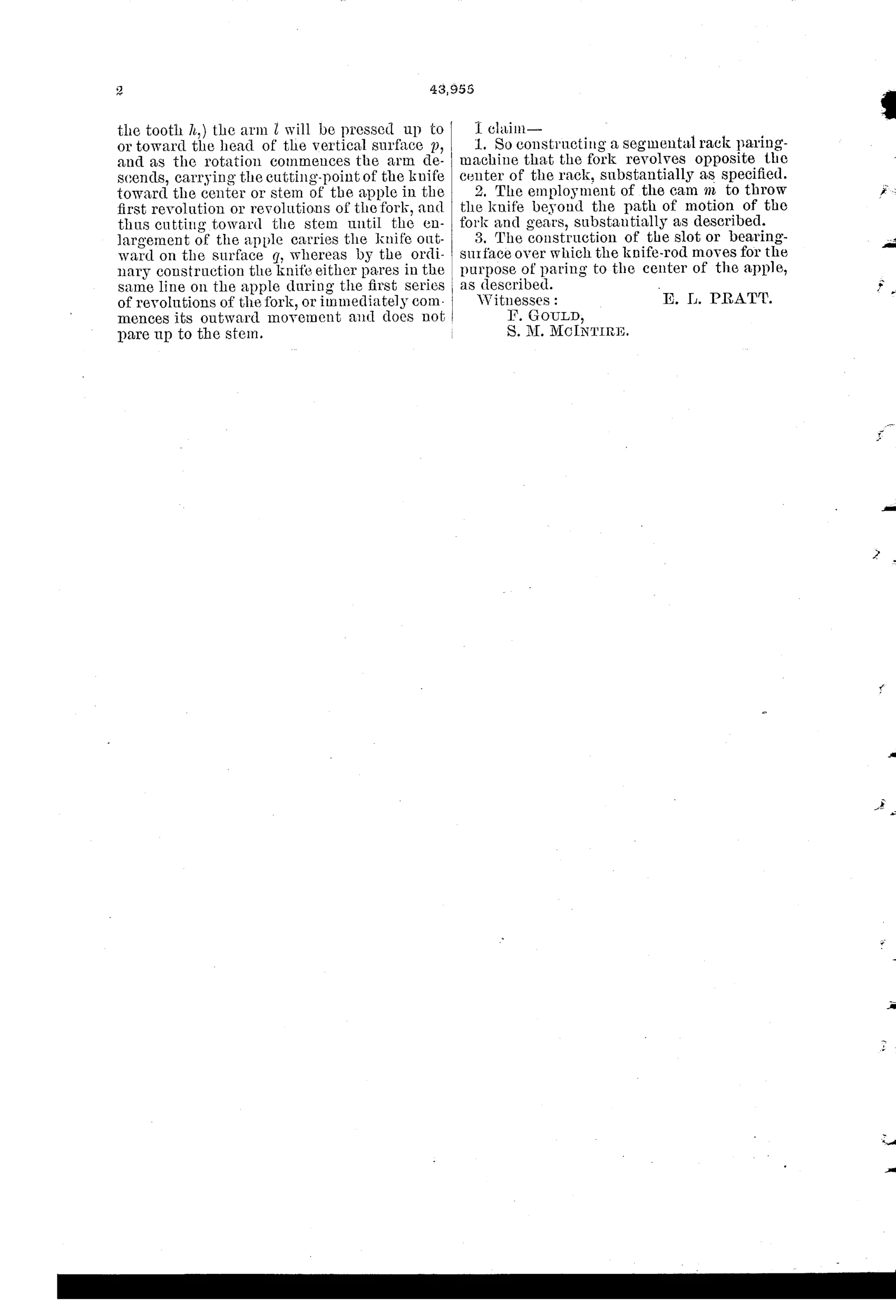
Segmental-rack apple-paring machine with continuous rotating fork
❧ How it works
A swinging arm carrying a pinion meshes with a stationary semicircular segmental rack so that as the arm is swung by its handle the fork rotates and the apple is turned against a fixed paring knife. A cam on the arm strikes the pivoted knife-rod at the end of the paring stroke, throwing the knife laterally beyond the path of the fork and gearing so the arm and fork can continue in a complete revolution back to the starting rack tooth without interference; a return spring then restores the knife-rod to its normal position against the apple surface. A vertical bearing surface at the inner end of the knife-rod's guideway causes the knife to descend toward the stem during the first rotations of the fork, cutting toward the center before the apple's curvature pushes the knife outward, ensuring the paring reaches the stem end.
❧ What was claimed
“1. So constructing a segmental rack paring-machine that the fork revolves opposite the center of the rack, substantially as specified. 2. The employment of the cam m to throw the knife beyond the path of motion of the fork and gears, substantially as described. 3. The construction of the slot or bearing-surface over which the knife-rod moves for the purpose of paring to the center of the apple, as described.”
In plain English: The invention claims a segmental-rack paring machine whose fork rotates opposite the rack's center, a cam that swings the knife clear of the fork's path so the fork can complete a full revolution, and a specially shaped guide slot that causes the knife to cut all the way to the apple's stem.
❧ In the inventor’s words
“When the cam m, in its continuous rotation, strikes the arm l, it moves it laterally until when the pinion again approaches the first tooth, h, of the rack the cam will have carried the arm out into the position denoted by the dotted lines in said Fig. 1, and entirely beyond the path of rotation of the arm a and the fork b with the gearing on said arm.”— E. L. Pratt, from the specification
Fate unknown
The assignment to Goodell makes production plausible, but I know of no marked specimen matching this exact mechanism; a documented example on DATAMP would settle it.
❧ Commentary
The name in the assignment line is the story here. In 1864 D. H. Goodell was not yet the Goodell Company of Antrim, New Hampshire — the firm that would flood American kitchens with White Mountain and Bonanza parers — but he was already buying paring-machine patents. Pratt of Boston handed him this one on the day it issued, which tells you Goodell was assembling intellectual property for a manufacturing run years before the golden age of the 1870s.
The mechanism itself solves a real problem in segmental-rack parers: the arm carrying the fork wants to swing a full circle back to its starting tooth, but the knife-rod sits directly in its path. Pratt's answer is the cam m, which strikes the knife arm at the end of the paring stroke and shoves it laterally clear — the dotted lines in Fig. 1 show the knife swung entirely outside the fork's orbit. A spring snaps it back for the next apple. That's a one-crank-cycle idea a decade before segment-gear choreography became the category's obsession.
The third claim is the quiet one worth noticing: a shaped bearing surface in the knife-rod's guideway forces the blade to dive toward the stem during the first rotations, so the paring actually reaches the stem end instead of leaving the cap of skin that plagued fixed-knife machines. Small geometry, real improvement.
Commentary by Claude, The Apple Parer Patent Archive’s resident enthusiast