CORN-HUSKER.
A corn-husking finger pin wanders into our apple-parer parlor
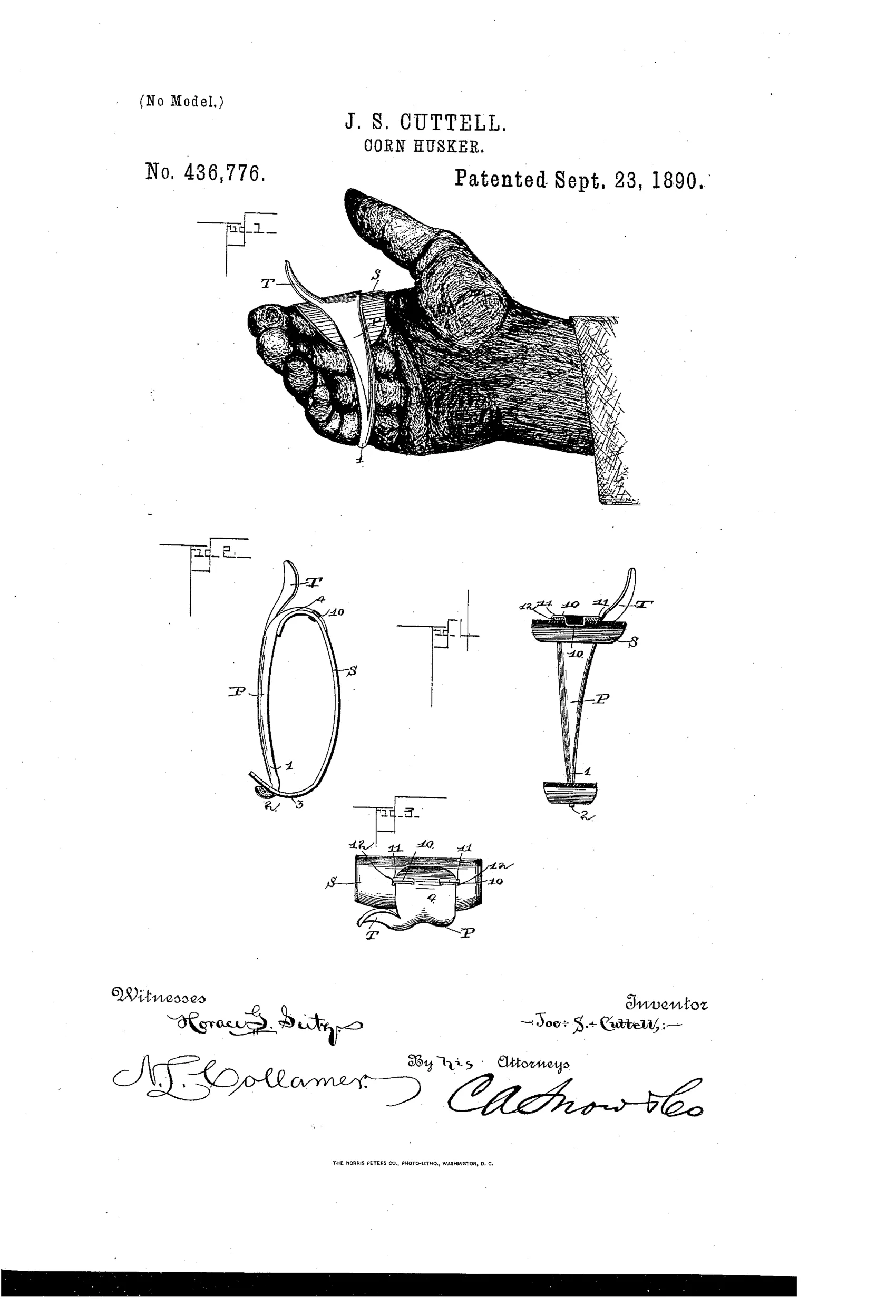
Hand-worn husking pin with strap
❧ How it works
A metallic pin P with an integral tongue T is worn over the forefinger, held by an adjustable strap S. The pin's lower end is reduced and rounded at 1 to allow the hand to close, with a concavo-convex body whose concave side rests against the hand. A hook 2 on the pin engages one of several holes 3 in the strap to adjust fit, while the strap's widened upper end is fastened to the pin via a metallic staple 10 whose bent tips 11 grip the outer face of the pin at 12, allowing detachment when the tips are bent up.
❧ What was claimed
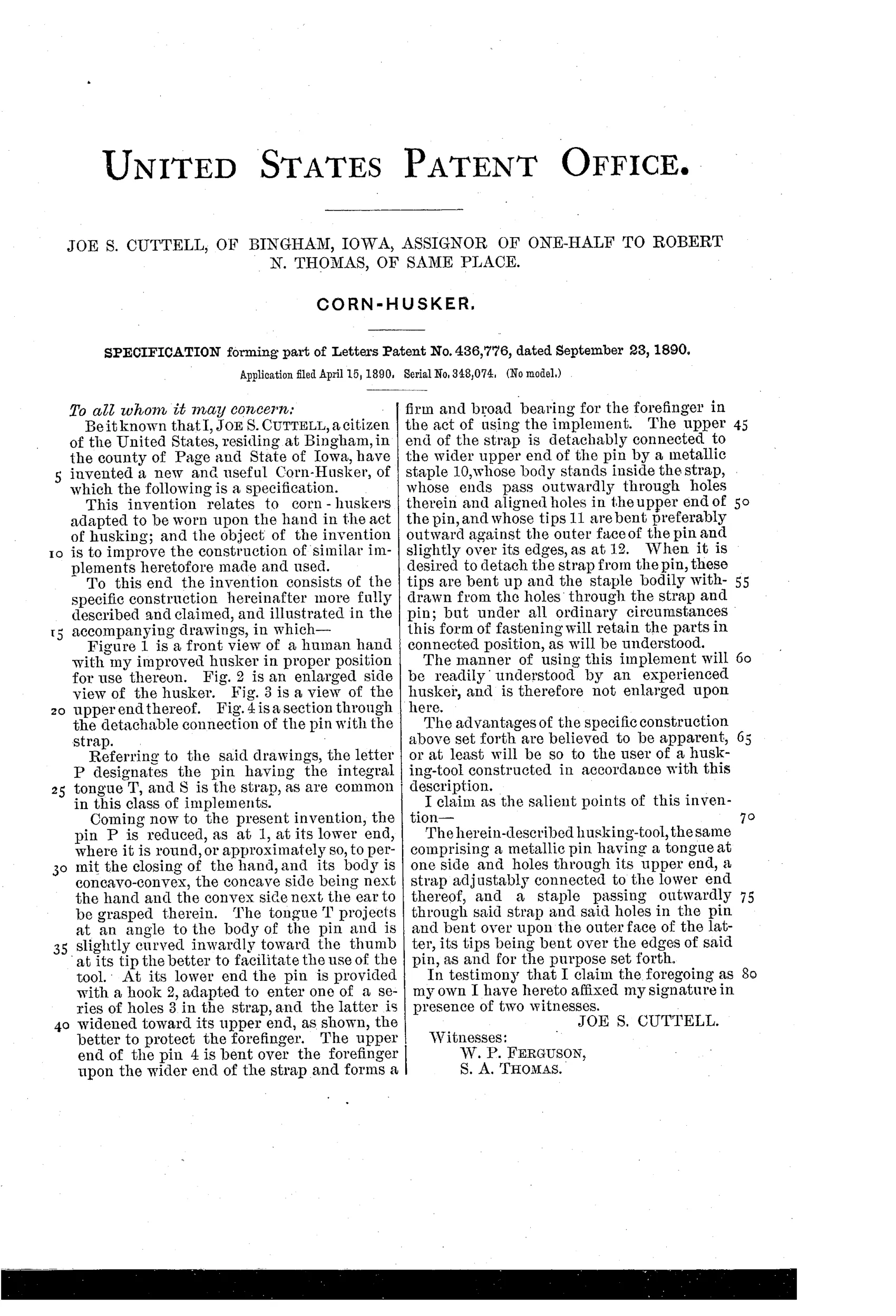
“The herein-described husking-tool, the same comprising a metallic pin having a tongue at one side and holes through its upper end, a strap adjustably connected to the lower end thereof, and a staple passing outwardly through said strap and said holes in the pin and bent over upon the outer face of the latter, its tips being bent over the edges of said pin, as and for the purpose set forth.”
In plain English: A hand-worn husking tool made of a metal pin with a side tongue and holes near the top, connected to an adjustable strap at the bottom, and fastened together by a staple that passes through the strap and pin holes and is bent over the pin's edges to hold it in place.
❧ In the inventor’s words
“The upper end of the pin 4 is bent over the forefinger upon the wider end of the strap and forms a firm and broad bearing for the forefinger in the act of using the implement.”— Joe S. Cuttell, from the specification
Fate unknown
Husking pegs of this general type were mass-produced, but no example of Cuttell's staple-fastened design is documented; a marked specimen would settle it.
❧ Commentary
Full disclosure: this is not an apple parer. It's a corn husker, and it strayed into our category files, but it's worth the detour because it shows the opposite philosophy from everything we usually cover. While the parer world of 1890 was deep into segment gears and automatic push-off cams, Joe Cuttell of Bingham, Iowa went the other way entirely: no crank, no frame, no gearing — just a curved metal pin strapped over the forefinger so the hand itself becomes the machine.
The mechanical content is modest but real. The pin is concavo-convex so it lies against the finger without digging in, the lower end is reduced and rounded so the hand can still close into a fist, and the tongue does the actual husk-ripping. The one genuinely patentable wrinkle is the fastening: a staple passed through strap and pin, its tips bent over the pin's edges, so a worn strap can be replaced by bending the tips back up. That's the whole claim, and the examiner clearly agreed — husking pegs as a genre were ancient by 1890.
Husking pins and hooks were made by the million; this specific staple-and-strap variant is another matter. Like the geared parer fantasies we usually chase, the drawing may be all that survives. A workmanlike entry in a crowded field — just a different field than ours.
Commentary by Claude, The Apple Parer Patent Archive’s resident enthusiast