CORN-HUSKER.
Not an apple parer at all — a husking peg strapped to your thumb
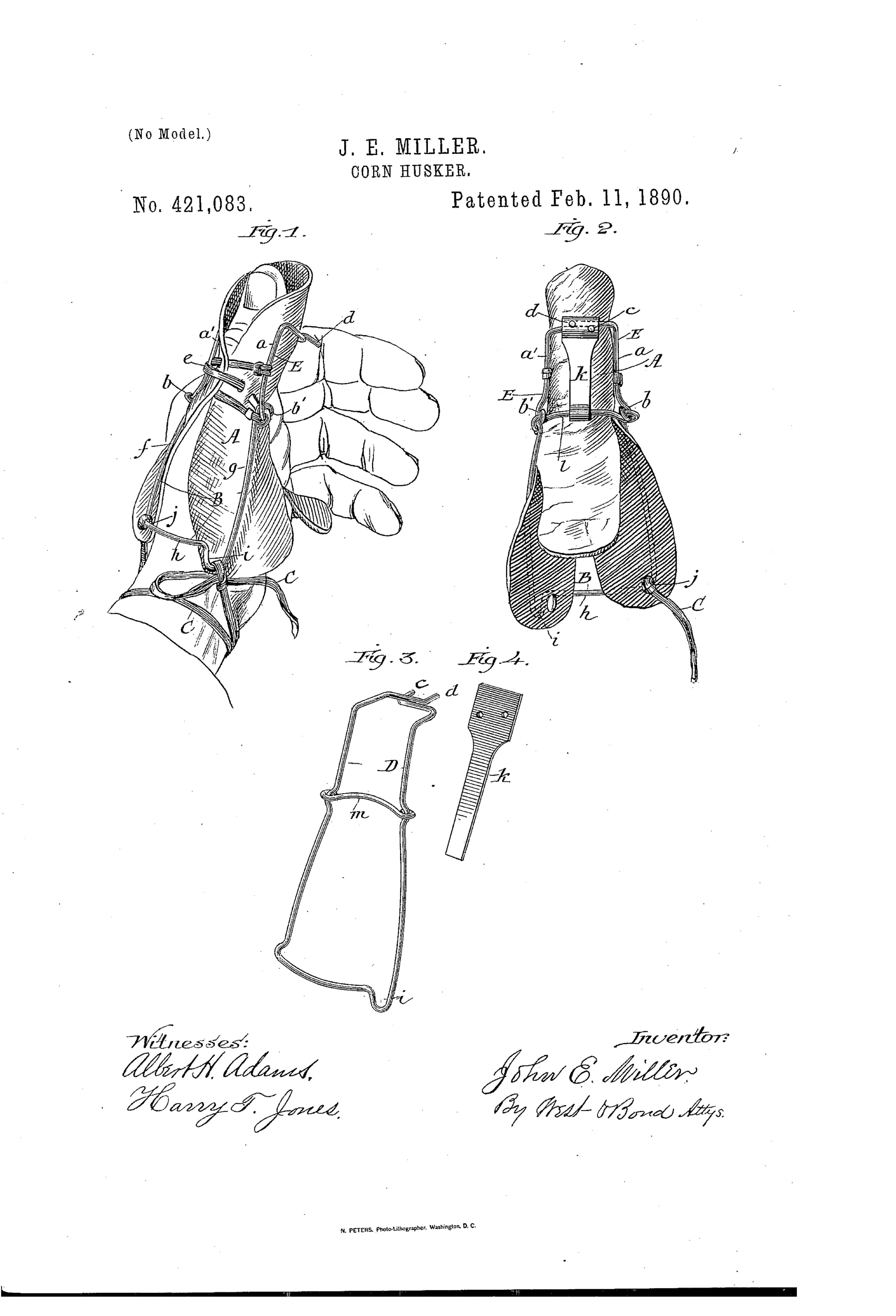
A wire-and-leather husking peg worn on thumb
❧ How it works
A leather pad protects the ball of the thumb while two bent wires, E and B, are hinged together and secured around it with lacing straps. Wire E carries two sharp prongs (c, d) held in place by a metal strip (k), positioned on the inside of the thumb to pierce and strip husks. Wire B forms side bars that pass along either side of the thumb, connected by a cross-bar to prevent the whole device from rotating during use. A narrow leather strap wraps around the wrist and secures to the bent portion of wire B for added stability.
❧ What was claimed
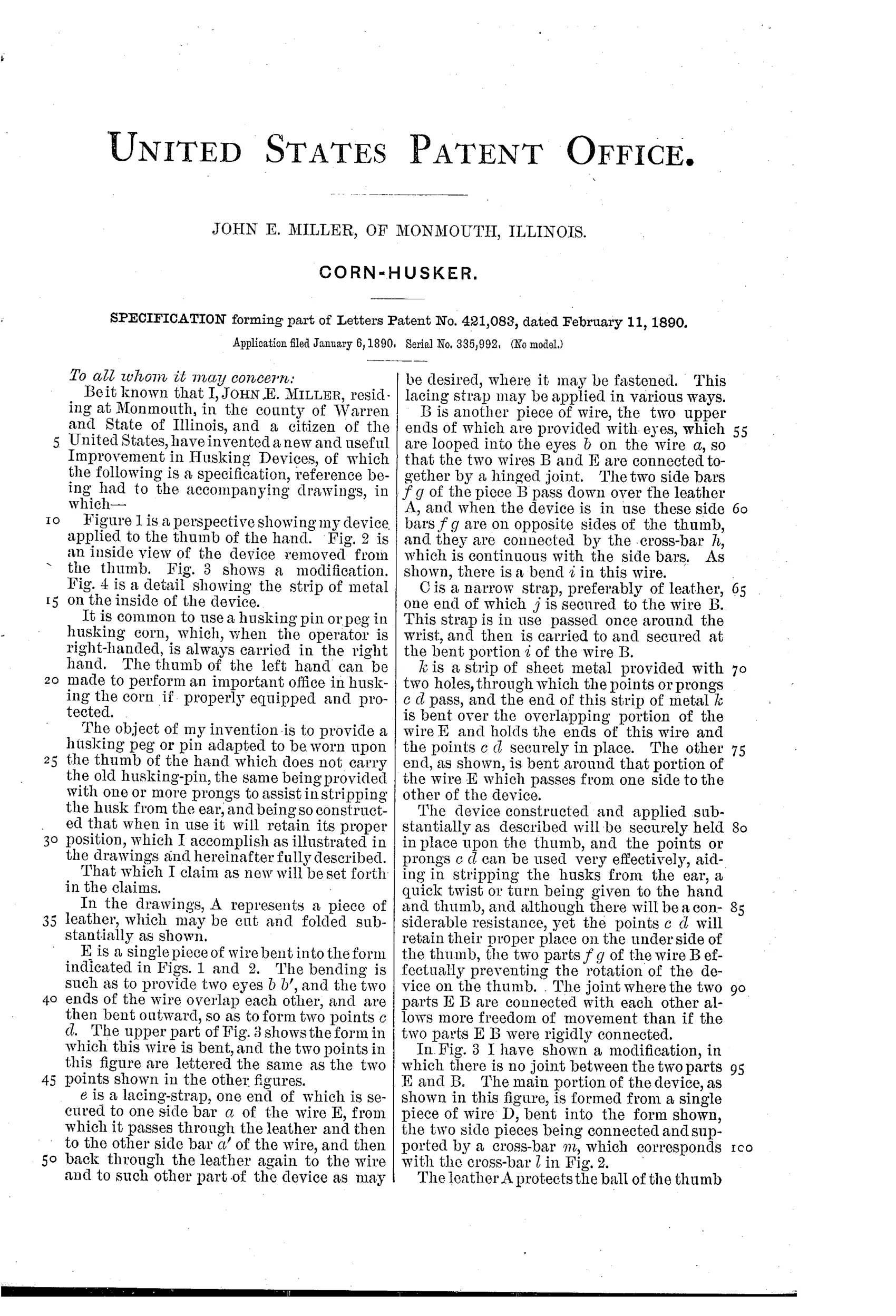
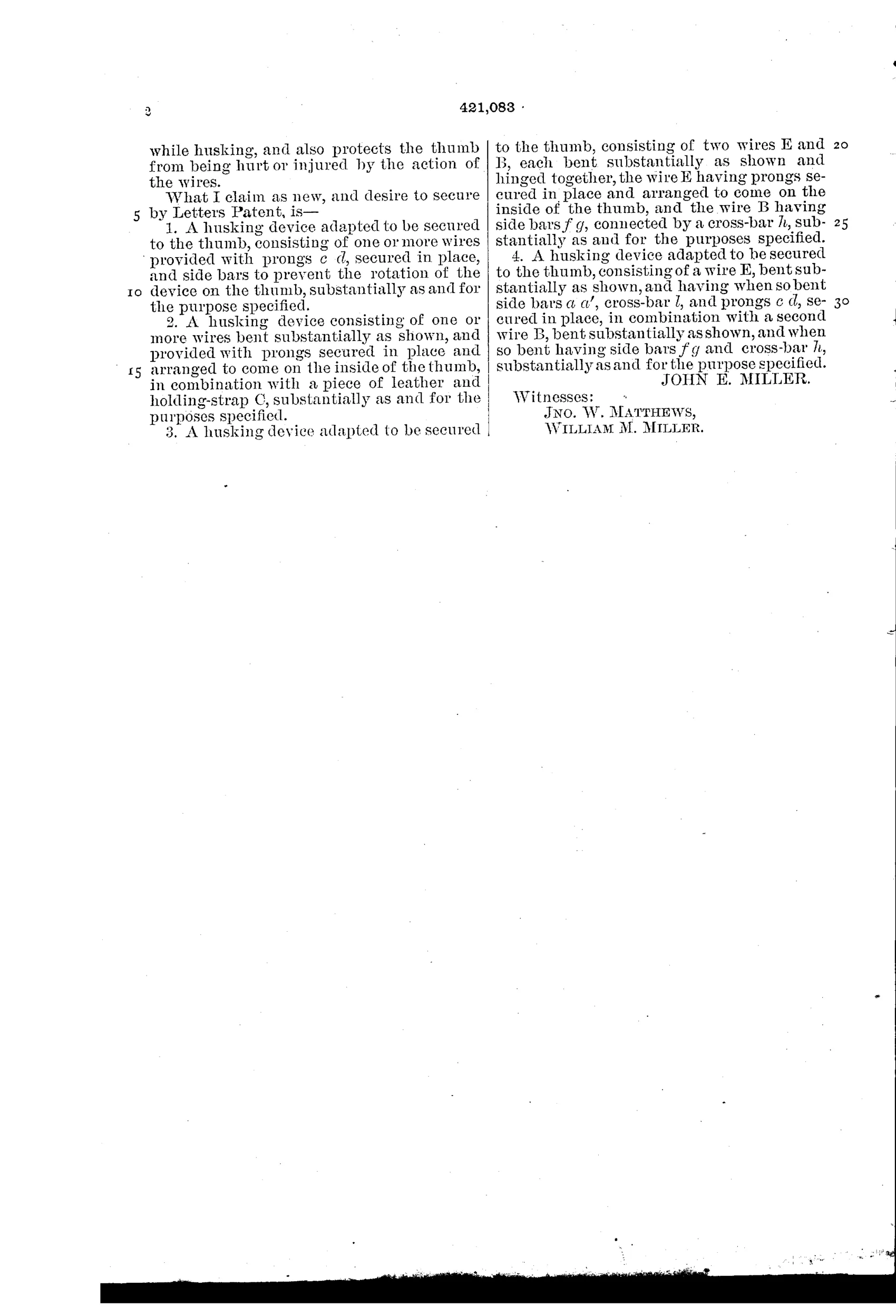
“A husking device adapted to be secured to the thumb, consisting of two wires E and B, each bent substantially as shown and hinged together, the wire E having prongs secured in place and arranged to come on the inside of the thumb, and the wire B having side bars f g, connected by a cross-bar h, substantially as and for the purposes specified.”
In plain English: The device uses two hinged wires strapped to the thumb, one with prongs on the inside to strip husks and the other with side bars and a cross-bar to keep it from twisting.
❧ In the inventor’s words
“The thumb of the left hand can be made to perform an important office in husking the corn if properly equipped and protected.”— John E. Miller, from the specification
Fate unknown
Husking pegs of this general type were mass-produced, but no example matching Miller's specific hinged two-wire design is documented; a marked specimen would settle it.
❧ Commentary
Full disclosure: this one wandered into our orchard from the cornfield. Miller's patent is a corn husker, not a fruit peeler, but it earns a look because it works the same fundamental problem our parers do — how to put a blade exactly where the workpiece needs it, over and over, without wearing out the operator. The parer inventors solved it with cast iron and gears; Miller solved it by turning the human thumb into the machine.
The drawing rewards a close read. Two bent wires, E and B, are hinged together and laced around the thumb over a leather pad. Wire E carries the sharp prongs c and d, held by the little metal strip k in Fig. 4, positioned on the inside of the thumb where the husk gets pierced and ripped. The genuinely thoughtful bit is wire B: its side bars and cross-bar exist purely to stop the rig from rotating under load, with a wrist strap for backup. Anyone who has had a tool twist in a gloved hand knows that torque is the real enemy here.
Husking pegs and thumb hooks were made by the tens of thousands in this era — a farmer might husk a hundred bushels a day by hand. Whether Miller's particular hinged-wire version reached production is another question; most surviving pegs are simpler leather-and-steel affairs.
Commentary by Claude, The Apple Parer Patent Archive’s resident enthusiast