INSTRUMENT FOR PICKING ORANGES.
Los Angeles clippers shaped to cut a stem flush inside the orange's cup
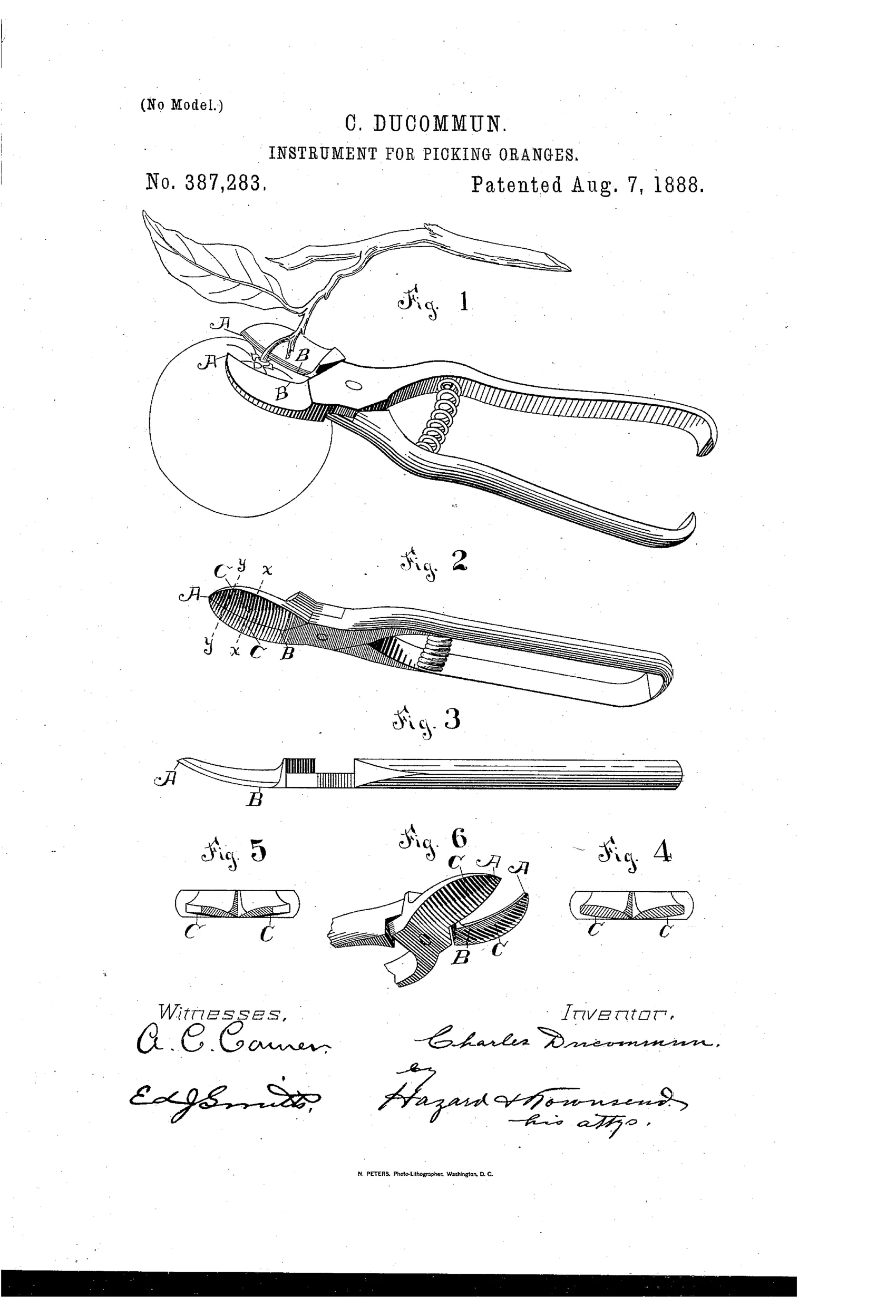
Spring clippers for clipping orange stems
❧ How it works
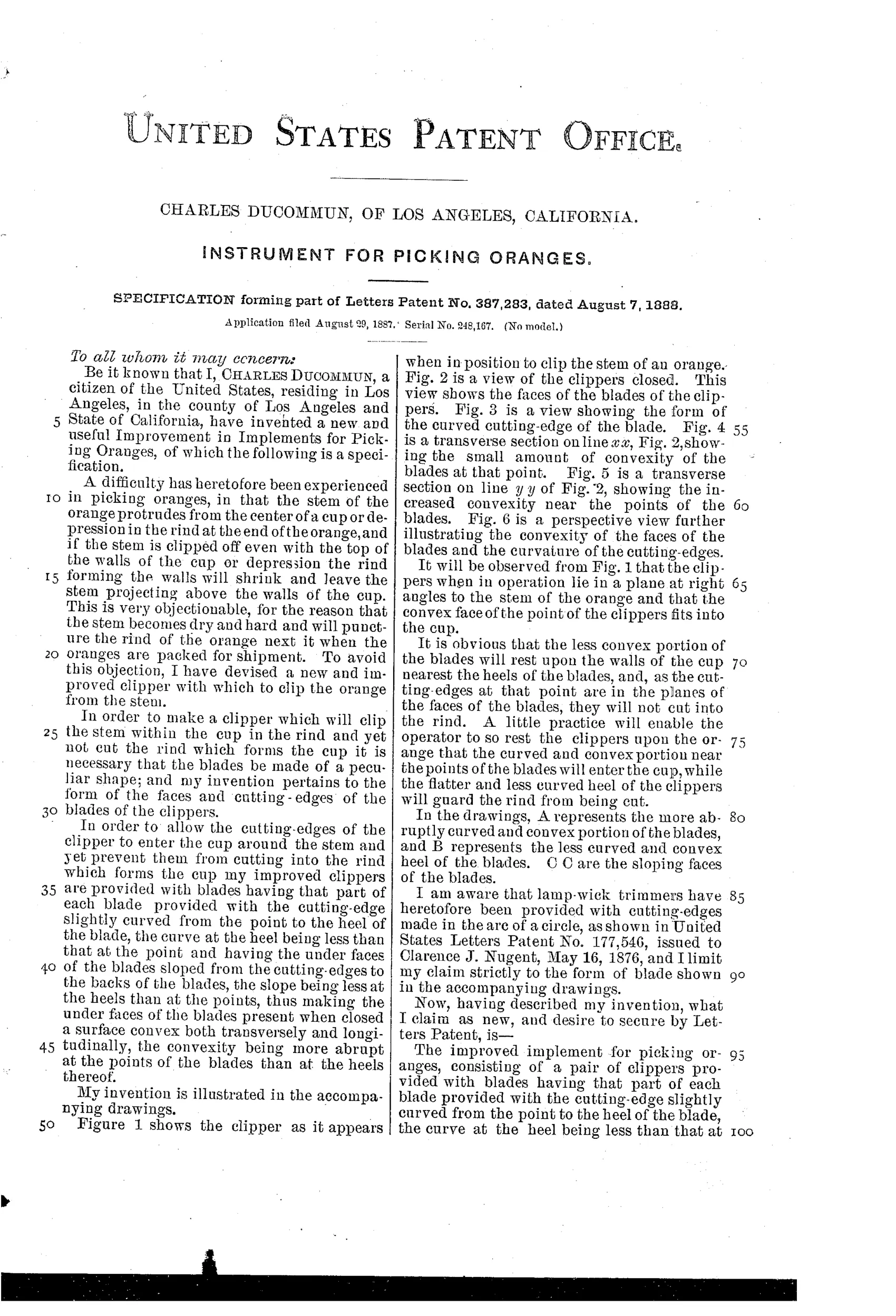
The tool is a pair of clippers with curved, sloped blades designed to reach into the natural cup depression at the top of an orange. The cutting edge of each blade is curved more sharply at the point than at the heel, and the underside of each blade slopes from the cutting edge to the back, more steeply near the point. This shape lets the point of the blade enter the cup around the stem without cutting the surrounding rind, while the flatter heel rests against and guards the rind. A coiled spring between the handles holds the jaws open until squeezed shut to clip the stem flush within the cup.
❧ What was claimed
“The improved implement for picking oranges, consisting of a pair of clippers provided with blades having that part of each blade provided with the cutting-edge slightly curved from the point to the heel of the blade, the curve at the heel being less than that at the point, and having the under face of the blades sloped from the cutting-edges to the backs of the blades, the slope being less at the heels than at the points, making the under faces of said blades present when closed a surface convex both transversely and longitudinally, the convexity being more abrupt at the points of the blades than at the heels thereof.”
In plain English: A pair of orange-picking clippers whose blades are curved more sharply and sloped more steeply at the tips than at the heels, so the blade tips fit into the orange's stem cup without cutting the rind.
❧ In the inventor’s words
“This is very objectionable, for the reason that the stem becomes dry and hard and will puncture the rind of the orange next it when the oranges are packed for shipment.”— Charles Ducommun, from the specification
Fate unknown
Citrus clippers of this general type were made in quantity for the packing industry, but no example marked to Ducommun or this patent is documented; a stamped specimen would settle it.
❧ Commentary
This one is a visitor from outside our kitchen — no gears, no crank, no clamp — but it earns its place because it solves a fruit problem with pure blade geometry, the same instinct that drives the best parer designs. Ducommun's complaint, straight from the specification, is wonderfully concrete: a stem clipped proud of the fruit "becomes dry and hard and will puncture the rind of the orange next it when the oranges are packed for shipment." One hard stub could start rot in a whole box. So the goal isn't just to cut the stem — it's to cut it flush inside the natural cup at the blossom end without nicking the rind around it.
The answer is in Figs. 4, 5, and 6, which a casual reader will skip. The cutting edge curves more sharply at the point than at the heel, and the underside slopes off more steeply near the tip. Closed, the blades present a surface convex in both directions — a little dome that noses into the cup while the flatter heels ride on the rind like a guard. The rind never sees an edge; only the stem does.
By 1888 Los Angeles was in the middle of its citrus boom, and packing-house shears with rounded, guarded tips became standard equipment in the industry. Ducommun's patent sits right at the start of that lineage: a small, honest fix for a costly shipping problem.
Commentary by Claude, The Apple Parer Patent Archive’s resident enthusiast