CANE-STRIPPER.
A Kentucky cane stripper that pares stalks the way a draw-plate pares wire
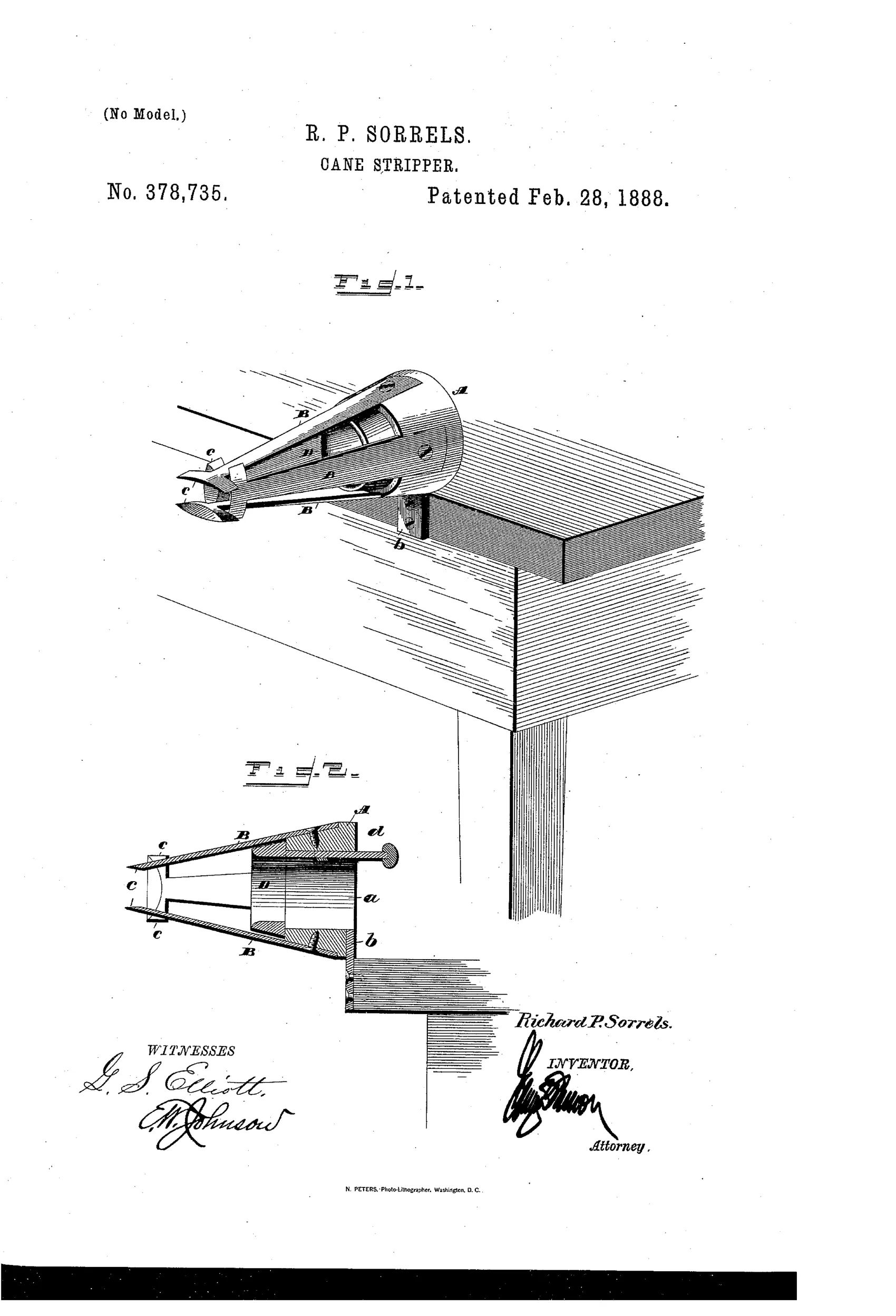
A hand-fed device for stripping leaves from cane stalks.
❧ How it works
A metal band or ring A, tapered on its outer edge and formed as a frustum of a cone, carries a series of converging spring-blade cutters B secured in recesses around its periphery. The cutter blades taper and curve inward at their outer ends into laterally-projecting, beveled cutting edges c that encircle the stalk. A sliding follower D with a rearward handle d is pushed forward to spread the blades apart so a stalk can be inserted, then as the stalk is drawn rearward the follower rides against the ring and the spring blades close upon and strip leaves and projections from the stalk. The bevel of the cutting edges is directed toward a point between the knives so the blades slide along the stalk removing only projecting matter rather than cutting into it.
❧ What was claimed
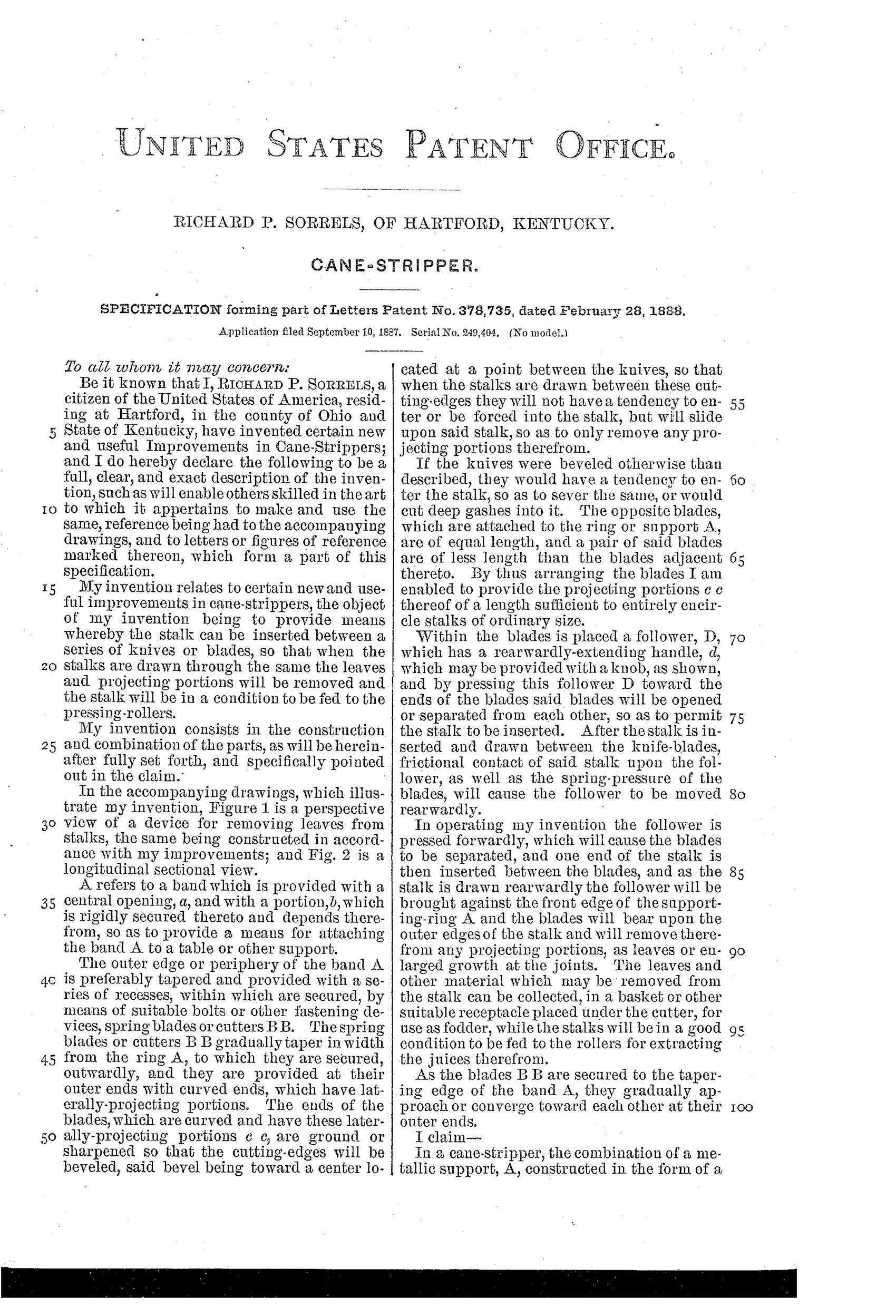
“In a cane-stripper, the combination of a metallic support, A, constructed in the form of a frustum of a cone, having slots or recesses in its outer surface and formed with a central opening, a series of converging cutters removably secured in the slots or recesses in the outer surface of the support A at their inner ends, and having laterally-projecting cutter-heads c at their opposite ends, and a follower provided with an integral handle for separating the cutters, and also constructed in the form of a frustum of a cone and having an opening therein of less diameter than the opening in the support A to form a projecting rim of metal which bears against the support A when said follower is not in operation, substantially as described.”
In plain English: The patent covers a cone-shaped metal support holding a ring of removable, converging cutter blades with hooked cutting tips, paired with a handled follower that spreads the blades apart to let a cane stalk in and then rests against the support to hold the blades closed during use.
❧ In the inventor’s words
“If the knives were beveled otherwise than described, they would have a tendency to enter the stalk, so as to sever the same, or would cut deep gashes into it.”— Richard P. Sorrels, from the specification
Fate unknown
No manufactured example or trade listing is documented to my knowledge; a marked specimen or a period hardware advertisement would settle it.
❧ Commentary
This one is a neighbor rather than a family member — not an apple parer, but it solves a paring problem with a mechanism our category's readers will recognize instantly: spring blades converging on a workpiece, beveled so they ride the surface instead of biting into it. Sorrels wanted to strip leaves and leaf-sheaths from sorghum or sugar cane by simply pulling the stalk through a ring of hooked knives, the way a wire is drawn through a die.
The clever bit is in the follower D. Push the handled cone forward and it wedges the spring blades apart so you can feed a stalk in; let go, and the follower's rim seats against the main cone A while the blades close on the stalk. The whole cycle is one hand motion, no adjustment. The other clever bit is the bevel direction — Sorrels states plainly that if the knives were beveled the other way they would gash or sever the stalk. That is exactly the geometry every good apple-parer blade arm exploits: a skew that lets the edge float on the profile and shave only what projects.
Mounted through a hole in a table edge like a clamp-on kitchen machine, it would probably work on straight, uniform stalks and struggle on crooked ones, since a fixed ring of blades cannot follow a bend. It reads as a sensible farm-shop idea from Hartford, Kentucky, in an era when sorghum stripping was real seasonal drudgery.
Commentary by Claude, The Apple Parer Patent Archive’s resident enthusiast