IMPROVED APPLE-PARER
An 1862 turntable parer built so the parings never touch the works
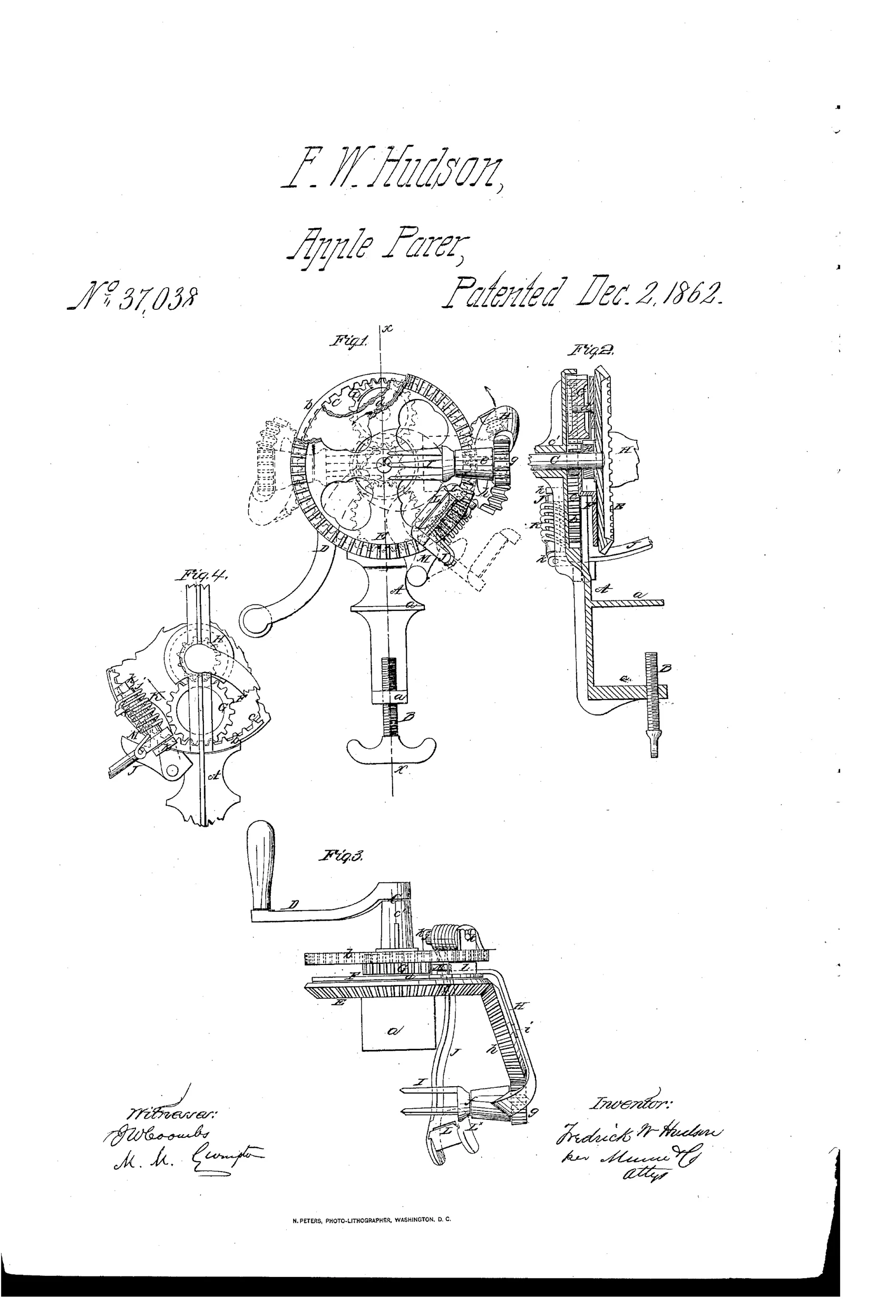
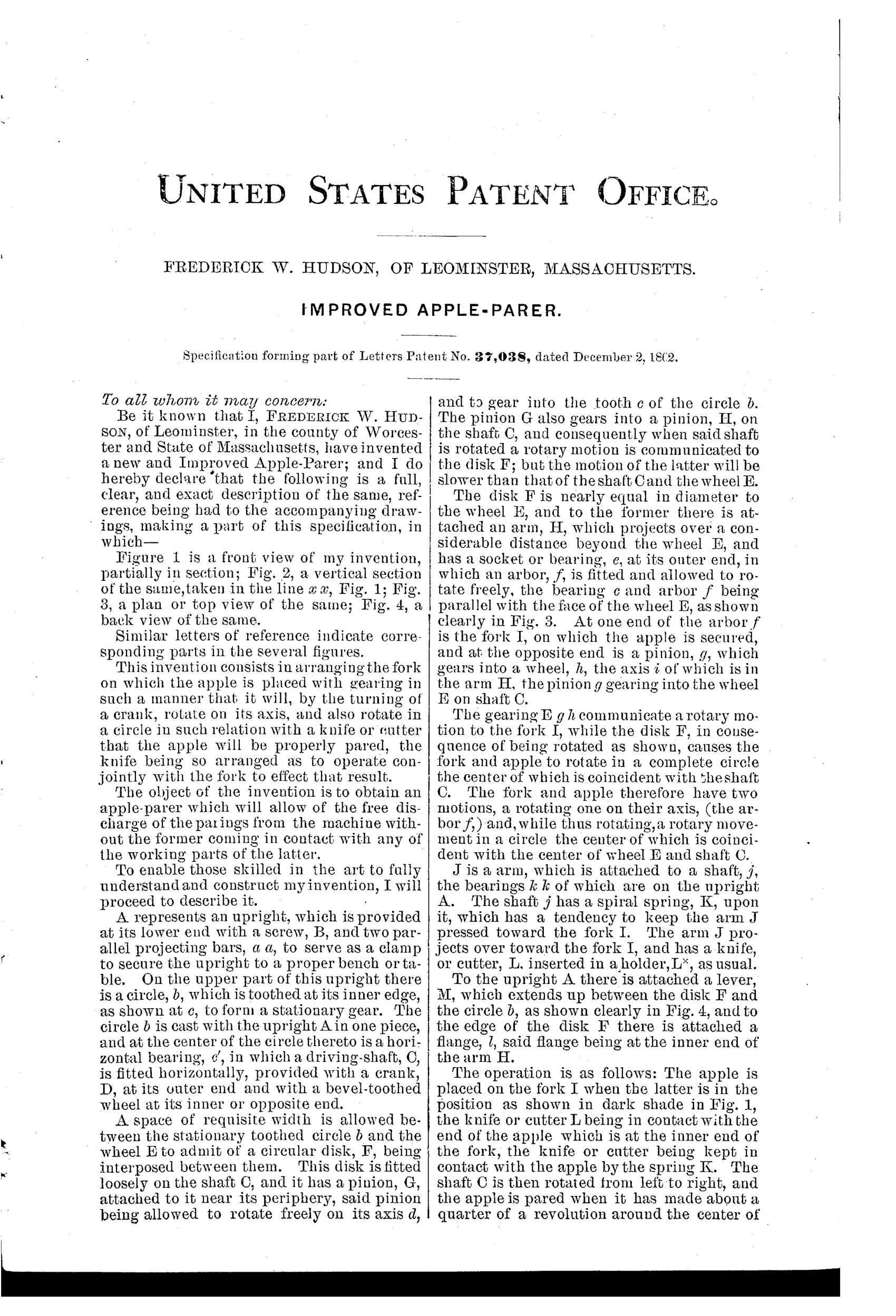
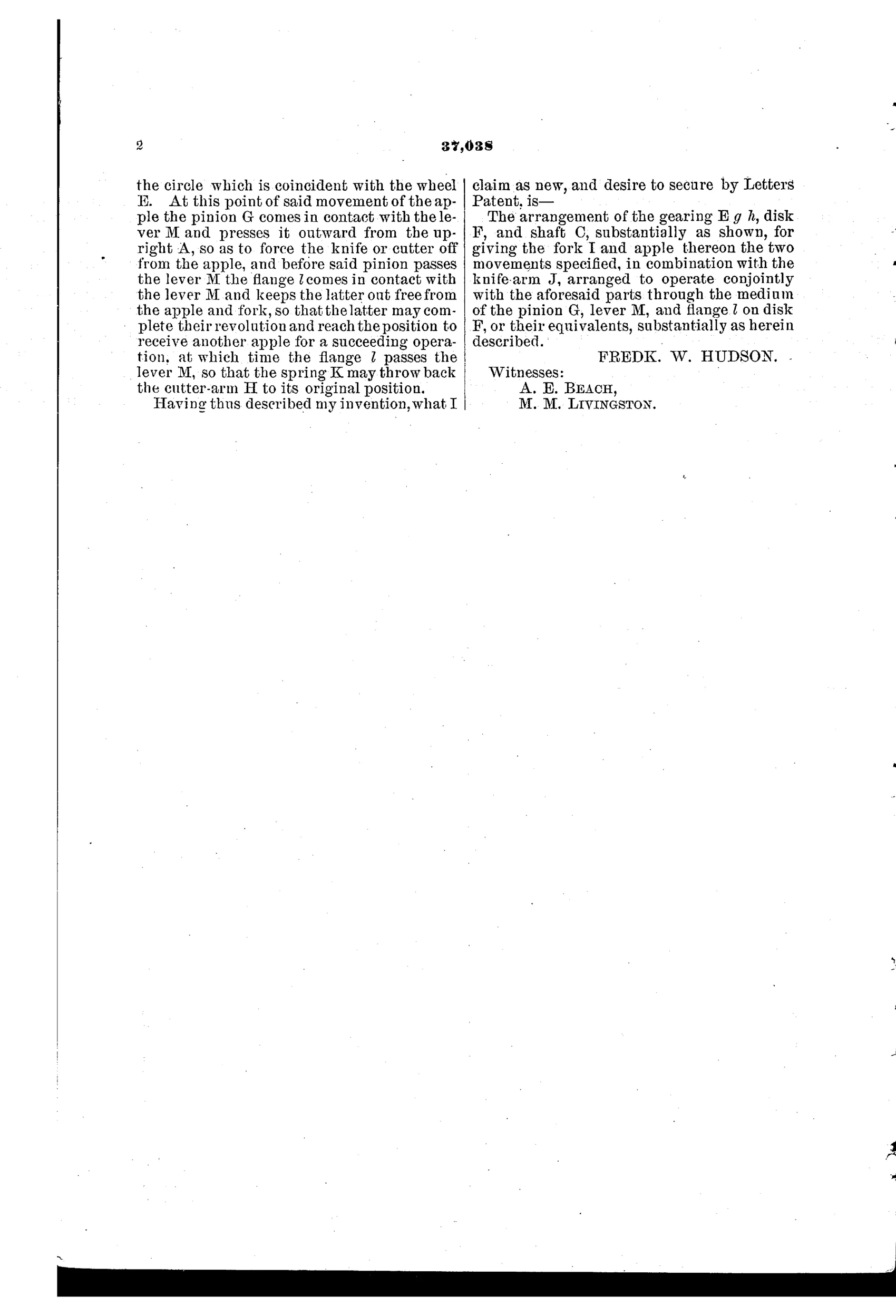
Geared crank-operated apple-paring machine
❧ How it works
An upright post holds a stationary toothed circle that meshes with a rotating disk driven by a hand-crank shaft, causing a fork holding the apple to both spin on its own axis and simultaneously revolve in a circle. A separate spring-loaded knife arm is pressed against the apple to pare it as it rotates and revolves. As the fork completes about a quarter revolution, a pinion strikes a lever that forces the knife off the apple, while a flange on the disk holds the lever clear until the fork returns to its starting position to receive a new apple, at which point the flange passes and the spring throws the knife back into cutting position.
❧ What was claimed
“The arrangement of the gearing E g h, disk F, and shaft C, substantially as shown, for giving the fork I and apple thereon the two movements specified, in combination with the knife-arm J, arranged to operate conjointly with the aforesaid parts through the medium of the pinion G, lever M, and flange l on disk F, or their equivalents, substantially as herein described.”
In plain English: The claim covers the specific gear-and-disk arrangement that makes the fork both spin and orbit while a knife arm automatically engages and disengages via a pinion, lever, and flange mechanism.
❧ In the inventor’s words
“The object of the invention is to obtain an apple-parer which will allow of the free discharge of the parings from the machine without the former coming in contact with any of the working parts of the latter.”— Frederick W. Hudson, from the specification
Fate unknown
Hudson-name parers are known to collectors and documented on DATAMP, but confirming that a surviving machine embodies this specific 1862 mechanism would take a marked example matched to the drawing.
❧ Commentary
Hudson's stated goal is refreshingly practical: keep the peelings away from the gears. Anyone who has cranked a mid-century parer knows why. Wet apple skin wraps around exposed pinions, packs into tooth spaces, and turns a smooth machine into a sticky one by the third bushel. His answer is an epicyclic layout — a stationary toothed ring on the upright post, a driven disk rolling a pinion around inside it — so the fork spins the apple on its own axis while carrying it in an orbit, out over open air where the parings can simply fall clear.
The cleverer detail is the knife choreography, easy to miss in Fig. 1's tangle. A pinion trips a lever that kicks the spring-loaded blade off the apple after roughly a quarter revolution of the orbit, and a flange on the disk holds the lever cocked until the fork swings back to its loading station — only then does the flange pass and the spring snap the knife home for the next apple. That is a one-crank pare-and-reset cycle, worked out a full fifteen years before the segment-gear golden age made such tricks standard equipment on machines like the Reading '78.
Hudson, working in Leominster in the early 1860s, sits right in the Massachusetts cluster that drove this trade. This is an early, credible statement of the return-type idea rather than a geared fantasy — the parts count is honest and the motions are all cam-and-spring simple.
Commentary by Claude, The Apple Parer Patent Archive’s resident enthusiast