IMPROVEMENT IN CUTTERS FOR SUGAR-CANE, SORGHUM, &c.
Not an apple parer at all — but the spring-jaw blade idea rhymes
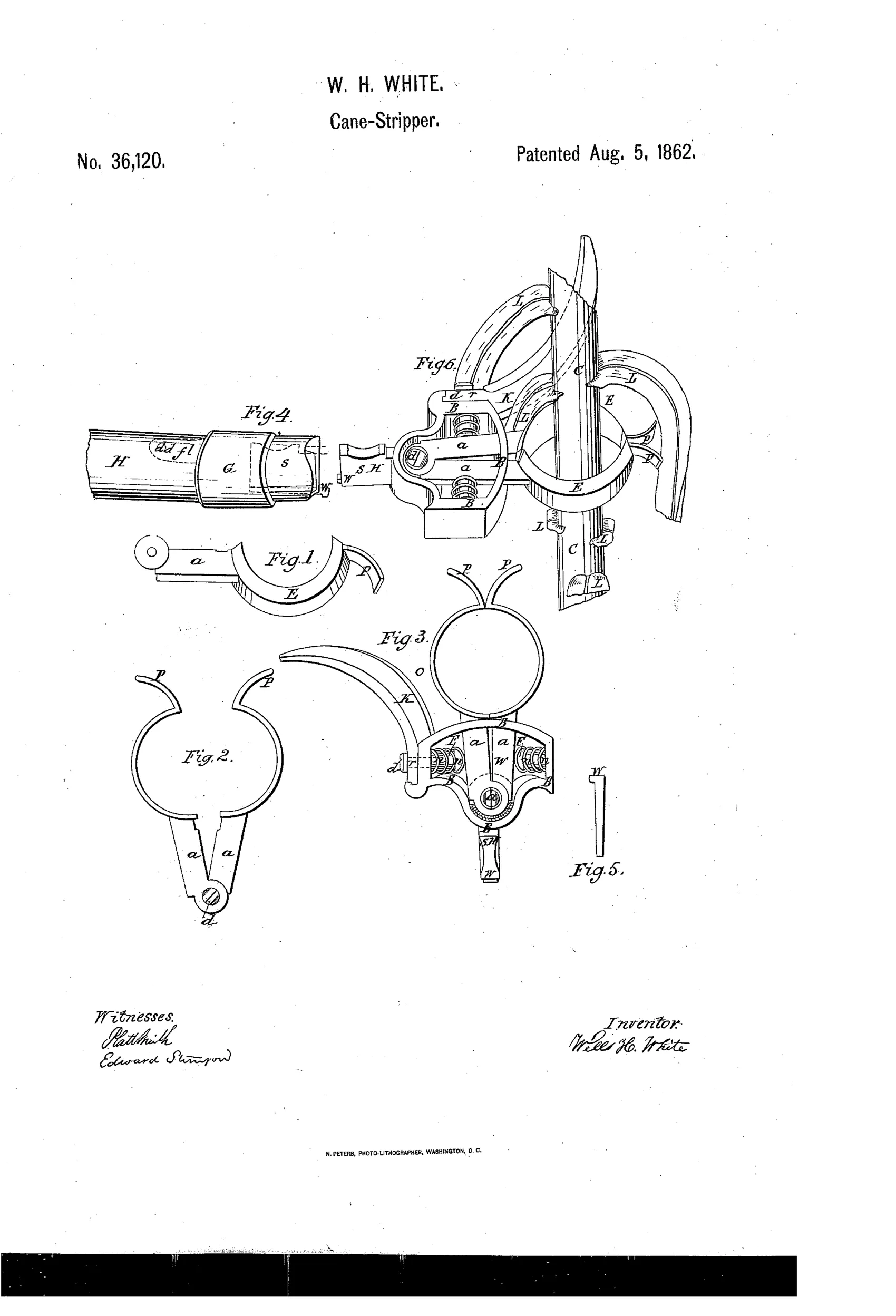
Hand tool for trimming and topping sugar-cane stalks
❧ How it works
Two spring-loaded semicircular knives are mounted in a frame so that when pushed against a cane stalk they spread apart, admit the stalk, and then close to completely surround and slice it. A third, cycle-shaped (sickle) knife is screwed to the side of the frame to cut the stalk down after it has been trimmed. The frame connects via a shank and socket-ferrule to a long handle (about four feet), secured by a key and screw, allowing the operator to work the tool with both hands from a standing position. In use, the tool is raised to the top of the cane, twisted to lop over the seed head, then drawn down to the base where a single quick upward stroke trims the leaves and tops the cane, followed by a draw cut with the side knife to sever the stalk.
❧ What was claimed
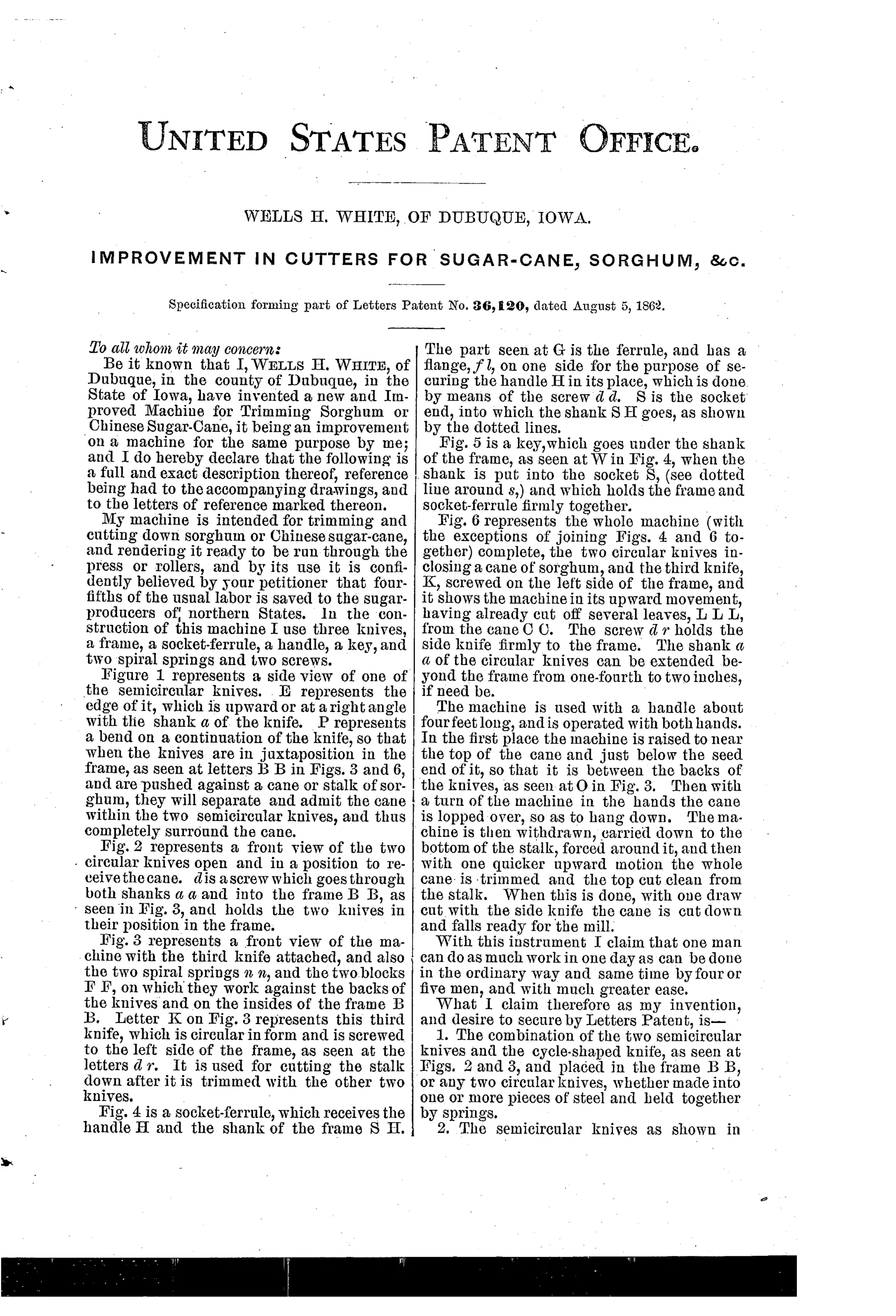
“The combination of the two semicircular knives and the cycle-shaped knife, as seen at Figs. 2 and 3, and placed in the frame B B, or any two circular knives, whether made into one or more pieces of steel and held together by springs.”
In plain English: A pair of spring-held circular knives combined with a sickle-shaped side knife, mounted in a frame, for trimming and cutting cane.
❧ In the inventor’s words
“With this instrument I claim that one man can do as much work in one day as can be done in the ordinary way and same time by four or five men, and with much greater ease.”— Wells H. White, from the specification
Fate unknown
No surviving example or production record is known to us, and sorghum tools of this era are thinly documented; a marked specimen or period advertisement would settle it.
❧ Commentary
First, an honest confession: this one wandered into our collection by keyword, not category. Wells H. White of Dubuque patented a cane stripper, a long-handled hand tool for topping and trimming sorghum stalks. But it earns a look, because the core mechanism — two spring-loaded semicircular knives that spread apart when pushed against a stalk, snap closed to fully encircle it, then strip everything off in one drawn stroke — is a first cousin to the self-adjusting, spring-tensioned blades that apple-parer inventors were chasing in the same decades. The problem is identical: a cutter that conforms to an irregular natural object without hand adjustment.
The timing tells the real story. August 1862: the Union had just lost its Louisiana sugar supply, and Northern farmers were planting sorghum in a hurry. White's claim that one man with this tool could do the work of four or five stripping cane by hand is the classic patent-era boast, but the workflow he describes — raise, twist to lop the seed head, draw down to strip, side-cut with the sickle blade — is genuinely thought through. Fig. 6, showing the jaws clamped around a leafy stalk, is the drawing to study.
The weak point is the four-foot handle: all the stripping force runs through a keyed socket-ferrule, and repeated draw strokes against tough cane leaves would test that joint quickly. A workmanlike wartime idea, probably harder to use than to draw.
Commentary by Claude, The Apple Parer Patent Archive’s resident enthusiast