HUSKING-PIN.
A corn-husking pin that folds like a pocketknife — a category outlier here
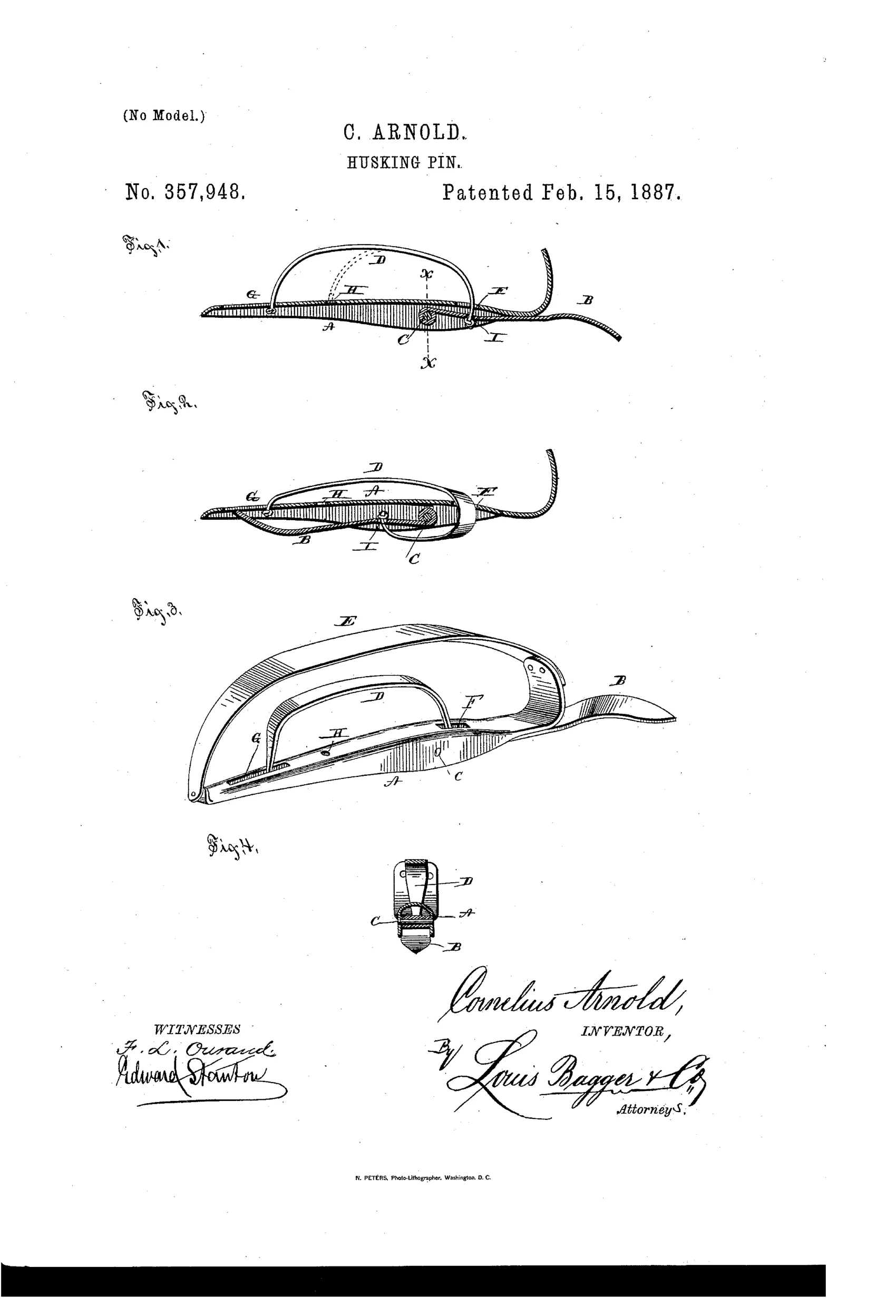
A hand-worn corn husking pin
❧ How it works
The device consists of a concave metal handle with one end bent up to brace the forefinger, with slots and a hole for adjustable finger-strap attachment. A pivoted husking-blade, pointed and twisted at one end to fit the thumb, is riveted to the handle and can pivot closed against friction on its eye. A knuckle-protecting strap may be secured to the turned-up end and the opposite end of the handle to shield the husker's hand.
❧ What was claimed
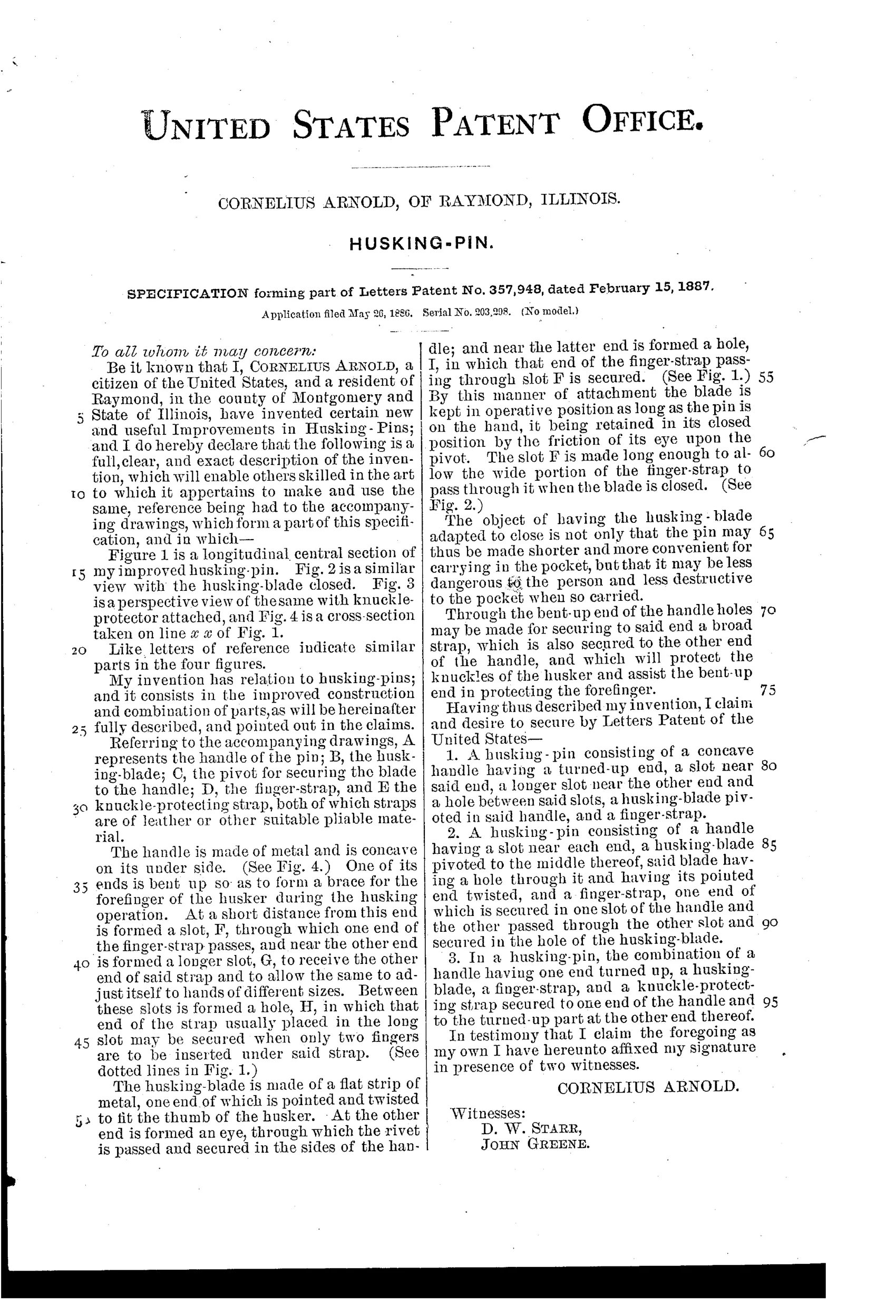
“2. A husking-pin consisting of a handle having a slot near each end, a husking-blade pivoted to the middle thereof, said blade having a hole through it and having its pointed end twisted, and a finger-strap, one end of which is secured in one slot of the handle and the other passed through the other slot and secured in the hole of the husking-blade.”
In plain English: A husking pin made of a slotted handle, a pivoting blade with a twisted pointed end, and a finger strap threaded through both slots and secured to the blade.
❧ In the inventor’s words
“The object of having the husking-blade adapted to close is not only that the pin may thus be made shorter and more convenient for carrying in the pocket, but that it may be less dangerous to the person and less destructive to the pocket when so carried.”— Cornelius Arnold, from the specification
Fate unknown
Husking pins were made and sold in great variety, but no marked example of Arnold's folding design is documented to us; a surviving specimen would settle it.
❧ Commentary
First, honesty: this is not an apple parer. It landed in our files anyway, and it earns a look as the hand-tool cousin of everything else on this site. While the parer inventors were piling gears onto cast-iron frames, Cornelius Arnold of Raymond, Illinois was solving the opposite problem — a tool with no moving parts to speak of, worn on the hand, for stripping husks off corn in the field.
The one genuinely clever move is the folding blade. Husking pins were normally fixed spikes strapped to the palm, and Arnold says plainly why his pivots shut: so it may be 'less dangerous to the person and less destructive to the pocket when so carried.' That is pocketknife thinking applied to a farm tool, and the friction pivot on the rivet eye is about the cheapest way to do it. Note in Figs. 1 and 2 how the finger strap threads through slots in the handle and anchors in a hole in the blade itself — the strap does double duty, holding the tool to the hand and keeping the blade indexed.
The optional knuckle-protecting strap in Fig. 3 shows he'd actually husked corn: dry husks and stalks chew up the back of the hand over a long day. A modest, practical patent in a field crowded with nearly identical pins — the folding feature is its whole claim to distinction.
Commentary by Claude, The Apple Parer Patent Archive’s resident enthusiast