CORN-HUSKING DEVICE
A corn husking peg wanders into the parer archive — hand power, no gears
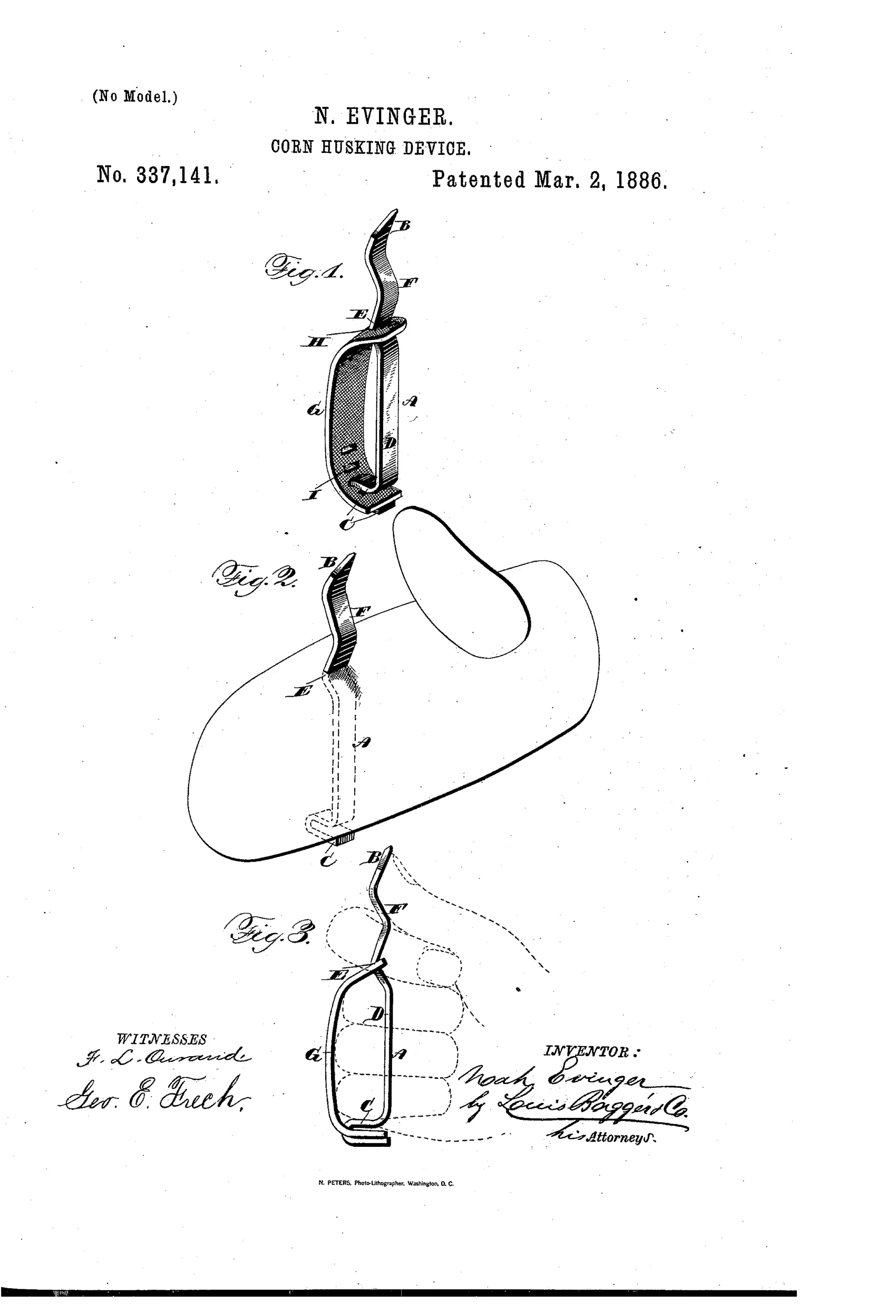
A hand-worn corn husking pin device
❧ How it works
A flat metal strip has one end pointed and the other end bent into a hook with parallel flat sides. The strip forms a straight handle above the hook, with a slight curve and a larger curve near the pointed tip. A broad leather strap, perforated at its upper end, fits over the strip at the lower curve, and its lower end has a series of perforations engaged by the hook so the strap can be adjusted to fit hands of different sizes. When worn on a mitten, the hook engages the palm edge, the pin passes along the inner side and penetrates the mitten near the first finger, holding the pin against the fingers for husking corn.
❧ What was claimed
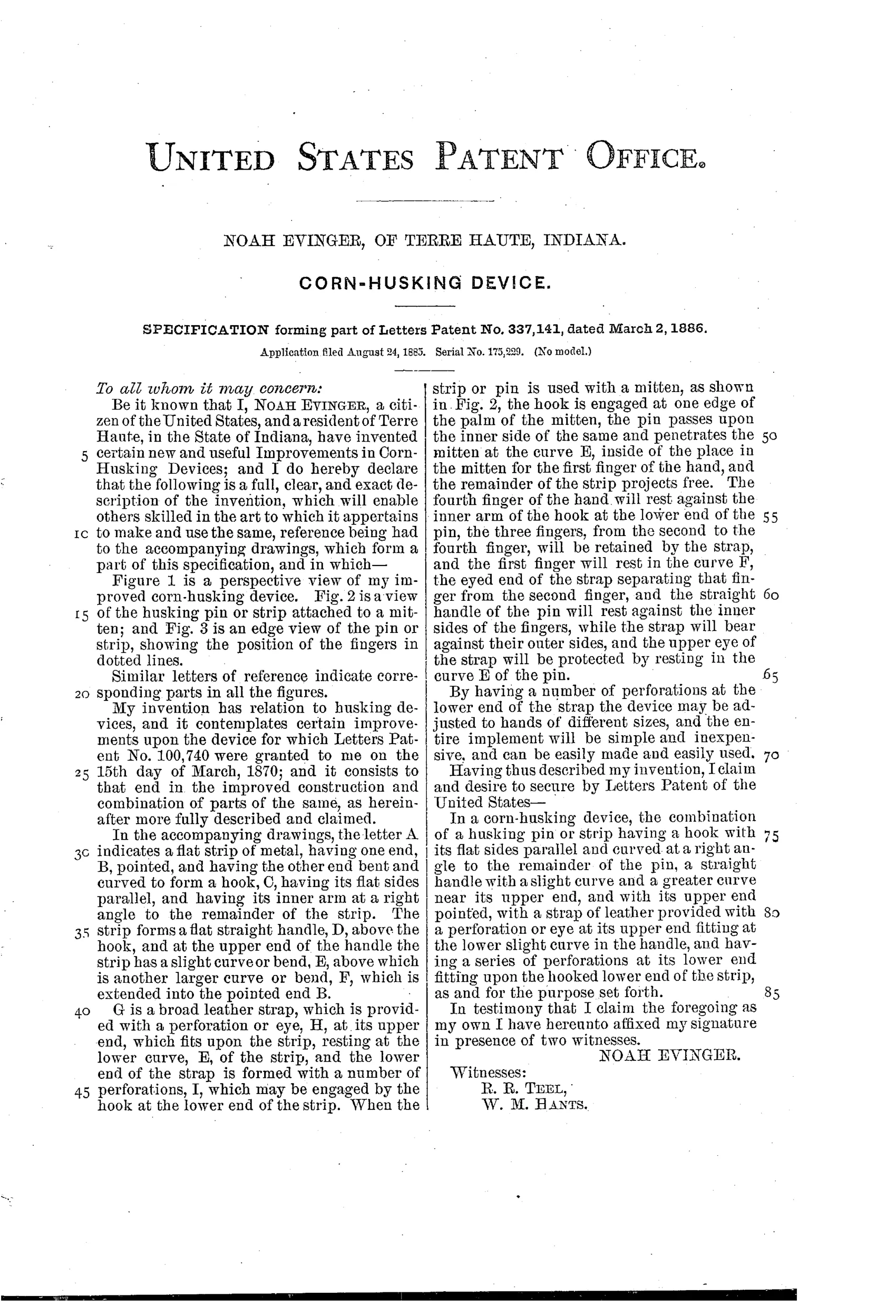
“In a corn-husking device, the combination of a husking pin or strip having a hook with its flat sides parallel and curved at a right angle to the remainder of the pin, a straight handle with a slight curve and a greater curve near its upper end, and with its upper end pointed, with a strap of leather provided with a perforation or eye at its upper end fitting at the lower slight curve in the handle, and having a series of perforations at its lower end fitting upon the hooked lower end of the strip, as and for the purpose set forth.”
In plain English: The invention combines a curved metal husking pin with a hooked lower end and pointed upper end with an adjustable perforated leather strap that attaches at both ends of the pin, allowing the device to fit different hand sizes.
❧ In the inventor’s words
“By having a number of perforations at the lower end of the strap the device may be adjusted to hands of different sizes, and the entire implement will be simple and inexpensive, and can be easily made and easily used.”— Noah Evinger, from the specification
Fate unknown
Husking pegs of this general type were widely manufactured, but no marked example of Evinger's specific design is documented; a surviving specimen matching the drawing would settle it.
❧ Commentary
First, an honest note: this isn't an apple parer. Noah Evinger's patent is a corn husking pin, a hand-worn peg for ripping husks off ears in the field. It shares only a family resemblance with our usual fare — a piece of shaped metal meant to make a repetitive food-processing chore faster. Where the parer inventors of the 1880s were piling on segment gears, Evinger went the opposite direction: no moving parts at all.
The design itself is thoughtful in the way good farm tools are. The metal strip hooks over the edge of the palm, the pointed end pierces the mitten near the first finger, and a perforated leather strap laces the whole thing snug — the row of holes on the strap's lower end catching on the hook so one size fits many hands. Fig. 3, with the fingers dotted in, shows what a casual reader would miss: the pin sits along the fingers, not across the palm, so the husker's natural grabbing motion does the tearing. Adjustability was the whole claim, and it's a modest, sensible one.
Husking pegs were made by the tens of thousands in this era, in dozens of patented variations; whether Evinger's particular hook-and-strap pattern ever left Terre Haute in quantity is another question. It's a workmanlike entry in a crowded field — just not our crowded field.
Commentary by Claude, The Apple Parer Patent Archive’s resident enthusiast