MACHINE FOR PARING APPLES
One isolated rack tooth solves the loading problem every screw-feed parer had
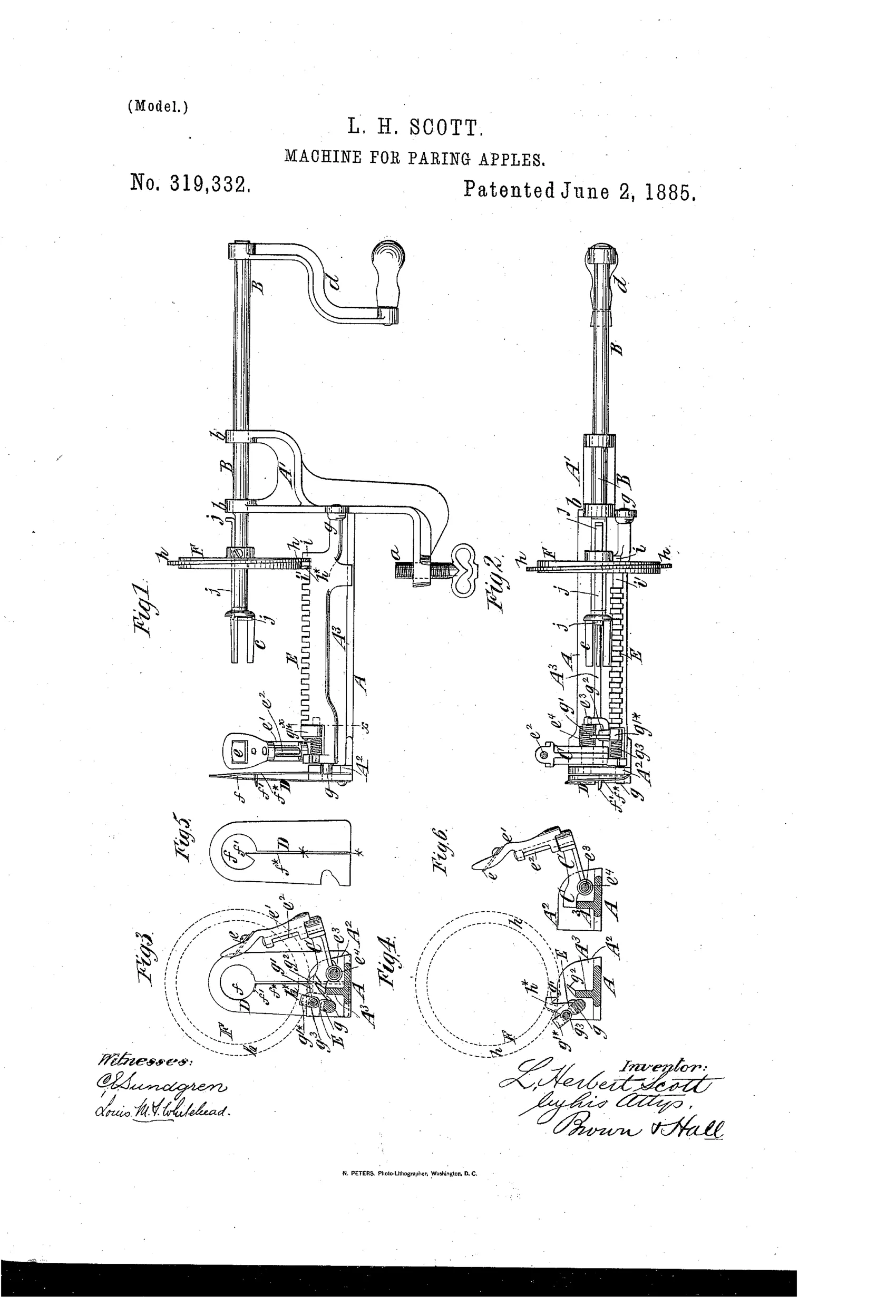
Hand-cranked apple paring, coring, and slicing machine
❧ How it works
An apple is impaled on a fork at the end of a hand-cranked spindle mounted in a cast frame. A screw-thread cam disk on the spindle engages a pivoted rack, feeding the spindle and apple forward past a swinging, spring-loaded paring knife while a combined coring and slicing knife cuts a cylindric core and a spiral shaving. An isolated tooth on the rack lets the spindle be turned briefly to hold the apple in place before feeding begins, and a latch releases the rack at the end of the stroke so the pusher can push the finished core off the fork.
❧ What was claimed
“The combination, with a fork-spindle provided with a disk, F, having upon it a screw-thread cam, of a rack, with which said cam engages for feeding the spindle along, and which is provided with an isolated tooth, with which said cam may be engaged for holding the spindle while placing an apple upon the fork, substantially as and for the purpose herein described.”
In plain English: The invention combines a spindle with a screw-cam disk and a feed rack having one isolated tooth so the cam can hold the spindle steady while an apple is loaded before the rack feeds it forward.
❧ In the inventor’s words
“The object of my invention is to increase the facility which machines of this kind afford for rapid work, as a few seconds of time saved in the paring of each apple is a matter of importance where the machines are in constant use.”— L. Herbert Scott, from the specification
Fate unknown
No production machine matching this design is documented in DATAMP or collector literature; a marked surviving example would settle it.
❧ Commentary
Screw-feed parers — where the apple travels forward on its spindle past a stationary knife — all share an awkward moment: while you're jamming an apple onto the fork, the spindle wants to wander or spin. Scott's answer is quietly elegant. His feed rack carries one isolated tooth, and the screw-thread cam on the spindle disk can be parked against it. Turn the crank a fraction and the apple seats firmly on the fork while everything holds still; only then does the cam pick up the full rack and start the feed. His stated goal was saving 'a few seconds of time' per apple, which tells you he was thinking about commercial paring rooms, not the family kitchen.
The rest is a competent parer-corer-slicer of the mid-1880s type: the coring knife takes a cylindrical core while a companion blade cuts a continuous spiral shaving, and a latch drops the rack at stroke's end so a pusher can shove the finished core off. Fig. 5, the flat blank for the coring-and-slicing knife, is the manufacturing tell — Scott had thought about how this piece would actually be stamped and rolled, not just how it looks in section.
By 1885 the field was crowded and Reading and Goodell already owned the market. This is a refinement, not a revolution, but the loading detent is a genuinely good idea that most competitors never bothered with.
Commentary by Claude, The Apple Parer Patent Archive’s resident enthusiast