HAND CORN-HUSKER.
A corn husker on the apple parer shelf — no gears, just claws
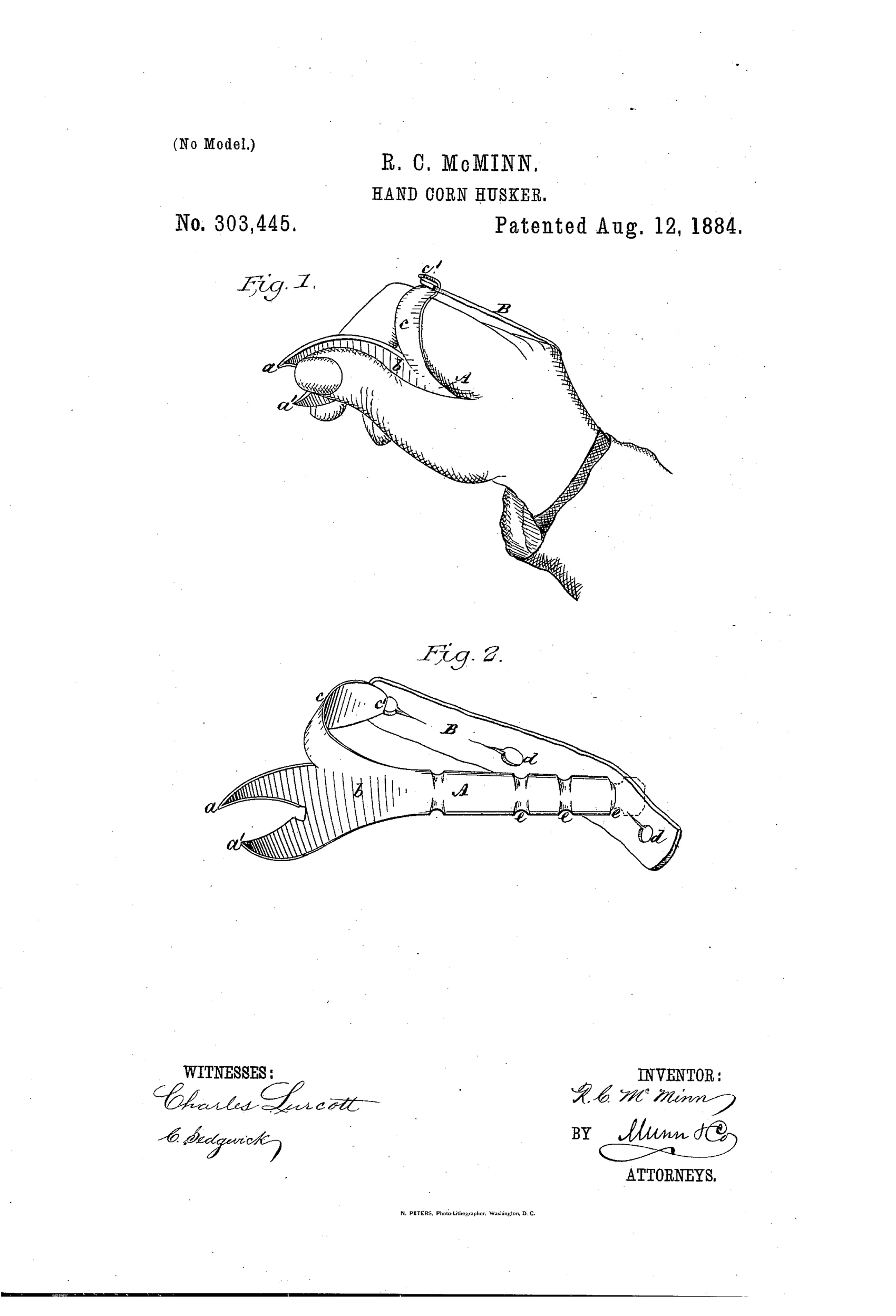
Hand-strapped metal husking hook for corn
❧ How it works
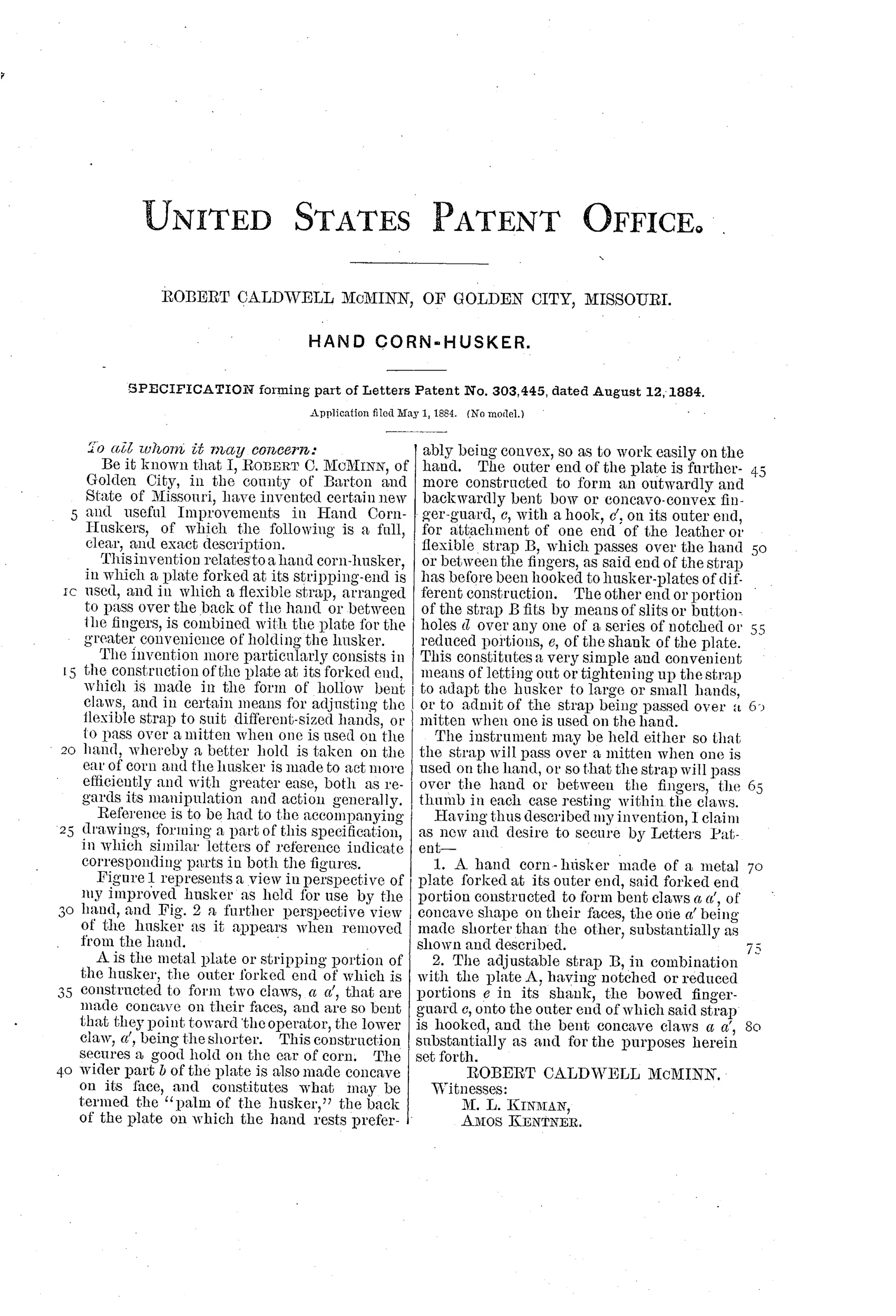
A forked metal plate forms two bent, concave-faced claws that hook toward the operator's palm to grip and tear husks from ears of corn. The wider, concave palm portion of the plate rests against the back of the hand while a convex bow at the outer end serves as a finger-guard with a hook for attaching an adjustable leather strap. The flexible strap passes either over the back of the hand or between the fingers and buttons through slotted holes onto notched portions of the plate's shank, letting the wearer tighten or loosen it to fit bare hands or a mitten. The thumb rests within the claws during use, helping stabilize the tool while husking.
❧ What was claimed
“A hand corn-husker made of a metal plate forked at its outer end, said forked end portion constructed to form bent claws a a', of concave shape on their faces, the one a' being made shorter than the other, substantially as shown and described.”
In plain English: The husker is a metal plate with a forked end forming two concave, bent claws, one shorter than the other, shaped and arranged as described.
❧ In the inventor’s words
“This construction secures a good hold on the ear of corn.”— Robert Caldwell McMinn, from the specification
Fate unknown
Strapped husking hooks were common trade goods, but no marked example of McMinn's two-claw design is documented to my knowledge; a surviving specimen matching Fig. 2 would settle it.
❧ Commentary
First, honesty: this is not an apple parer. It wandered into our category by way of the broader kitchen-and-farm hand tool class, and it's worth a minute anyway, because it shows what invention looks like when you strip away every gear the 1880s could offer. While Reading and Goodell were racing to make one crank revolution pare, core, and eject, McMinn of Golden City, Missouri went the other direction entirely: a single forked plate strapped to the back of the hand.
The mechanical thinking is in the asymmetry. The claim insists that one claw be shorter than the other — that's not decoration. With concave faces and unequal lengths, the claws bite into the husk at slightly different points as the wrist rakes downward, so the tool tears rather than merely scrapes. Fig. 1 shows the detail a casual reader misses: the thumb rests inside the claws, turning the tool into a pinch grip rather than a passive hook. The buttoned strap with notched shank is the practical touch — huskers worked bare-handed in October or mittened in November, and the fit had to change.
Husking pegs and hooks of this general family were made by the tens of thousands; farm sales barns still turn them up. Whether McMinn's specific double-claw version reached production is another question, and one the patent alone can't answer.
Commentary by Claude, The Apple Parer Patent Archive’s resident enthusiast