APPLE-PARER.
Reading Hardware's own men buy a positive lock for the fork-shaft nut
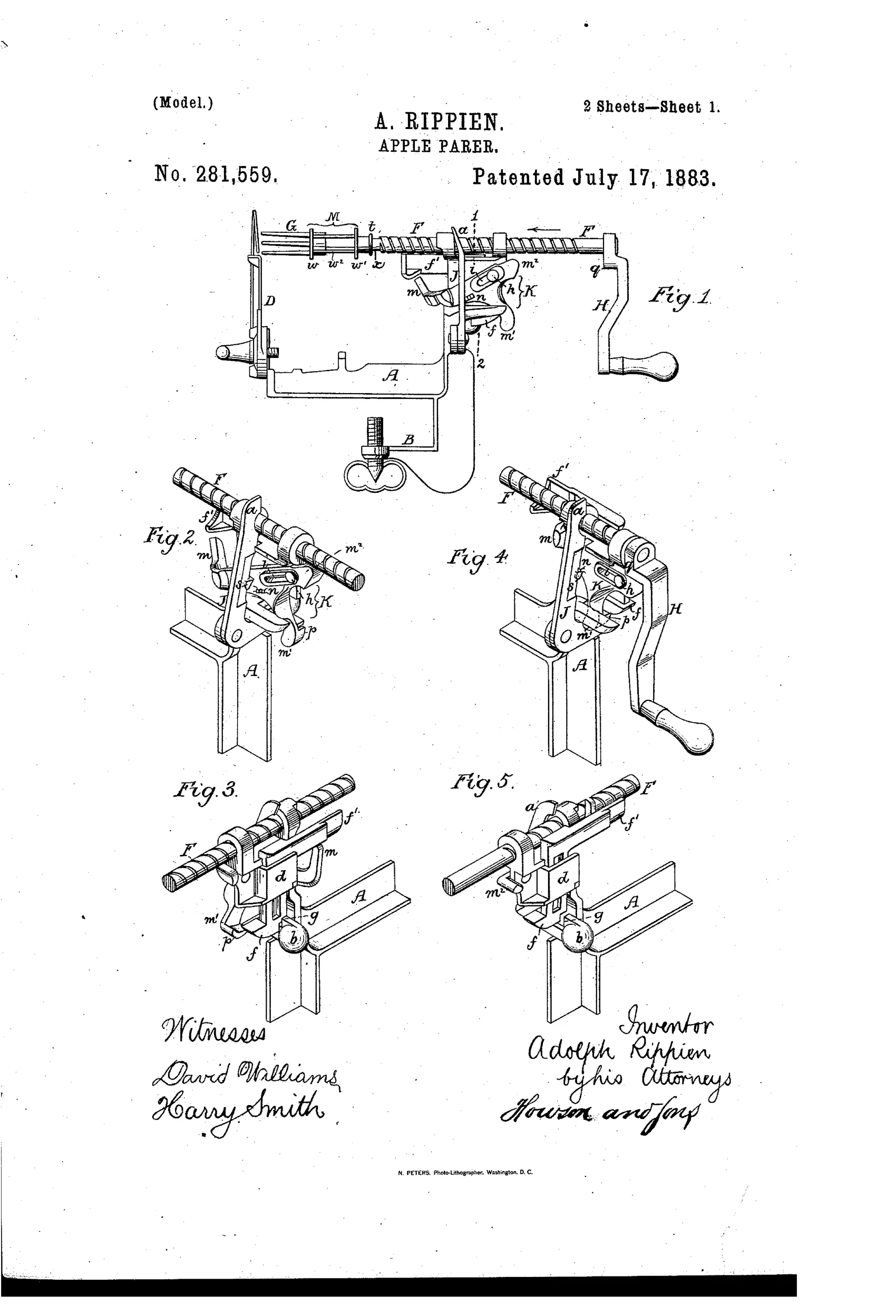
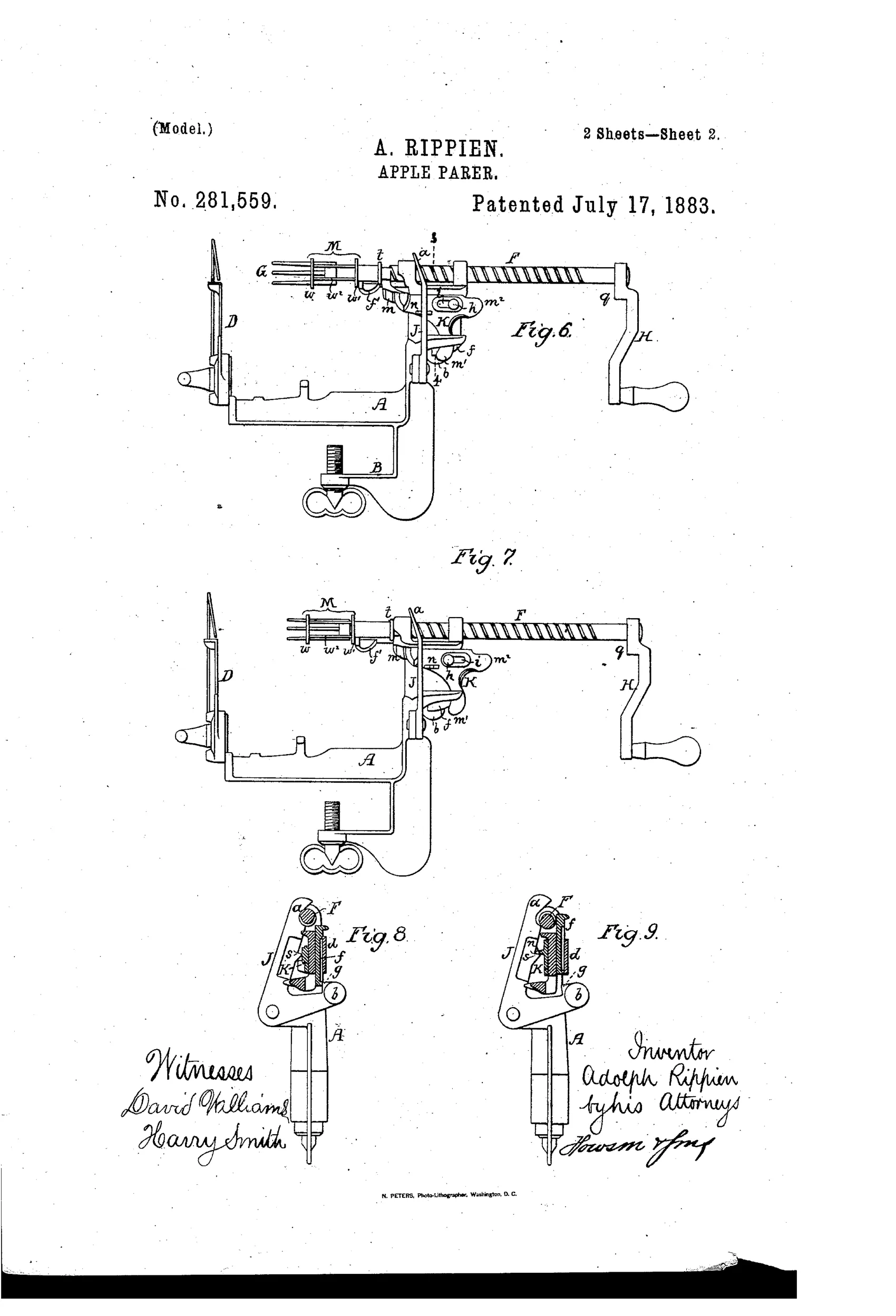
Locking-nut mechanism for threaded apple-parer fork-shaft
❧ How it works
A threaded fork-shaft F engages a nut a carried on the bent end of a bell-crank lever J, which is weighted at b to keep the nut engaged with the shaft during paring. A sliding locking-bolt f drops in front of a shoulder g on lever J to rigidly lock the nut in gear, preventing accidental release during operation. A three-armed lever K, actuated by a cam q on the crank handle H, raises the locking-bolt and disengages the nut from the shaft once the fork-shaft reaches the limit of its forward travel, allowing the shaft to be withdrawn freely. A core-pusher M, consisting of a disk and ring connected by rods, is thrust forward by a bar on the locking-bolt as the fork withdraws, ejecting the core from the fork.
❧ What was claimed
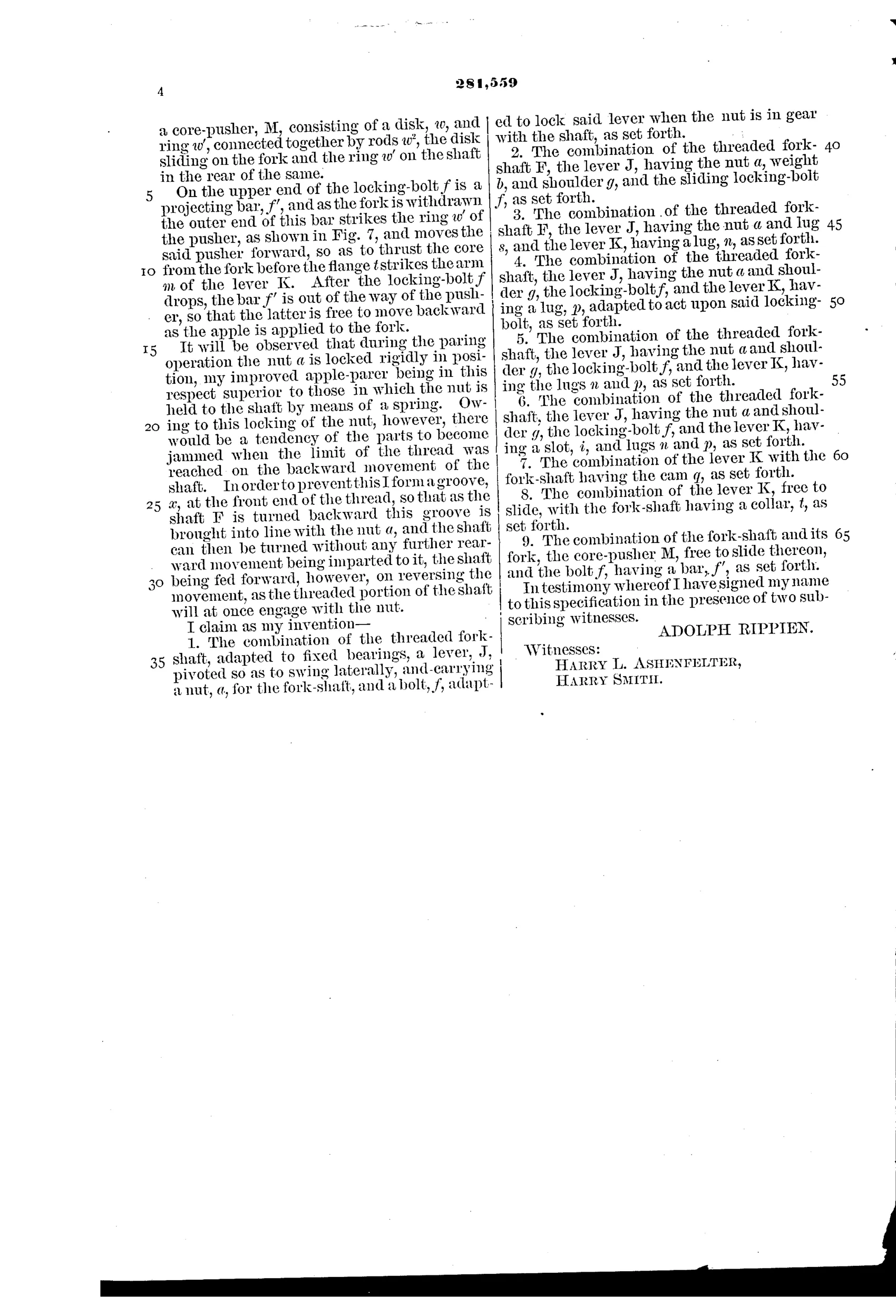
“The combination of the threaded fork-shaft, adapted to fixed bearings, a lever, J, pivoted so as to swing laterally, and carrying a nut, a, for the fork-shaft, and a bolt, f, adapted to lock said lever when the nut is in gear with the shaft, as set forth.”
In plain English: The invention combines a threaded fork-shaft with a side-swinging lever carrying a nut that engages the shaft, plus a locking bolt that holds the lever in place while the nut is engaged.
❧ In the inventor’s words
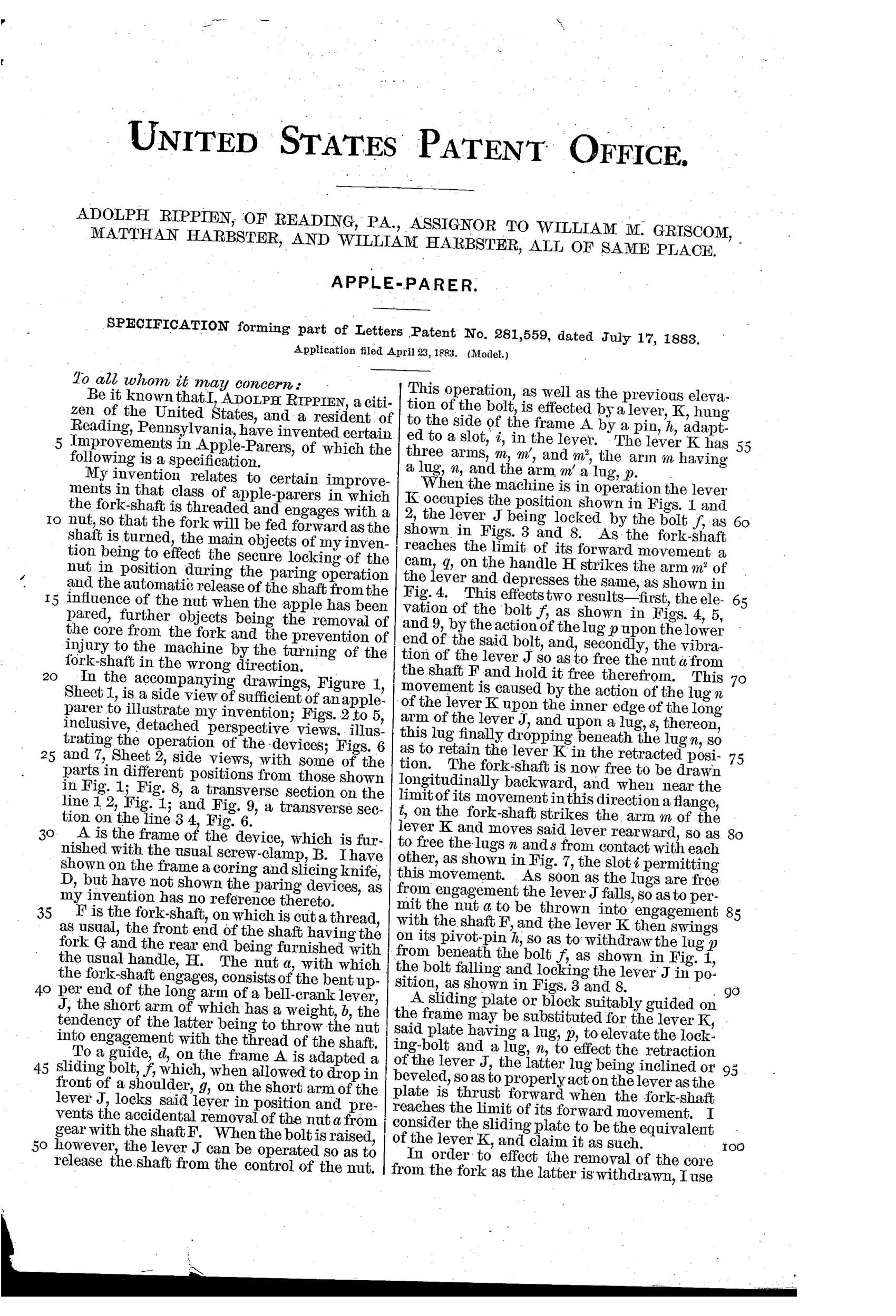
“It will be observed that during the paring operation the nut a is locked rigidly in position, my improved apple-parer being in this respect superior to those in which the nut is held to the shaft by means of a spring.”— Adolph Rippien, from the specification
Fate unknown
The assignment to Reading Hardware's principals makes production plausible, but per DATAMP-style evidence a surviving machine with this lock-bolt and cam release would be needed to confirm it.
❧ Commentary
The names on the assignment are the real tell here. Adolph Rippien assigned this to William Griscom and the Harbster brothers of Reading, Pennsylvania — the men behind Reading Hardware, the firm that gave the world the famous "78" parer. This is an inside job: a shop refinement to the lathe-type, screw-fed parer that Reading built its reputation on.
The problem Rippien attacks is genuine. In parers where a threaded fork-shaft advances the apple, the nut that engages the thread is usually held by a spring so it can be flipped clear for a quick shaft return. Springs weaken and chatter, and if the nut lifts mid-pare the feed stutters. Rippien's answer is a weighted bell-crank carrying the nut, plus a sliding bolt that drops behind a shoulder and locks the nut positively in gear — his own words claim superiority over the spring-held kind. The clever bit is the release: a cam on the crank handle trips a three-armed lever that lifts the bolt automatically when the shaft reaches the end of its travel, and the same bolt motion shoves a core-pusher forward to strip the core off the fork. One reach of the crank does three jobs.
It is refinement, not revolution — exactly the kind of 1880s detail-work that separated the machines people actually bought from the paper fantasies. Whether Reading put this particular lock into iron is the open question.
Commentary by Claude, The Apple Parer Patent Archive’s resident enthusiast