POTATO-PEELING MACHINE
Moffat holds the potato still and sends the whole machine spinning around it
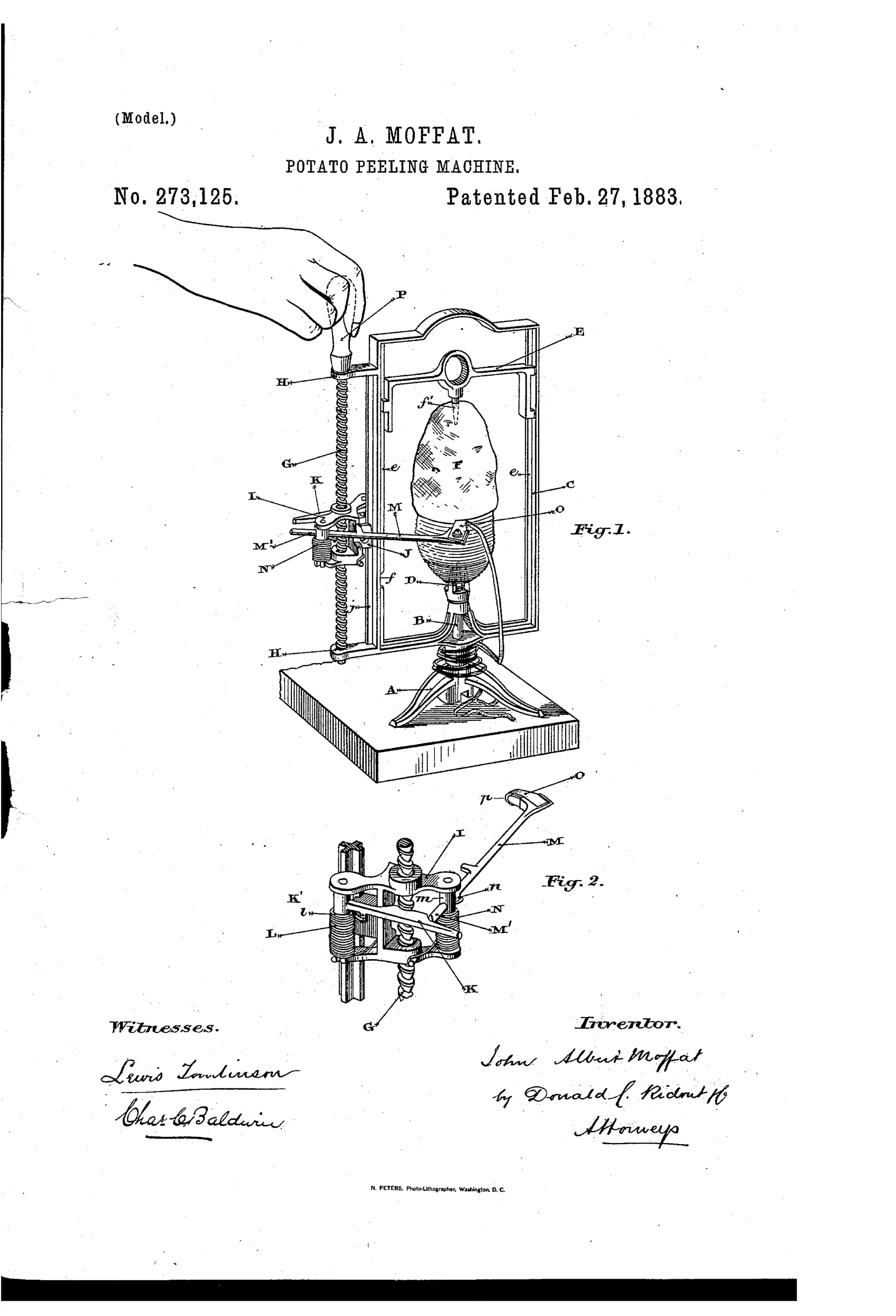
Hand-cranked machine for peeling potatoes with rotating knife.
❧ How it works
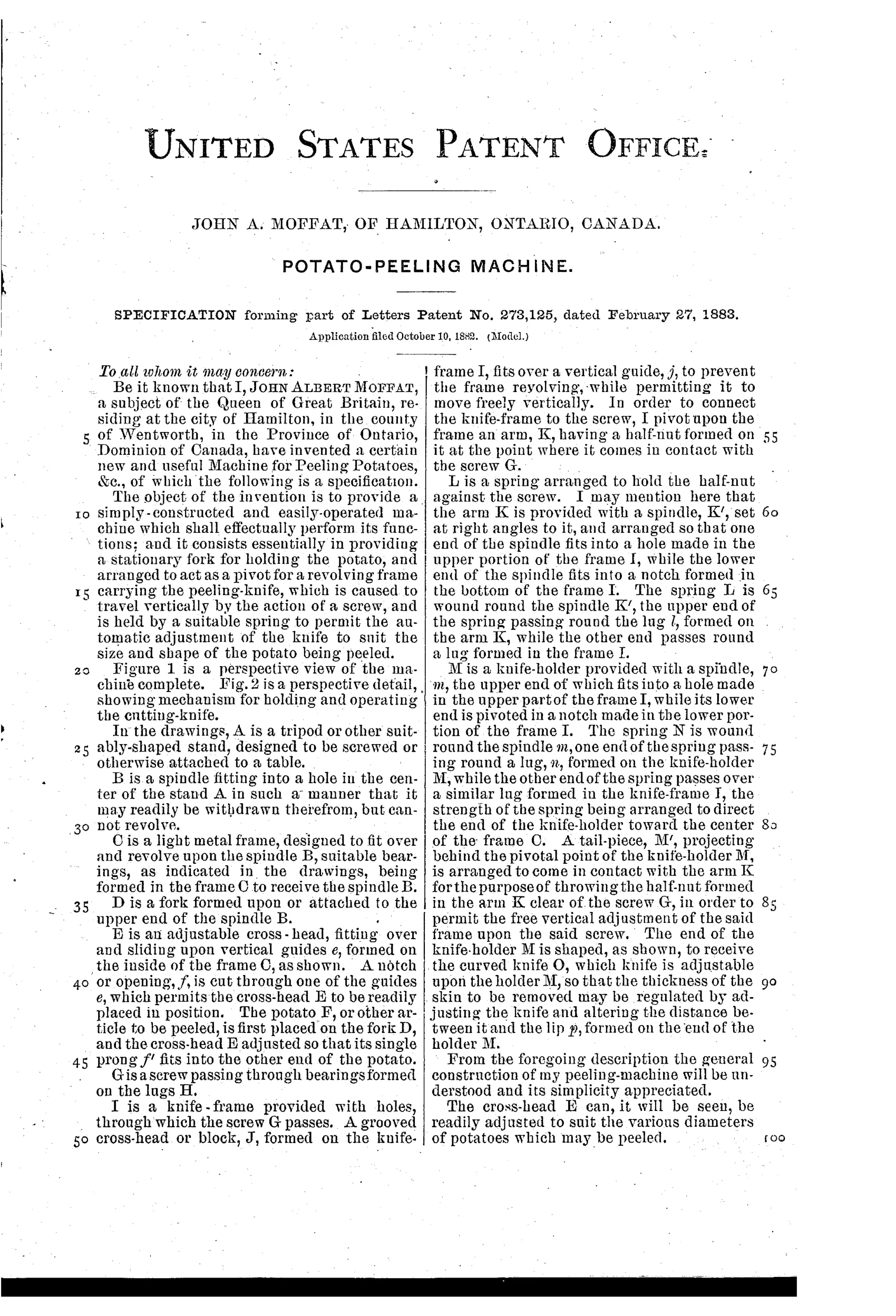
A potato is speared on a stationary fork mounted atop a fixed spindle rising from a tripod stand. A revolving frame fits over this spindle and carries a vertically-adjustable knife-holder driven by a screw shaft, so that turning the frame by its handle causes the curved knife to travel spirally around the potato, cutting off the skin. A half-nut arm engages the screw to advance the knife-frame vertically, while a spring keeps the knife pressed against the potato surface to accommodate irregular shapes. When peeling is finished, the knife-holder is thrown back to disengage the half-nut, allowing the frame to be dropped freely back to its starting position for the next potato.
❧ What was claimed
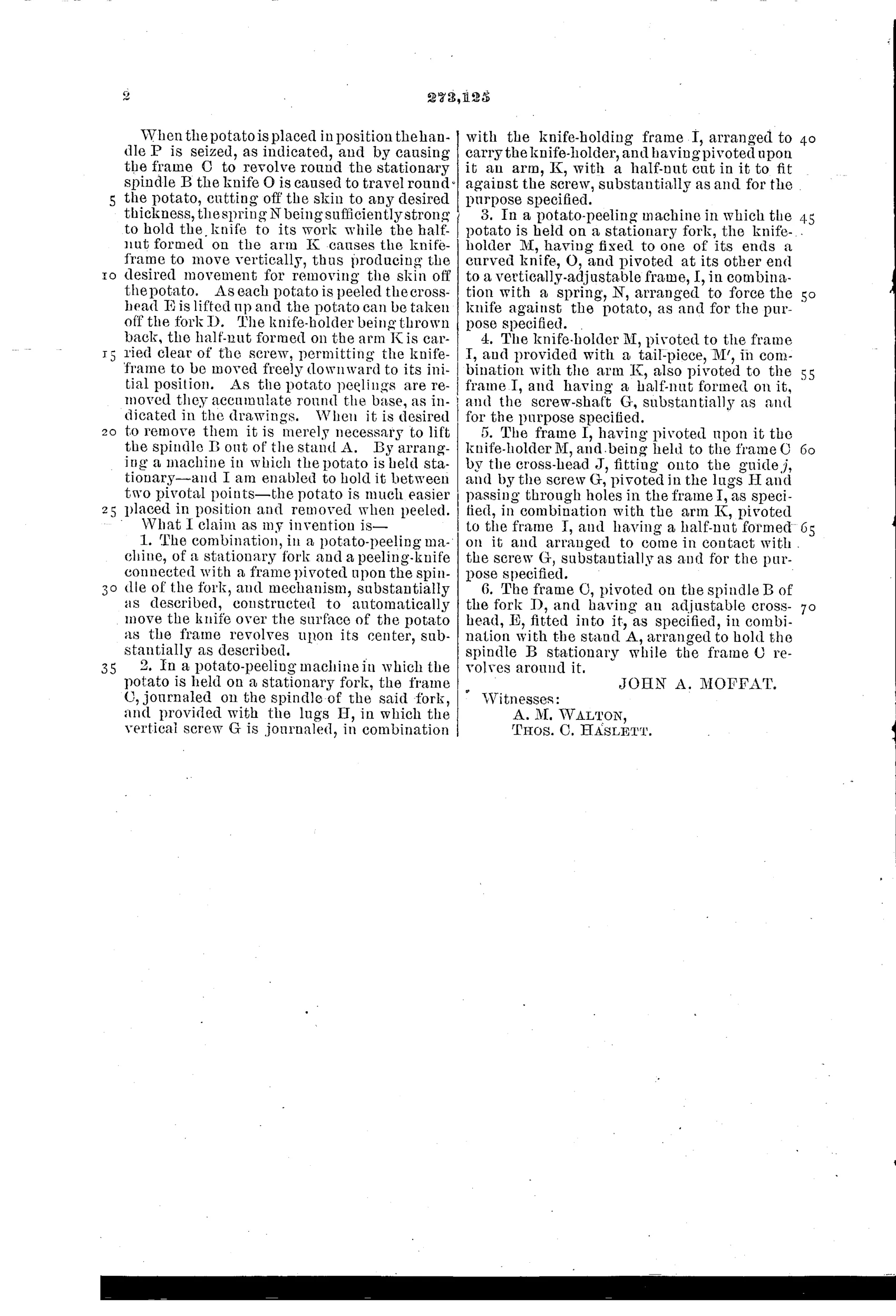
“The combination, in a potato-peeling machine, of a stationary fork and a peeling-knife connected with a frame pivoted upon the spindle of the fork, and mechanism, substantially as described, constructed to automatically move the knife over the surface of the potato as the frame revolves upon its center, substantially as described.”
In plain English: The invention combines a fixed fork holding the potato with a knife mounted on a rotating frame that automatically moves the blade over the potato's surface as the frame turns.
❧ In the inventor’s words
“By arranging a machine in which the potato is held stationary—and I am enabled to hold it between two pivotal points—the potato is much easier placed in position and removed when peeled.”— John Albert Moffat, from the specification
Fate unknown
No production version or surviving example is documented in the usual collector references; a marked specimen would settle it.
❧ Commentary
Most parers in this category do the obvious thing: spin the fruit against a blade that stays more or less put. Moffat, working from Hamilton, Ontario, flips the arrangement completely. His potato sits dead still on a fork atop a fixed spindle, and the entire knife-carrying frame revolves around it, climbing a screw shaft as it goes so the blade traces a spiral up the tuber. His own justification is the interesting part — a stationary potato is 'much easier placed in position and removed when peeled,' and can be held between two pivot points rather than whipped around on a fork it might fly off of. For a lumpy, heavy potato rather than a tidy apple, that logic holds up.
The half-nut is the clever detail a casual reader will miss. The knife-holder engages a split nut on the screw to feed upward during peeling; throw the holder back and the nut disengages, letting the frame drop straight down to the start — no cranking in reverse. That's the same quick-return thinking the apple-parer men were chasing with segment gears in the same decade, solved here with a lathe-shop trick instead. The spring-loaded blade to follow irregular contours is standard practice by 1883, but necessary for potatoes.
The drawback is equally plain in Fig. 1: you're swinging a tall frame around a tripod on your countertop, which is more machine than most kitchens wanted for a job a paring knife did in seconds. Honest, well-worked engineering pointed at a market that never quite materialized for mechanical potato peelers.
Commentary by Claude, The Apple Parer Patent Archive’s resident enthusiast