CORN-HUSKING IMPLEMENT.
A finger-worn husking peg from Kansas — the parer's field-side cousin
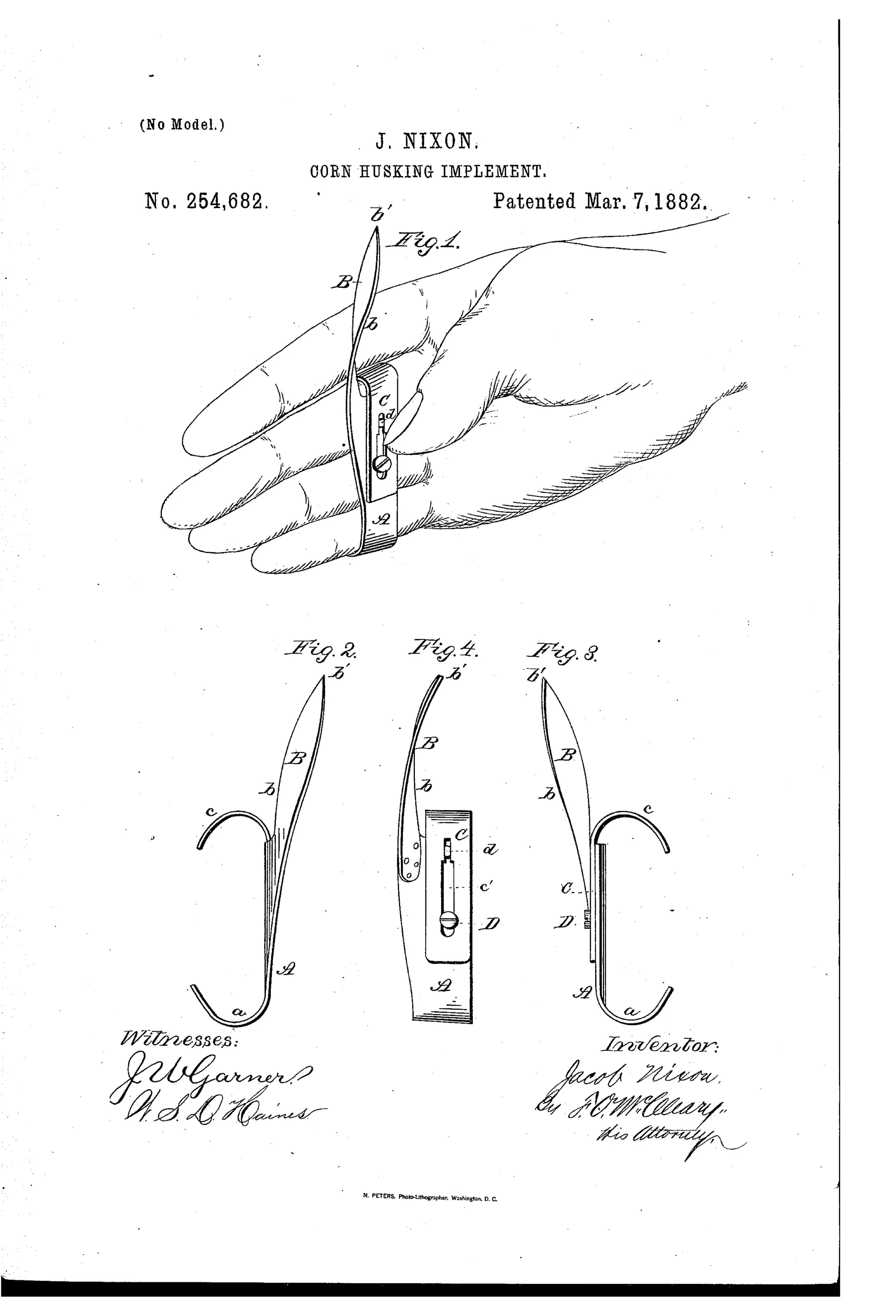
Finger-worn hand implement for husking corn
❧ How it works
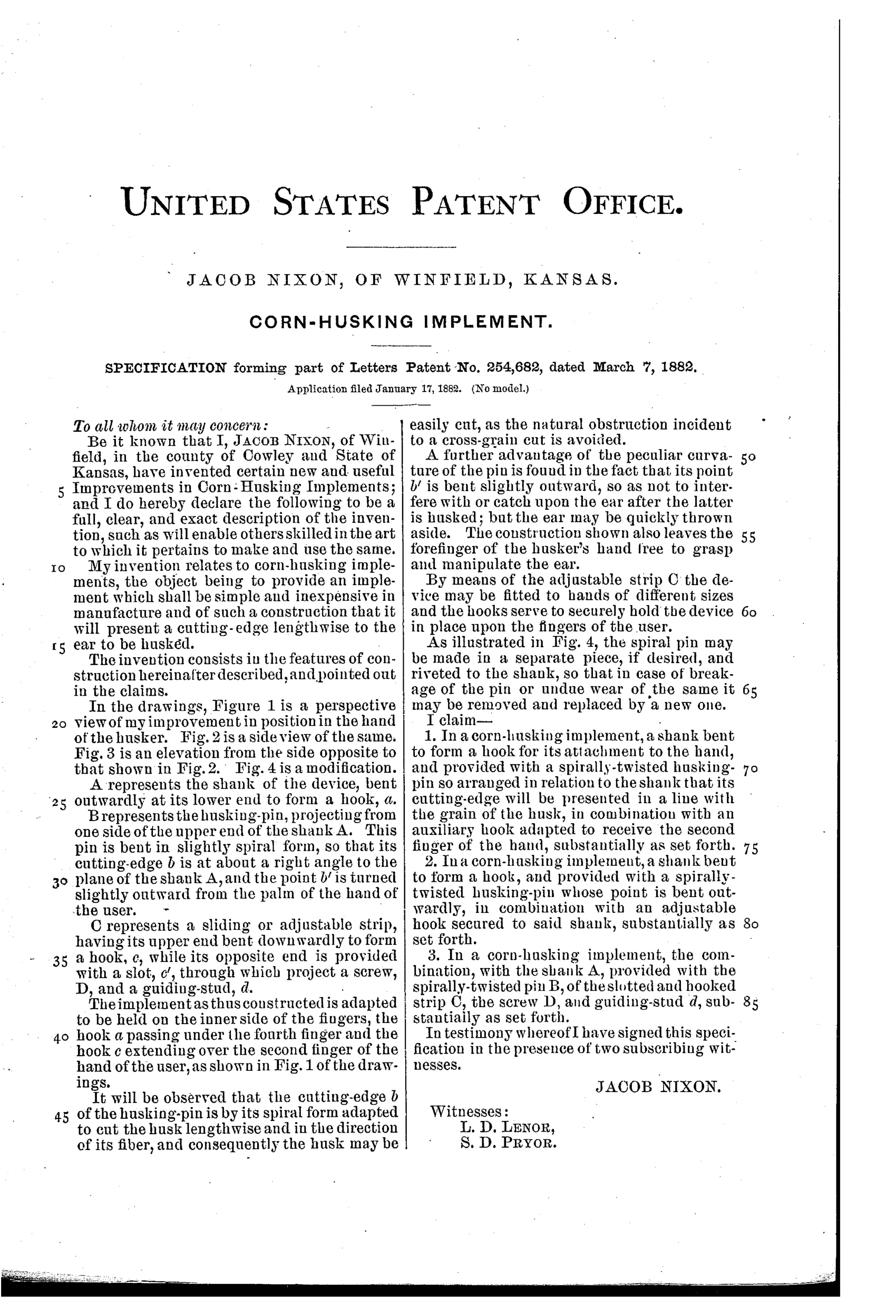
A shank A is bent outward at its lower end to form a hook a that passes under the fourth finger. A husking-pin B projects from the upper end of the shank in a slightly spiral form, presenting its cutting edge in line with the grain of the husk. An adjustable strip C, secured by a screw D and guiding-stud d through a slot c', has a hooked upper end c that extends over the second finger, allowing the device to be fitted to hands of different sizes. In a modification (Fig. 4) the spiral pin is made as a separate piece riveted to the shank so it can be replaced if broken or worn.
❧ What was claimed
“In a corn-husking implement, a shank bent to form a hook for its attachment to the hand, and provided with a spirally-twisted husking-pin so arranged in relation to the shank that its cutting-edge will be presented in a line with the grain of the husk, in combination with an auxiliary hook adapted to receive the second finger of the hand, substantially as set forth.”
In plain English: A finger-worn husking tool with a hook that attaches to one finger and a spirally twisted cutting pin aligned with the husk's grain, plus a second hook for another finger.
❧ In the inventor’s words
“It will be observed that the cutting-edge b of the husking-pin is by its spiral form adapted to cut the husk lengthwise and in the direction of its fiber, and consequently the husk may be easily cut, as the natural obstruction incident to a cross-grain cut is avoided.”— Jacob Nixon, from the specification
Fate unknown
Husking pegs of this general type were manufactured widely, but no example matching Nixon's specific adjustable two-hook design is documented to us; a marked specimen would settle it.
❧ Commentary
Full disclosure: this one strayed into our collection from the cornfield, not the orchard. But it earns its place here because Jacob Nixon of Winfield, Kansas is chasing exactly the problem our parer inventors chased — how a blade should meet plant fiber. His whole claim turns on the husking pin being spirally twisted so its cutting edge lies parallel with the grain of the husk. His own words say it best: a cross-grain cut fights you, a with-the-grain cut doesn't. That's the same instinct that made lathe-type parer blades pivot and skew rather than scrape square-on.
The drawing is worth a slow look. Fig. 1 shows the fit: a hooked shank passing under the fourth finger, and an adjustable strip C — slotted, with a screw and guide stud — hooking over the second finger, so one casting fits different hands. Fig. 4 shows the practical touch a farmer would appreciate: the spiral pin made as a separate riveted piece, replaceable when it wears or snaps mid-harvest.
Husking pegs and hooks were made by the hundreds of thousands in this era — corn was husked by hand well into the twentieth century, and patented pegs were a crowded field of their own. Nixon's two-finger, adjustable-strap version is a plausible, workmanlike entry in that crowd. Whether his particular pattern reached a hardware counter is another question.
Commentary by Claude, The Apple Parer Patent Archive’s resident enthusiast