HAND CORN-HUSKER.
Not an apple parer at all — a husking peg you hammer to fit your hand
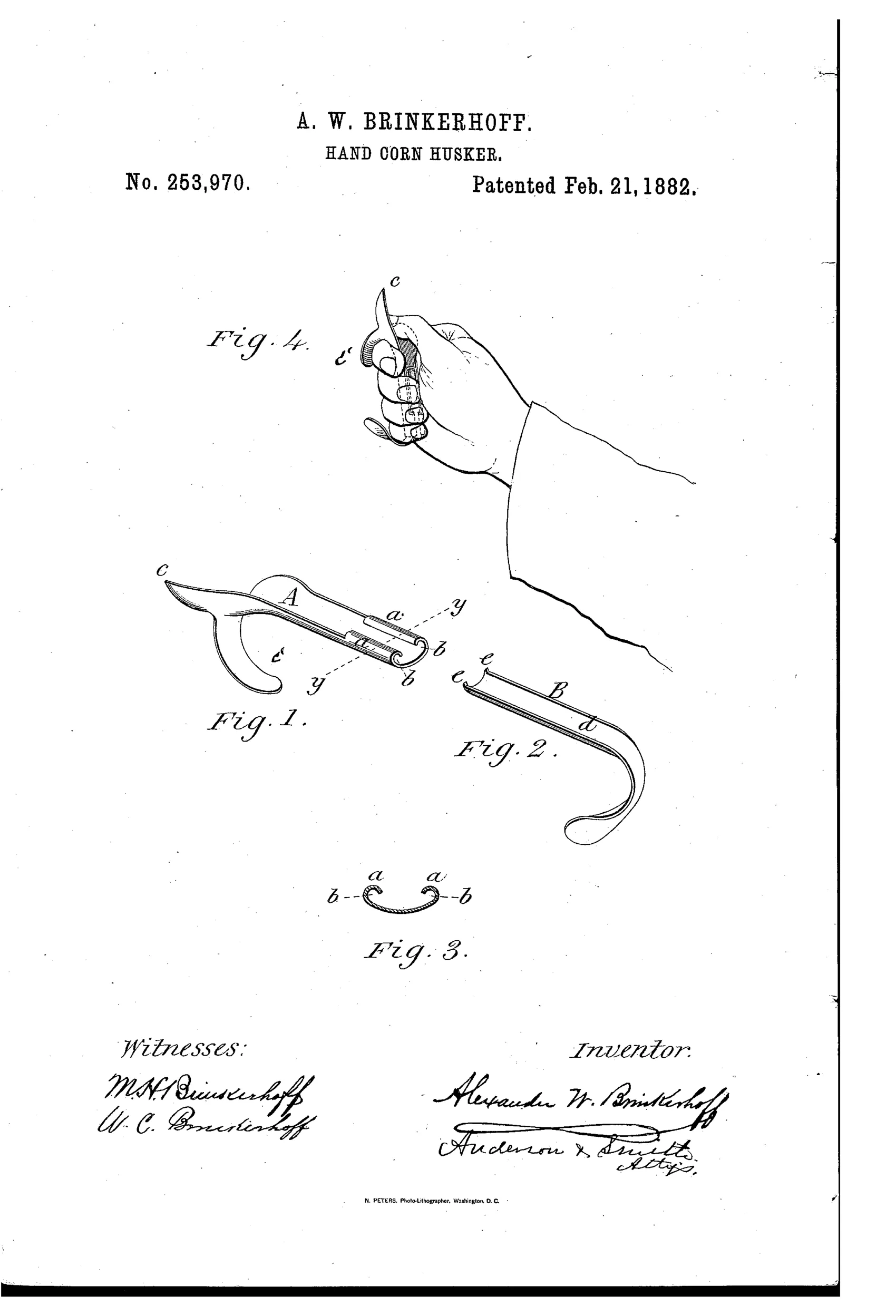
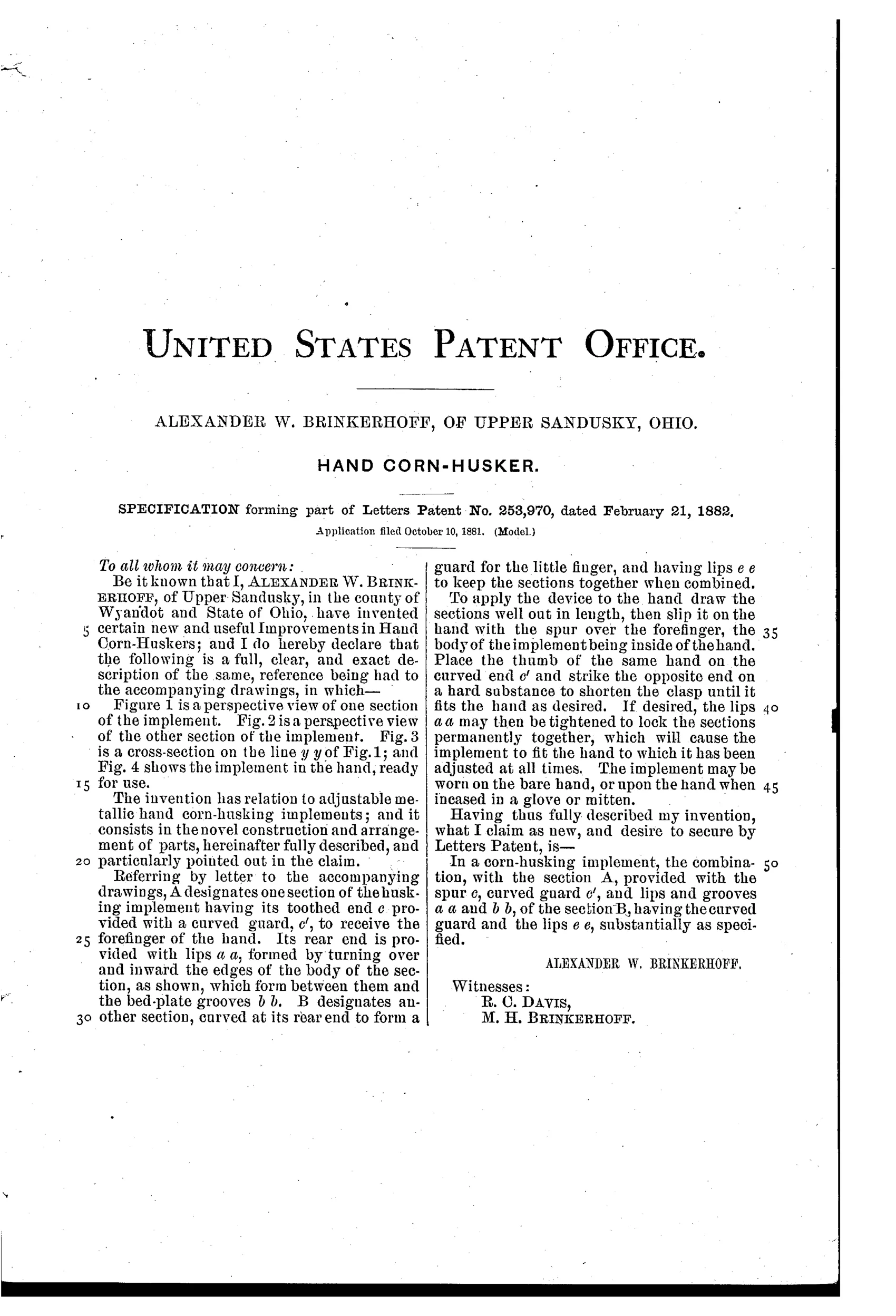
Adjustable metal hand corn-husking peg
❧ How it works
The implement consists of two metallic sections, A and B, that slide together and are locked in position by lips and grooves. Section A has a toothed spur c with a curved guard c' to fit over the forefinger, while section B curves at its rear to form a guard for the little finger. The device is drawn out in length, slipped onto the hand, and then shortened by striking the curved end against a hard surface until it fits snugly. Once adjusted, the lips a a can be tightened to permanently lock the sections together so the tool retains the wearer's hand size.
❧ What was claimed
“In a corn-husking implement, the combination, with the section A, provided with the spur c, curved guard c', and lips and grooves a a and b b, of the section B, having the curved guard and the lips e e, substantially as specified.”
In plain English: The patent covers a two-part corn husker where one piece with a toothed spur and locking grooves fits together with a second curved piece with matching lips, so the whole tool can be adjusted and locked to fit the user's hand.
❧ In the inventor’s words
“The implement may be worn on the bare hand, or upon the hand when incased in a glove or mitten.”— Alexander W. Brinkerhoff, from the specification
Fate unknown
Husking pegs were made in enormous quantities and Brinkerhoff-marked hooks are known to farm-tool collectors, but a surviving two-piece adjustable example matching this drawing would settle whether this specific design reached production.
❧ Commentary
Let's be upfront: this one wandered into our category by accident. It's a hand corn-husker, not a fruit peeler — but it earns a moment of attention because it solves a fitting problem with pure blacksmith logic. The tool is two curved metal sections that telescope together, one carrying a toothed spur over the forefinger, the other hooking around the little finger. To size it, you pull it out long, slip it on, then whack the curved end against a post until it snugs down onto your own hand. Adjustment by percussion. Once it fits, the interlocking lips can be crimped tight and the tool is permanently yours.
That's actually a shrewd bit of design for 1882. Husking pegs were sold by the barrel and hands come in every size; most makers just offered small, medium, and large. Brinkerhoff's answer — let the buyer forge-fit it in ten seconds — cuts inventory to one SKU. His specification even allows for wearing it over a mitten, which anyone who has husked corn in an Ohio November will appreciate.
For readers here for gear trains and pivoting blade arms, there's nothing of that sort. But it's a nice reminder that the same 1880s hardware culture that gave us the Reading '78 was also churning out humbler hand tools, and the good ones share a trait: the ingenuity is in fit and adjustment, not ornament.
Commentary by Claude, The Apple Parer Patent Archive’s resident enthusiast