PEELING AND SHREDDING DEVICE
Pull the shaft, spin the blade: one peeler for either hand, either job
Reversible hand tool for peeling or shredding vegetables
❧ How it works
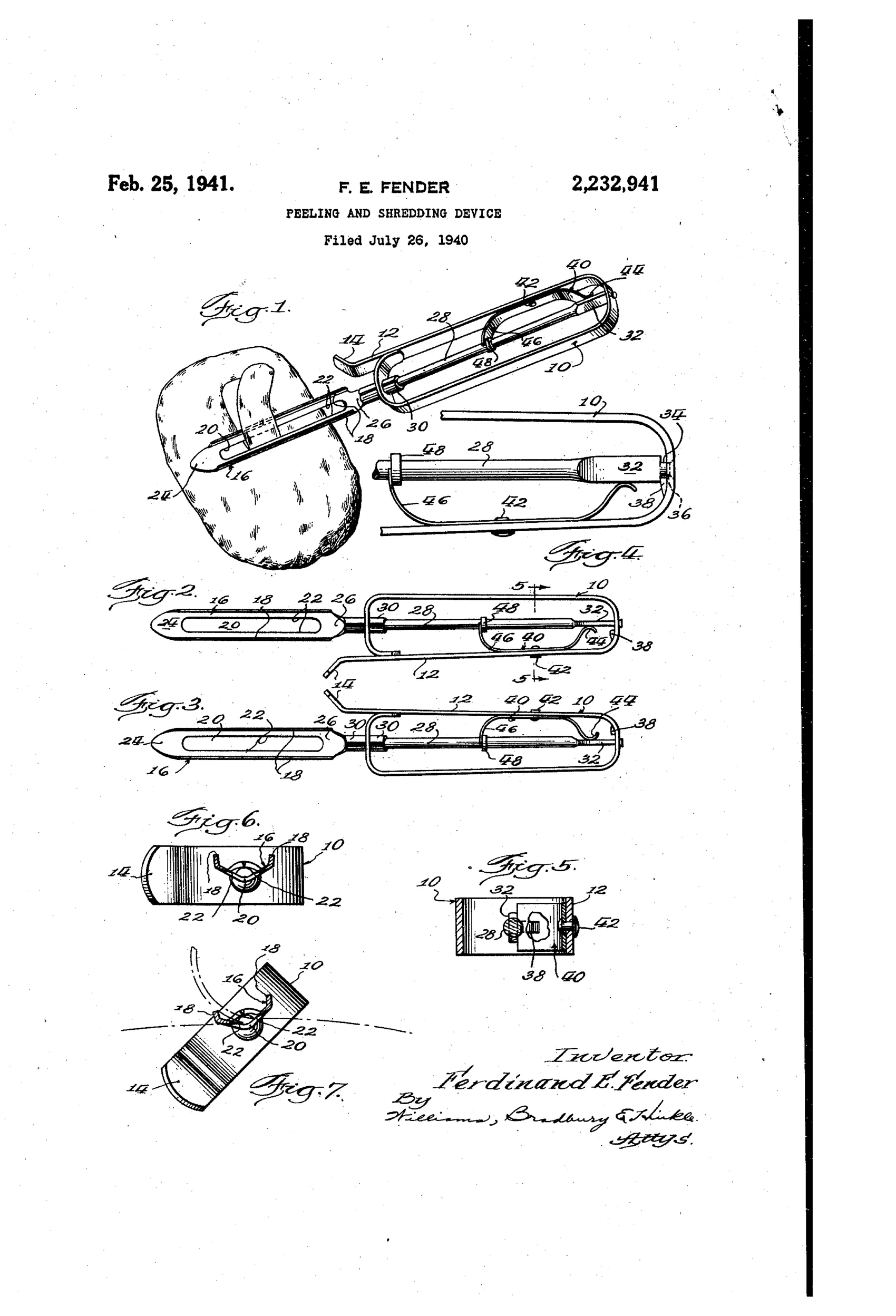
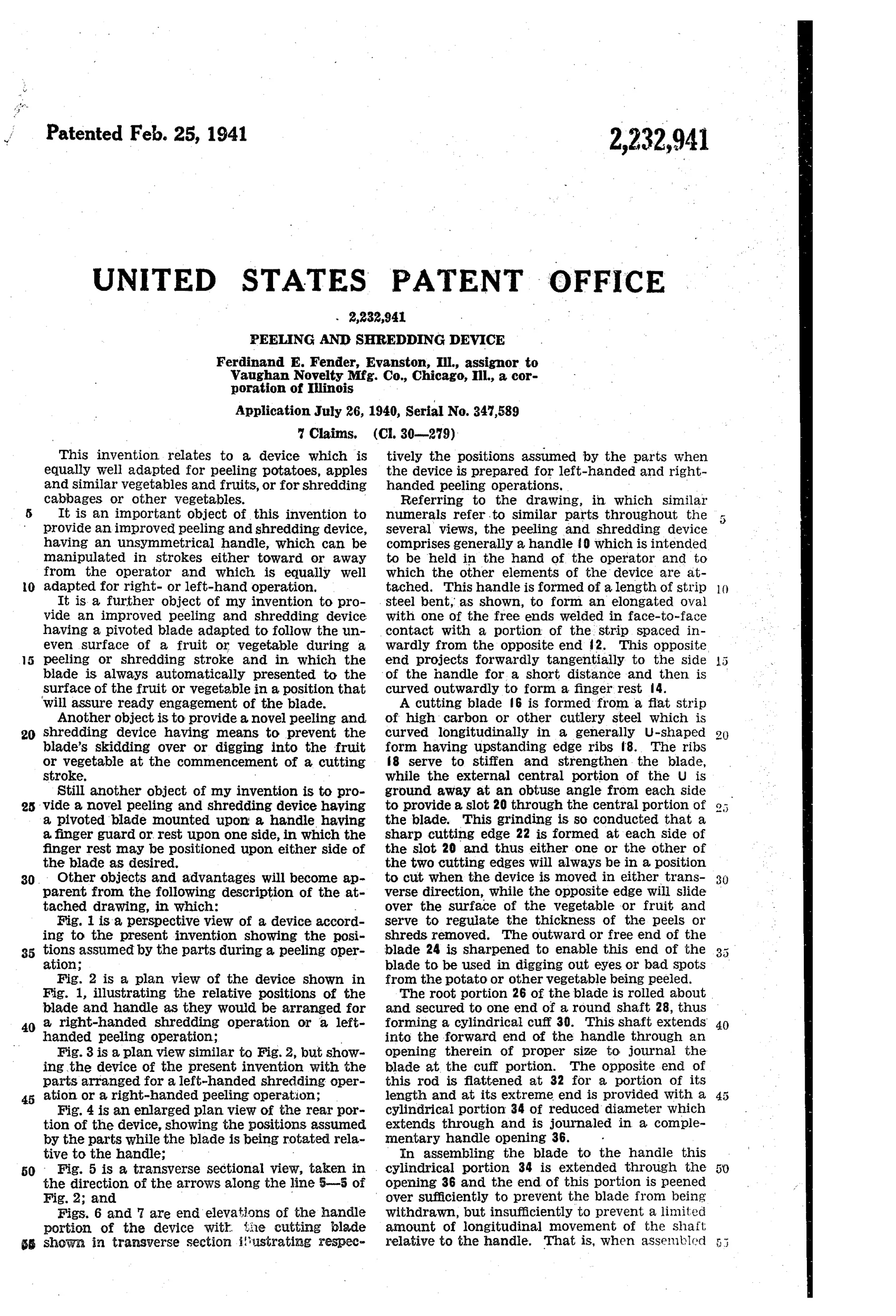
A U-shaped cutting blade is riveted to a round shaft that is journaled for rotation and limited axial sliding within an oval strip-steel handle. A stop on the handle cooperates with a flattened portion of the shaft to restrict rotation to less than 180 degrees when the blade is pushed inward, while pulling the shaft outward clears the stop and allows the blade to be freely rotated a full revolution to reverse the cutting edge for peeling or shredding. A flat spring riveted inside the handle bears against the flattened shaft portion, resiliently returning the blade to its working position and to a mid-position between the rotational limits after each stroke. The unsymmetrical handle includes a finger rest formed by bending one welded end of the strip outward, which can be gripped by the forefinger for peeling or the thumb for shredding, making the tool usable in either hand and for either operation.
❧ What was claimed
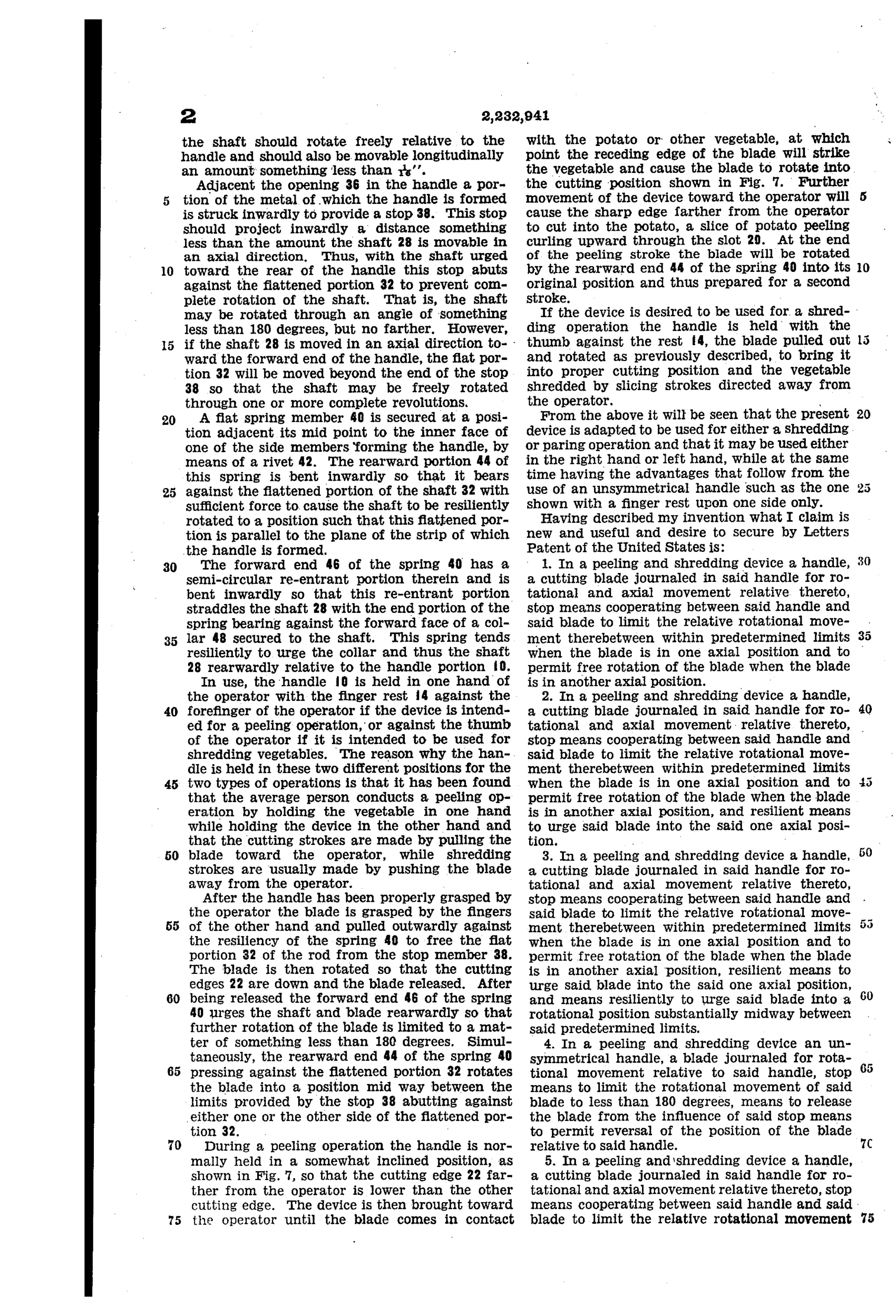
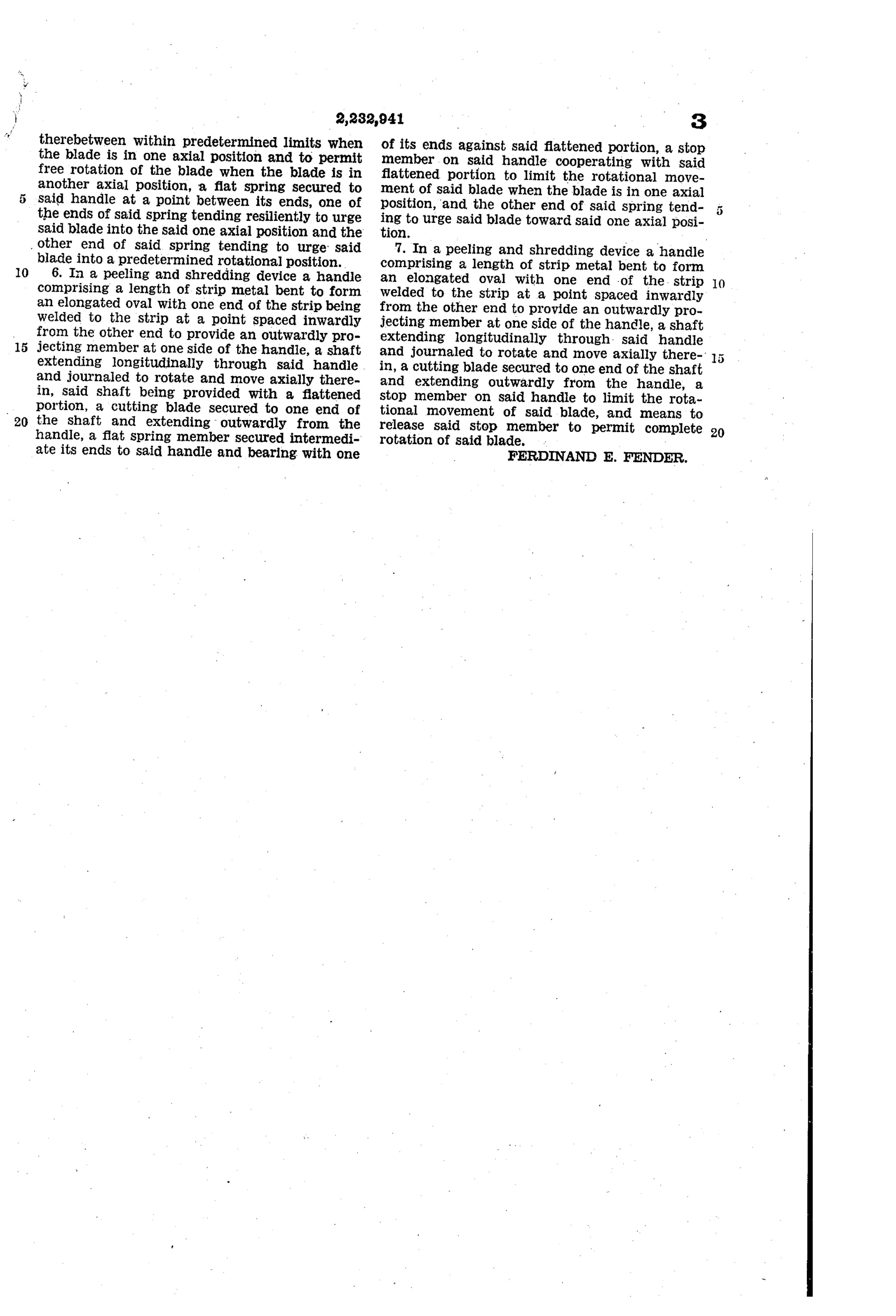
“In a peeling and shredding device a handle, a cutting blade journaled in said handle for rotational and axial movement relative thereto, stop means cooperating between said handle and said blade to limit the relative rotational movement therebetween within predetermined limits when the blade is in one axial position and to permit free rotation of the blade when the blade is in another axial position, and resilient means to urge said blade into the said one axial position.”
In plain English: The blade can slide and rotate in the handle; a stop limits its rotation in one sliding position but allows free spinning in another, and a spring pulls it back to the limited position.
❧ In the inventor’s words
“From the above it will be seen that the present device is adapted to be used for either a shredding or paring operation and that it may be used either in the right hand or left hand, while at the same time having the advantages that follow from the use of an unsymmetrical handle such as the one shown with a finger rest upon one side only.”— Ferdinand E. Fender, from the specification
Fate unknown
Vaughan Novelty was an active Chicago kitchen-tool manufacturer and this design is cheap to produce, but I can't confirm this exact reversible mechanism shipped; a Vaughan-marked example with the pull-and-spin shaft would settle it.
❧ Commentary
By 1941 the clamp-on cast-iron parer's golden age was half a century gone, and the action had moved to stamped-steel hand tools that cost a dime and lived in every kitchen drawer. Fender's patent is squarely in that world — but it's a genuinely thoughtful piece of small-parts engineering, not just another swivel peeler.
The trick is in the shaft. The U-shaped blade rides on a round shaft with a flat ground on it. Pushed in, that flat hits a stop inside the strip-steel handle, so the blade can only rock through part of a turn — the familiar self-aligning swivel action that lets the edge follow a potato's contour. Pull the shaft out a fraction of an inch and the flat clears the stop: now the blade spins a full revolution, so you can flip the edge over and use the same tool for shredding, or reverse it for a left-handed grip. A single flat spring inside the handle does double duty, holding the shaft in its working position and centering the blade between its rocking limits after each stroke. Figs. 2 and 3 show the same tool set up right- and left-handed — the whole point of the exercise.
The asymmetric handle with its one bent-out finger rest is the tell that someone actually held prototypes: forefinger there for peeling, thumb for shredding. Assigned to Vaughan Novelty of Chicago, a real high-volume gadget maker, this is a production-minded design through and through — cheap stampings, one spring, two rivets.
Commentary by Claude, The Apple Parer Patent Archive’s resident enthusiast