Vegetable-Parer
A ratchet lets the cook dial blade pressure to match the vegetable's hardness
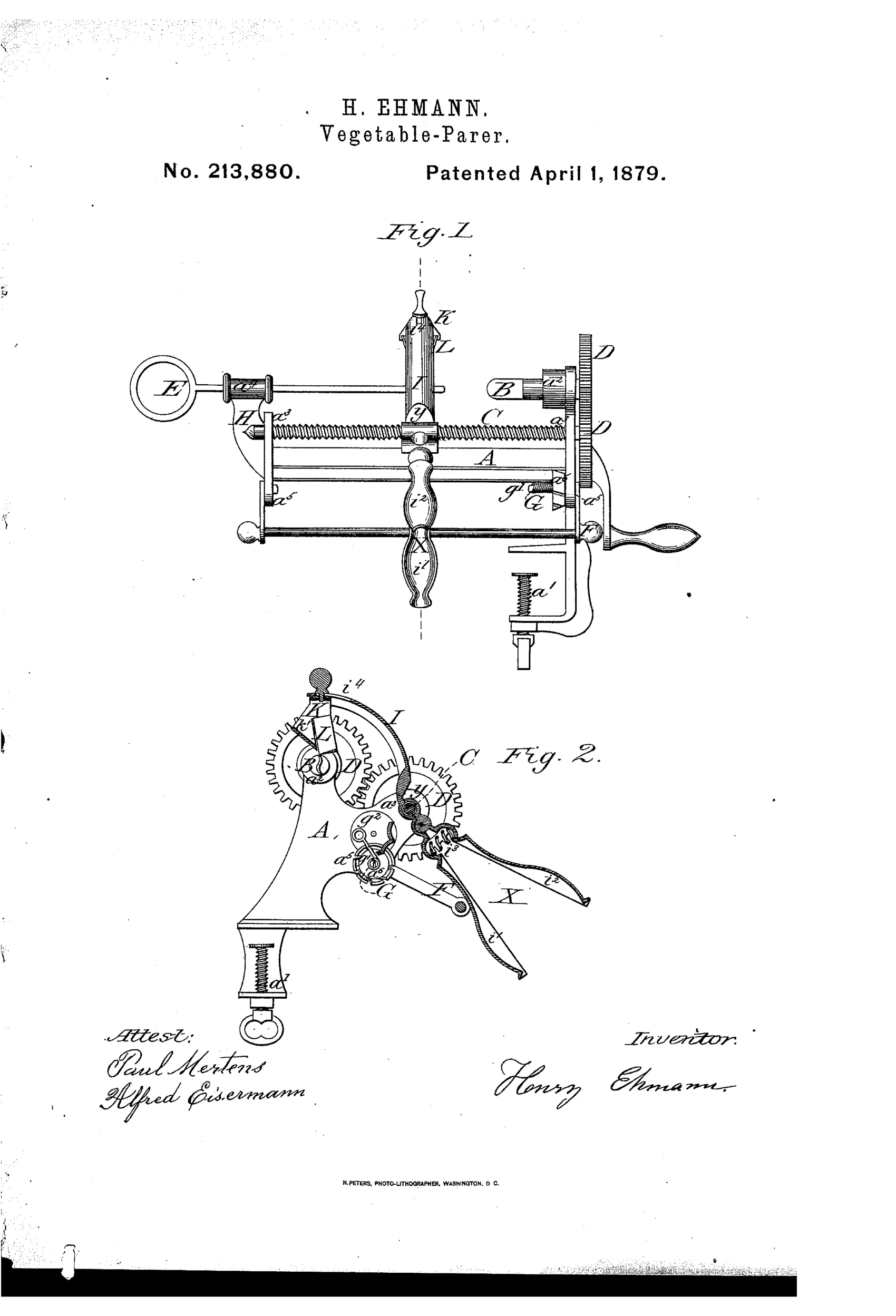
Hand-cranked geared machine for paring vegetables
❧ How it works
A vegetable is mounted on an S-shaped rotating receiver knife driven by a crank through spur-wheels that also turn a leading-screw. The leading-screw carries a swinging press-frame and coiled spring that push a pivoted parer-rest and V-shaped paring knife inward against the vegetable as it rotates. A back-center tightener presses into the vegetable's far end to steady it while an S-shaped knife on the leading-screw simultaneously cores the eye. A ratchet adjusts spring tension to vary cutting depth according to the vegetable's hardness.
❧ What was claimed
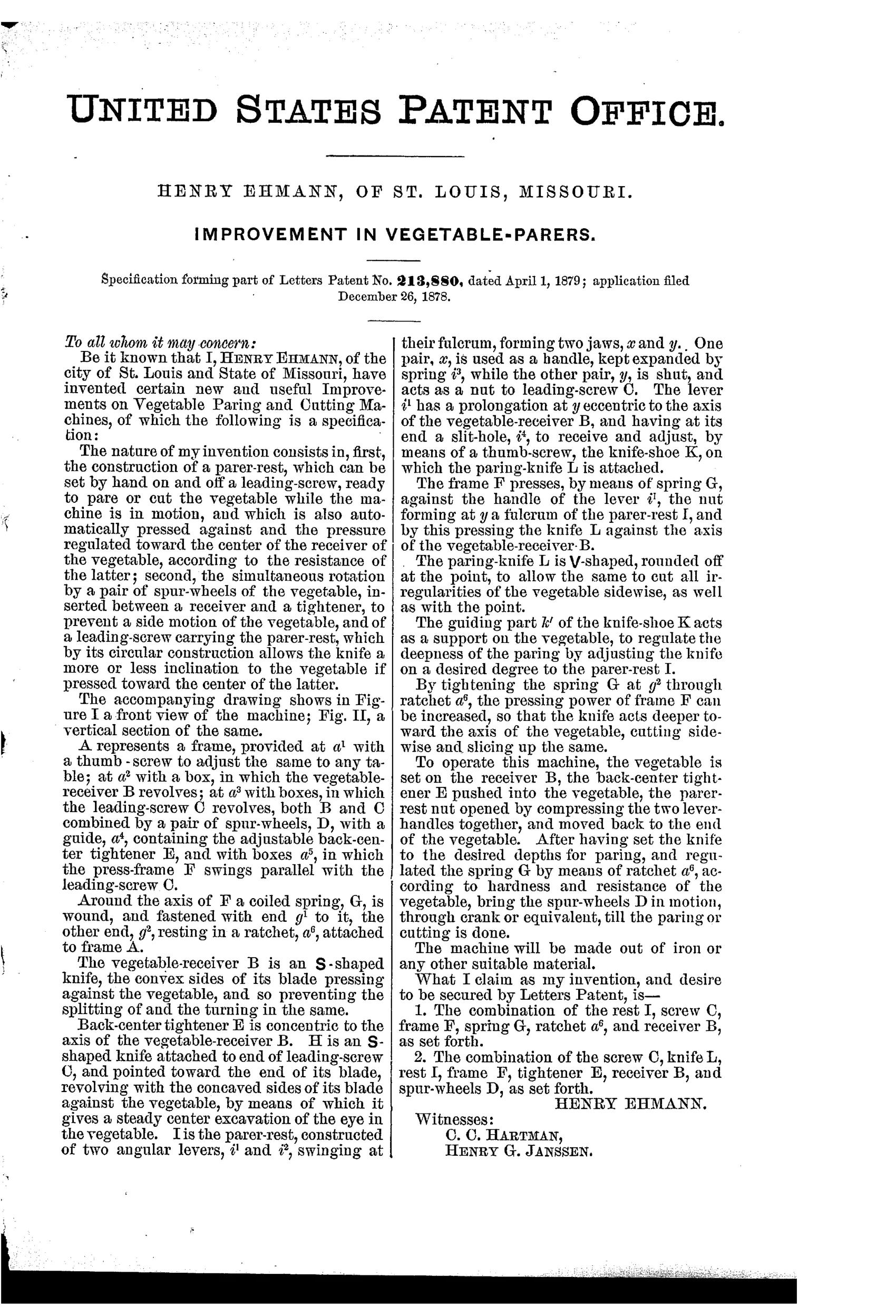
“1. The combination of the rest I, screw C, frame F, spring G, ratchet a6, and receiver B, as set forth.”
In plain English: The patent covers the combined parts—the parer-rest, leading-screw, pressing frame, spring, ratchet, and vegetable receiver—working together as described.
❧ In the inventor’s words
“The paring-knife L is V-shaped, rounded off at the point, to allow the same to cut all irregularities of the vegetable sidewise, as well as with the point.”— Henry Ehmann, from the specification
Fate unknown
No production machine matching this design is documented in the collector record; a marked surviving example would settle it.
❧ Commentary
Most parers of the 1870s were tuned for one customer: the apple. Henry Ehmann of St. Louis aimed wider, and the tell is that ratchet. A coiled spring presses his V-shaped knife against the spinning vegetable, and the ratchet lets you crank the spring tension up for a turnip or down for a potato. That adjustable-pressure idea is the genuinely thoughtful part — apple parers mostly got away with a fixed spring because apples are usefully consistent, and vegetables are not.
The rest of the machine is a lathe-type layout with some real density packed in. The crank drives spur-wheels that spin the vegetable on an S-shaped receiver knife while also turning a leading-screw; that screw carries the swinging press-frame, so the blade advances along the piece automatically. A back-center tightener steadies the far end — necessary, because a big irregular root would wobble off a fork that holds an apple fine. And the receiver itself doubles as a coring knife, eating the eye while the outside gets pared.
Would it work? Probably, on roundish produce. But the complexity that makes it clever also made it expensive next to a paring knife, which handles a knobby potato with less fuss. The golden-age geared makers stuck with apples for a reason, and Ehmann's machine reads as an ambitious answer to a question the market wasn't quite asking.
Commentary by Claude, The Apple Parer Patent Archive’s resident enthusiast