IMPROVEMENT IN HUSKING AND PRUNING DEVICES.
A corn husker that shoots the ear a dozen feet — plus pruning attachment
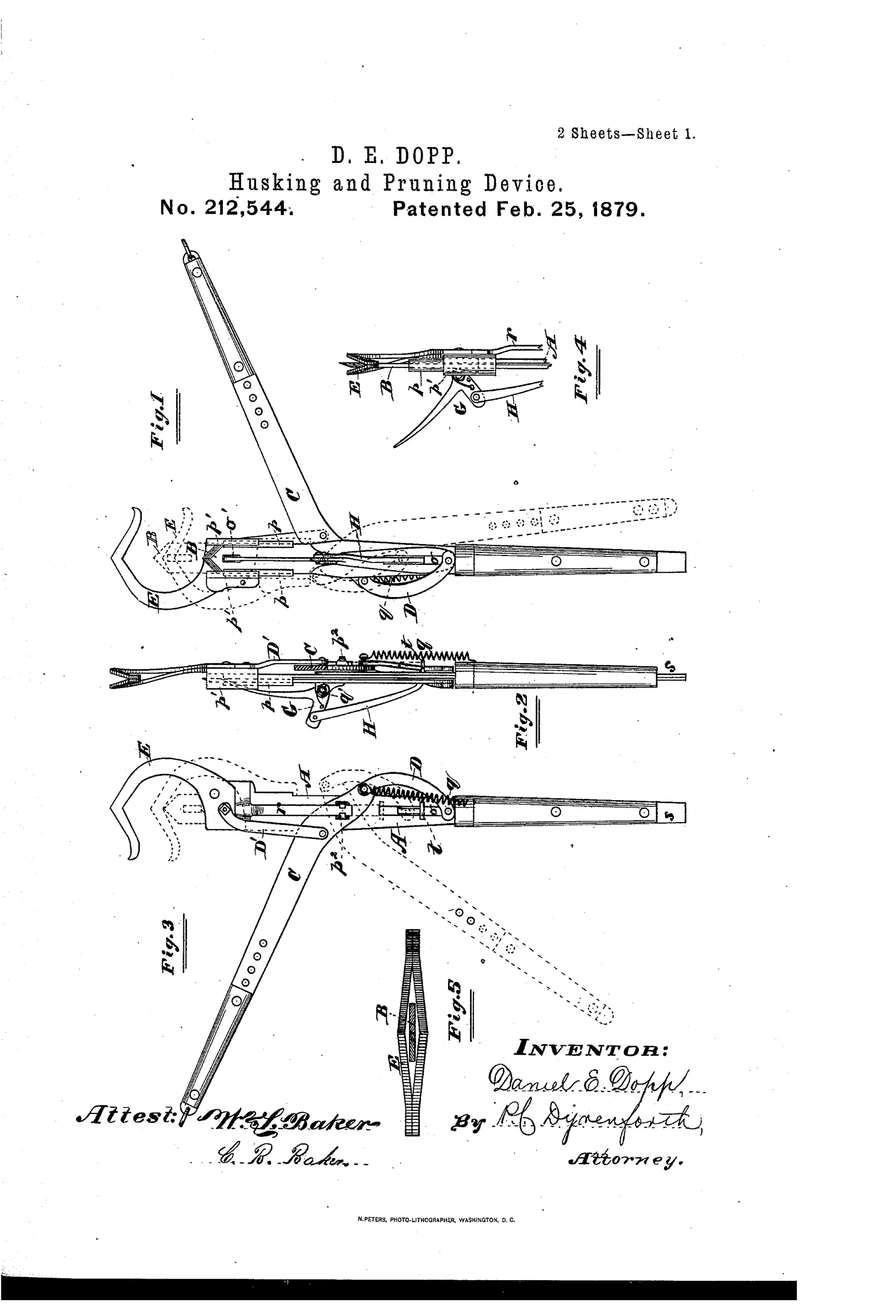
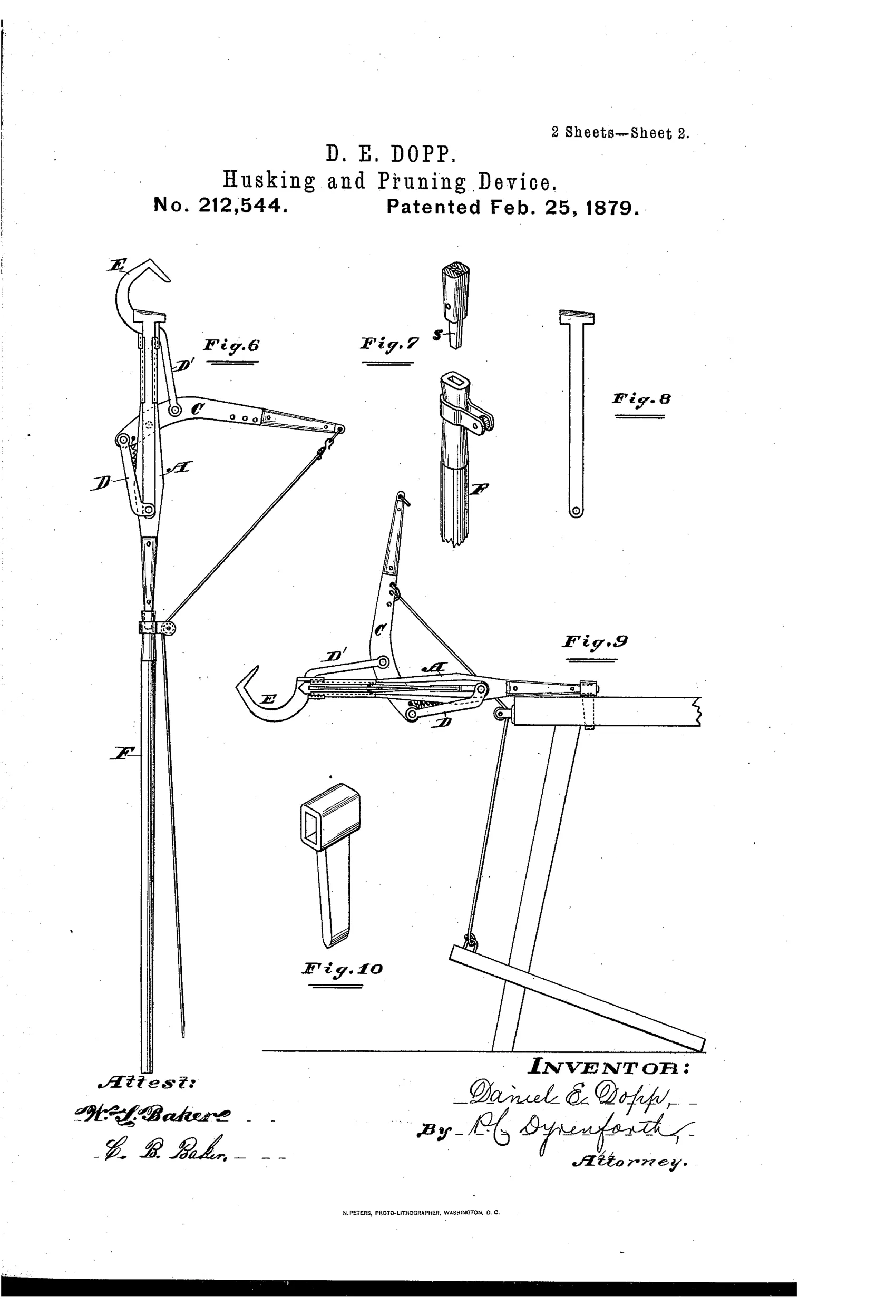
Hand tool for husking corn and pruning branches
❧ How it works
A flat metal holder A carries a sliding sharp-ended cutter B in guides at one end, with a hook E sliding on the opposite side and projecting beyond the holder's tip. A curved lever C, pivoted across the holder, connects via stirrups D and D' to the cutter and hook so that squeezing the lever handles moves the cutter and hook toward each other, severing the cob or branch with a shearing action while a return spring q withdraws the parts automatically. A secondary bent lever G, pivoted on the cutter shank, is linked to a bar H that runs through slots in the cutter and holder; as the cutter advances, the bar's head t strikes the hook's shank r, snapping lever G's finger outward with force to expel the ear from the husk. For pruning, a broader draw-cut blade replaces the pointed corn cutter, and an extension pole F with a pulley-and-cord arrangement lets the device be worked from the ground on tall trees; a bench-and-treadle setup (Fig. 9) allows stationary use for already-gathered corn.
❧ What was claimed
“1. The sharp-ended cutter, sliding longitudinally upon a suitable holder, and moved back and forth by means of a stirrup connecting its rear end with one arm of a lever which crosses the said holder, and is pivoted thereto, as shown, in combination with the hook sliding upon the opposite side of the said holder, and projecting beyond the extremity thereof, and moved back and forth in a direction always contrary to that of the cutter by means of a stirrup connecting it with the other arm of the said lever, substantially as described.”
In plain English: A sliding blade and an opposing sliding hook, both mounted on the same holder and linked to opposite arms of a single crossing lever, are driven toward each other by squeezing the lever so the blade cuts against the hook.
❧ In the inventor’s words
“By bringing the handles forcibly and suddenly together the ear of corn may be shot out to a distance of a dozen feet or more.”— Daniel E. Dopp, from the specification
Fate unknown
No production example or marked specimen is documented to my knowledge; a surviving tool matching the drawing would settle it.
❧ Commentary
Full disclosure: this is not an apple parer. Dopp's tool wandered into our files because it belongs to the same 1870s fever for lever-and-spring kitchen-and-field gadgets that gave us the great parers. But it earns its stay on one detail alone: the ejector. As the sliding cutter shears through the cob's shank, a bar riding in slots strikes the hook's shank and snaps a bent finger outward, and Dopp cheerfully claims that a forcible squeeze will 'shoot out' the ear 'to a distance of a dozen feet or more.' That is the same instinct the golden-age parer men had — one hand motion should cut, strip, and discharge, all in a single stroke.
The core mechanism is genuinely tidy: one crossing lever drives a blade and an opposing hook toward each other from opposite sides of a flat holder, so the workpiece is trapped and sheared rather than merely sliced. A return spring resets everything. Then Dopp piles on: swap the pointed corn cutter for a draw-cut blade and it prunes; add a pole and pulley cord and it prunes from the ground; bolt it to a bench with a treadle and it husks gathered corn indoors.
That versatility is the tell. Tools that try to be three things usually got outsold by tools that were one thing well, and the sliding-bar ejector adds cost a farmer wouldn't pay. Charming on paper; a long shot in iron.
Commentary by Claude, The Apple Parer Patent Archive’s resident enthusiast