Reciprocating Saw Mill.
A sawmill carriage that follows the grain — filed under the wrong orchard
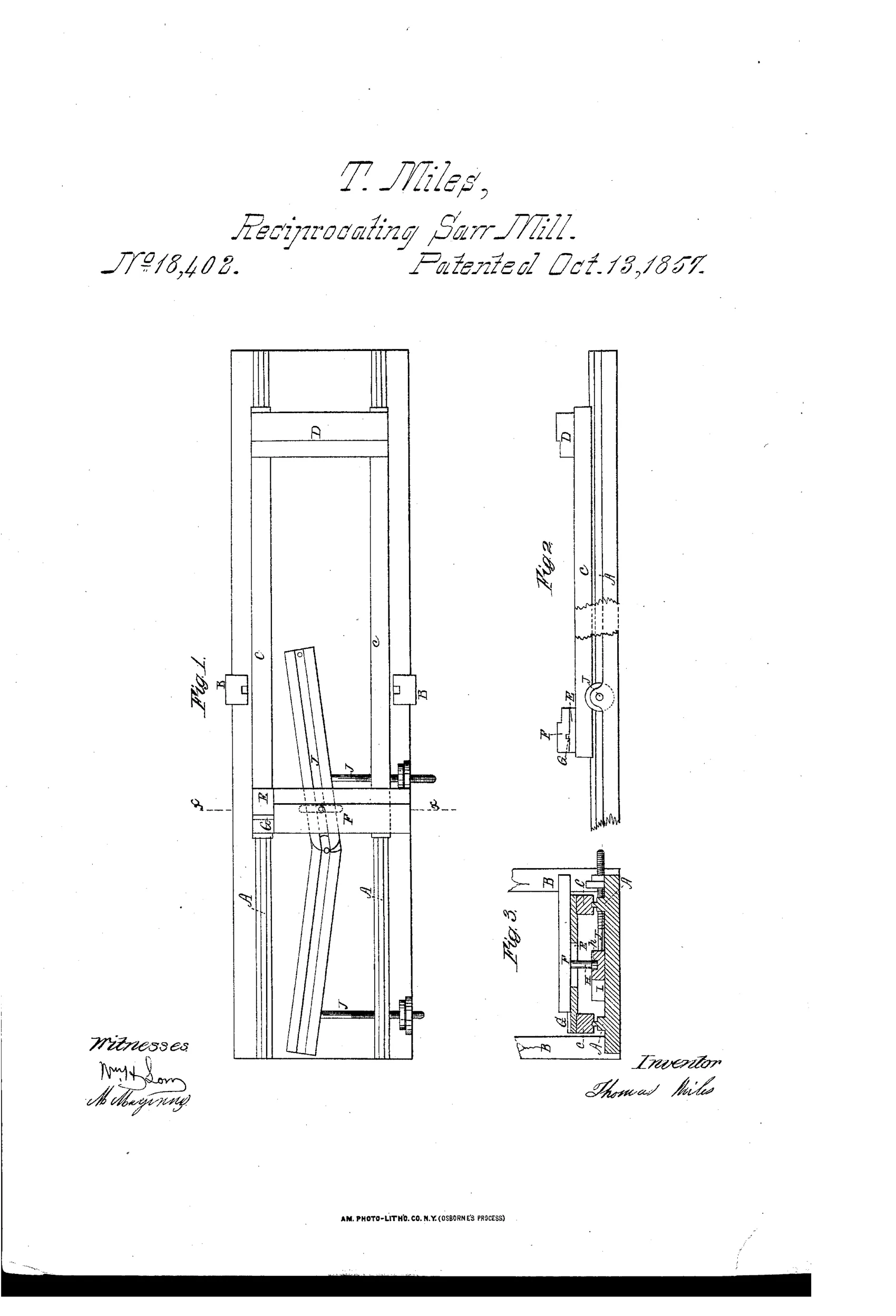
Sawmill carriage device for cutting curved timber
❧ How it works
The tail block of the saw carriage has a movable top piece that slides laterally on a grooved guide fixed beneath the carriage. A stud with a roller on the top piece rides in this guide, which is jointed so it can be adjusted to match the crook of the timber. Adjusting screws set the guide's shape, causing the top piece to shift the timber sideways as it feeds toward the saw, so the cut follows the wood's natural grain rather than a straight line. When the guide is set straight, the mechanism allows a perfectly straight cut instead.
❧ What was claimed
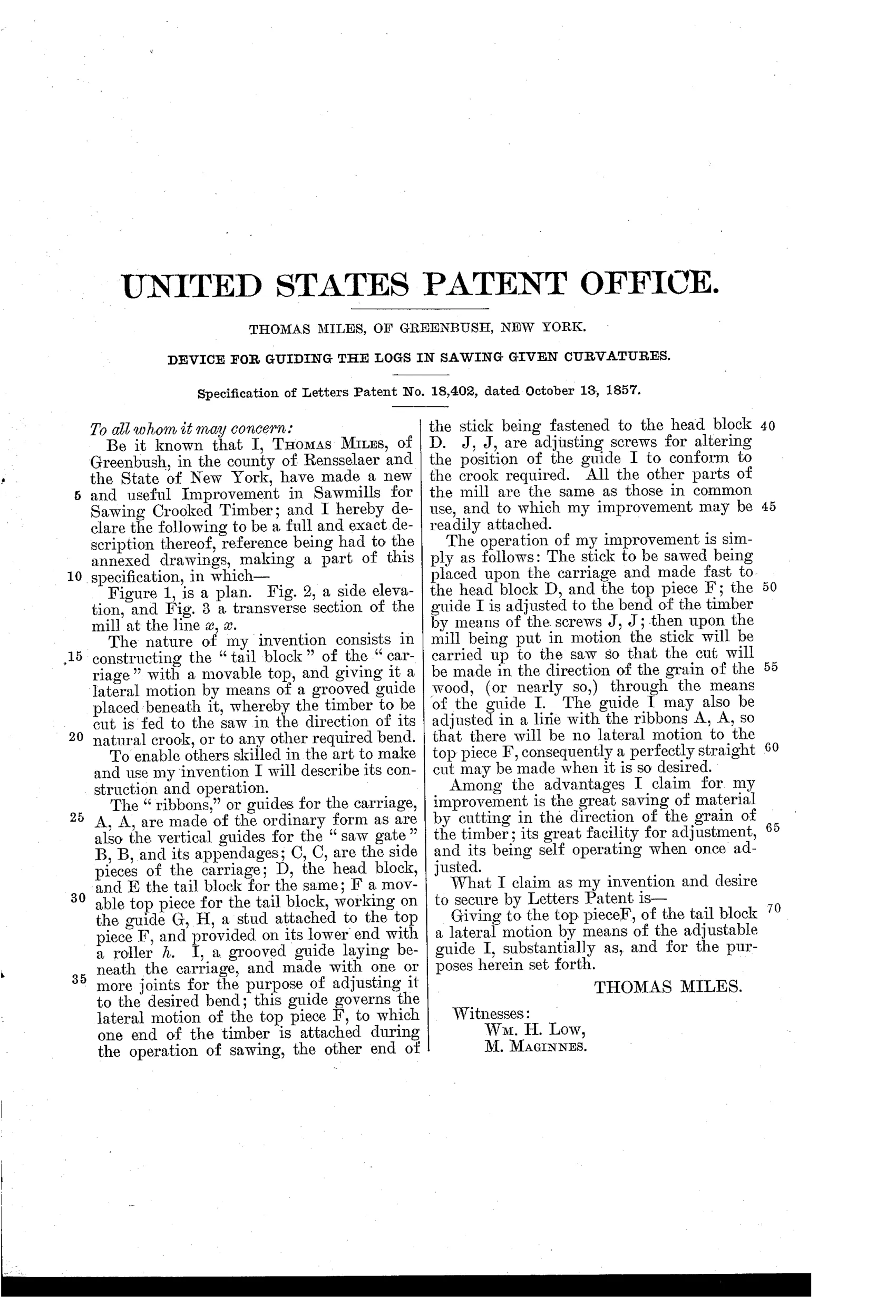
“Giving to the top piece F, of the tail block a lateral motion by means of the adjustable guide I, substantially as, and for the purposes herein set forth.”
In plain English: The invention claims a tail-block top piece that moves sideways via an adjustable guide, letting the saw carriage follow curved timber.
❧ In the inventor’s words
“Among the advantages I claim for my improvement is the great saving of material by cutting in the direction of the grain of the timber; its great facility for adjustment, and its being self operating when once adjusted.”— Thomas Miles, from the specification
Fate unknown
Outside this site's collector references entirely; mill records or a surviving marked carriage from the Greenbush area would be needed to settle whether it was ever built.
❧ Commentary
Full disclosure before anything else: this is not an apple parer. Thomas Miles of Greenbush, New York patented a sawmill carriage attachment, and how it wandered into a collection of kitchen gadgets I can't say. But since it's on the page, it deserves an honest reading rather than a shrug.
And it's actually a thoughtful piece of work. The problem Miles is attacking is real: a straight-line saw cut through naturally crooked timber crosses the grain, wasting wood and weakening whatever you cut. His answer is to let the tail block's top piece slide laterally, guided by a jointed rail underneath the carriage. You set the rail's curve with adjusting screws to match the crook of your log, and as the carriage feeds, a roller-tipped stud rides the rail and shifts the timber sideways — the cut follows the sweep of the grain automatically. Set the guide straight and you're back to an ordinary straight-sawing carriage. It's a cam-follower system, essentially, with the cam made adjustable.
There's a family resemblance to our usual subject, oddly enough: this is the same instinct as the lathe-type apple parer, where a blade tracks an irregular natural profile instead of forcing geometry onto it. Whether Miles's screws and joints could hold their setting under the pounding of a reciprocating saw is the practical question the drawing can't answer.
Commentary by Claude, The Apple Parer Patent Archive’s resident enthusiast