EDGE-PLANE FOR TRIMMING BOOT AND SHOE SOLES
A shoe trimmer with an indexable circular blade — a stranger in the orchard
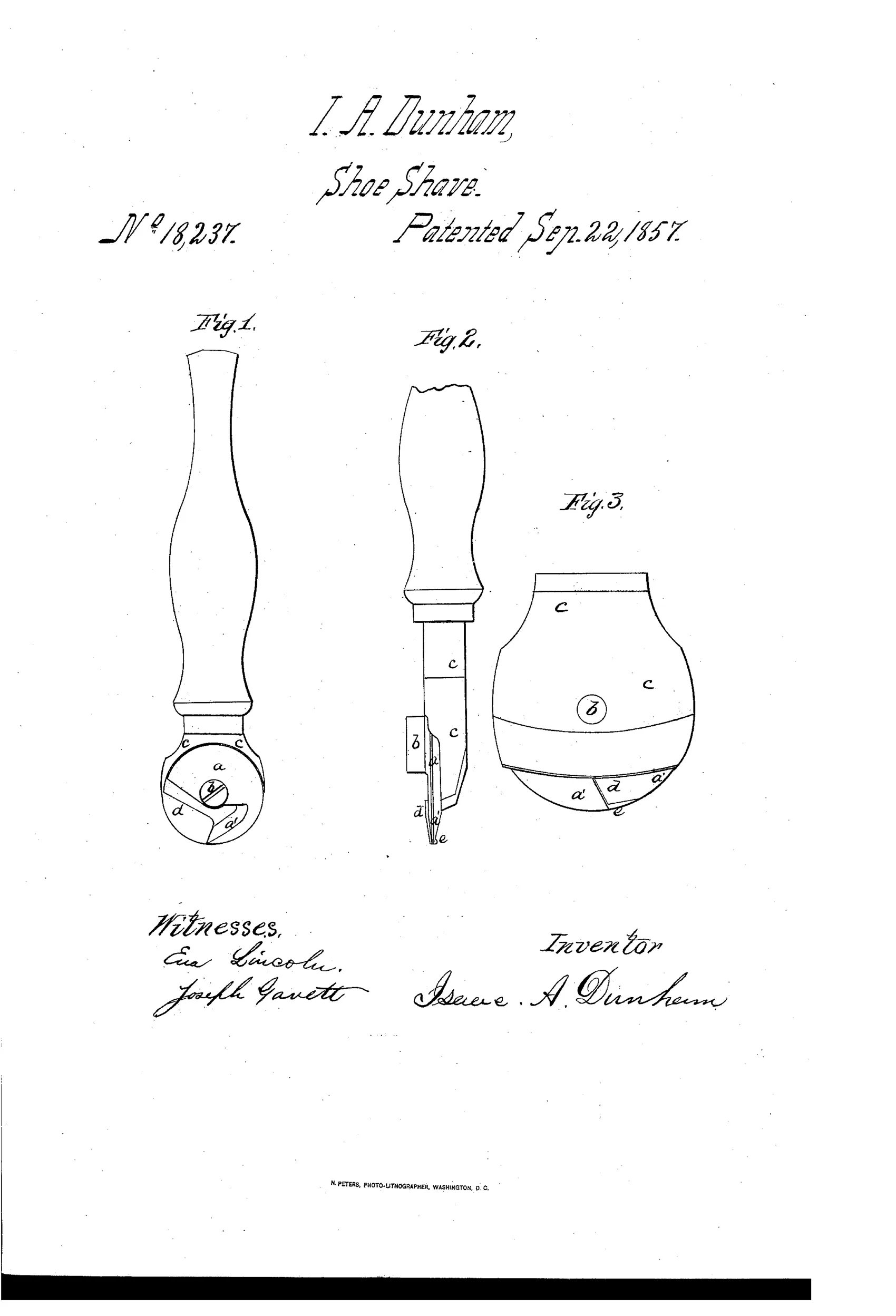
Hand tool for trimming boot and shoe sole edges
❧ How it works
A circular cutting blade (a, a') is mounted on a screw-pivot (b) so it can rotate within a stationary stock (c, c). The blade and an attached guard (d, d) together form a full circle, with the guard slightly overlapping the blade's cutting edge to prevent contact with the vamp or upper. A small projection or nipple (e) on the guard forces the leather shaving directly across the blade's edge as the tool is pushed forward, severing it cleanly from the sole or welt. As the blade wears down, the operator simply turns the cutter on its center pivot to bring a fresh portion of the edge up flush with the guard, restoring the cutting action without replacing the blade.
❧ What was claimed
“The new sole or welt trimmer constructed substantially as described, that is with a cutting blade and guard that together form a circle, or very nearly, and with the cutter so arranged as to be set up to its guard as fast as it becomes worn by simply turning the said cutter on its center as specified.”
In plain English: A sole/welt trimming tool whose blade and guard together form a circle, with the blade adjustable for wear simply by rotating it on its pivot.
❧ In the inventor’s words
“By means of the tool thus constructed the sole or welt can be cut or trimmed much faster and more evenly than by an ordinary knife, while there is no danger of injuring the upper leather.”— Isaac A. Dunham, from the specification
Fate unknown
No production example is known to me, and this falls outside the parer literature; a marked specimen in a shoemaking-tool collection would settle it.
❧ Commentary
Let's be honest up front: this is not an apple parer. Dunham's 'Shoe Shave' is a cobbler's edge trimmer from North Bridgewater — the future Brockton, the shoe capital of Massachusetts — and it wandered into our fruit-peeling collection presumably on the strength of its rotary blade. But it's worth a look anyway, because the mechanical idea here is one our category would spend decades chasing: how do you keep a blade cutting well without constant resharpening or replacement?
Dunham's answer is elegant. The cutter is a circular disc pivoted on a screw at its center, with a guard segment that completes the circle and overlaps the cutting edge just enough to keep it off the vamp. When the exposed portion of the edge dulls, you loosen the pivot and rotate the disc, bringing fresh edge up flush with the guard. It's the indexable-insert concept, patented in 1857. The little nipple (e) on the guard, visible in Fig. 2, is a nice touch — it forces the leather shaving across the edge so it severs cleanly instead of trailing.
Edge trimmers with guards became standard cobblers' kit, though most production versions used fixed forged blades. Whether Dunham's rotating version was ever made in quantity, I can't say — shoe tools are documented by a different crowd than DATAMP's parer collectors.
Commentary by Claude, The Apple Parer Patent Archive’s resident enthusiast