DEVICE FOR PEELING AND CORING PEARS
Pear halves get the parer treatment: a rack-and-pinion sweep from Oregon canning country
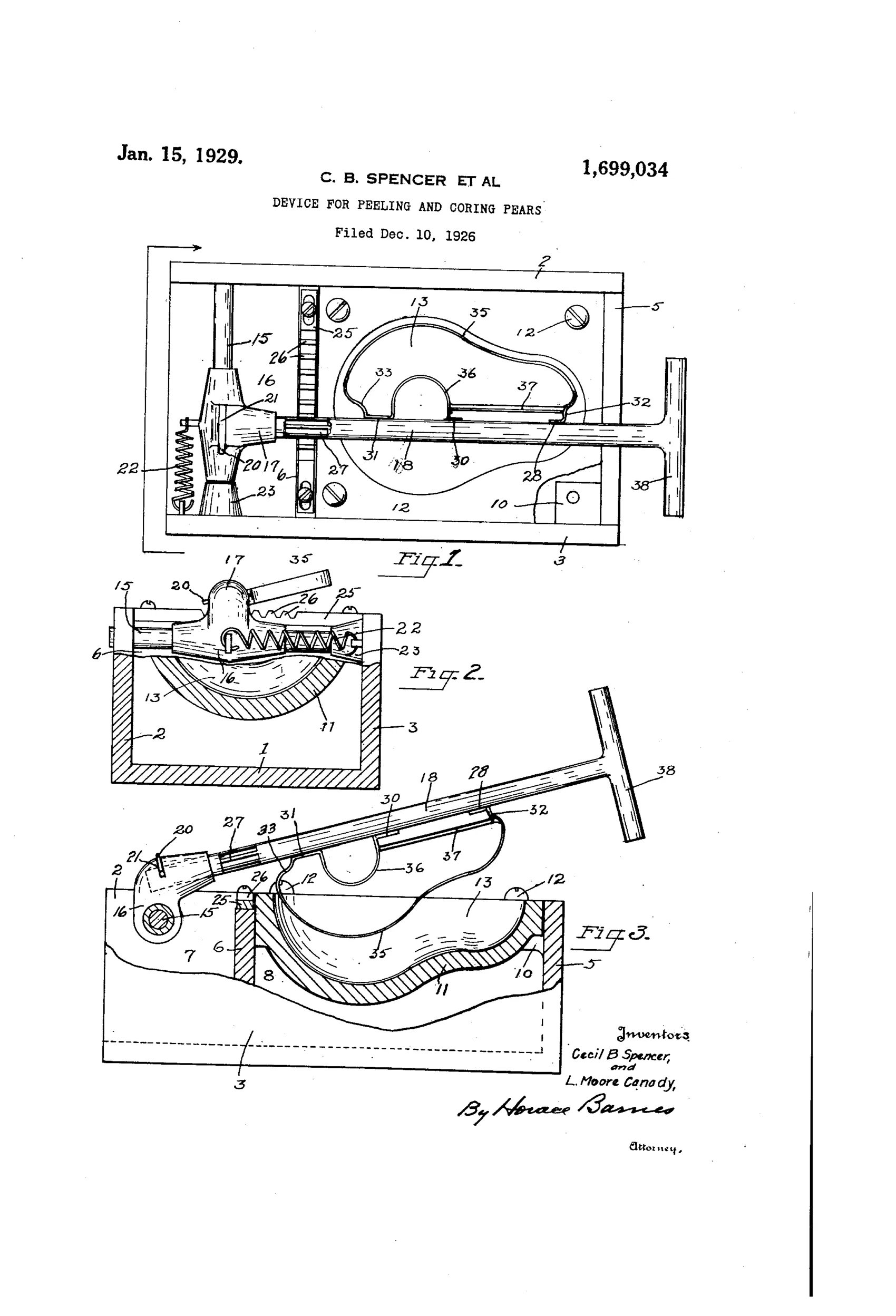

Hand-cranked machine for peeling and coring pear halves
❧ How it works
A pear half is set into a curved receptacle whose shape matches the fruit's contour. A shaft carrying peeling, coring, and stemming knives pivots down onto the fruit and is rotated by a handle to sweep the blades through a half-circle. A rack-and-pinion arrangement forces the shaft to travel laterally across the receptacle as it turns, so the cutting edges enter and exit the fruit cleanly at the start and finish of the stroke. A coil spring yieldingly returns the shaft and knife head to its starting position once the operator lifts the shaft off the rack teeth.
❧ What was claimed
“Fruit peeling devices of the class described, consisting in a frame provided with a receptacle to receive a half-section of fruit, a horizontally disposed bar in said frame, a head slidably mounted longitudinally of said bar and pivotally movable thereon, a rack-bar mounted in said frame, a shaft rotatably supported in said head having a plurality of pinion-teeth formed about its periphery engageable with said rack-bar, and a plurality of knives mounted upon said shaft and operatively engageable with the fruit contained within said receptacle.”
In plain English: A pear-peeling machine where a knife-carrying shaft, mounted on a sliding pivoting head, has pinion teeth that mesh with a fixed rack bar so that turning the shaft also moves it sideways across the fruit receptacle.
❧ In the inventor’s words
“cutting away the waste portions of the fruit from the body thereof and leaving the latter free of all imperfections and each piece thereof cut to uniform standard size.”— Cecil B. Spencer and L. Moore Canaday, from the specification
Fate unknown
No production example or DATAMP listing is known to me; a marked specimen or an Oregon cannery equipment catalog entry would settle it.
❧ Commentary
Most of this category spins the fruit and holds the knife still. Spencer and Canaday flip it: the pear half sits dead in a form-fitted receptacle and the knives do the traveling. A shaft carrying peeling, coring, and stemming blades pivots down onto the fruit, and pinion teeth on the shaft mesh with a fixed rack so that turning the T-handle both rotates the blades and walks them laterally across the pear. That compound motion is the whole invention — it makes the cutting edges enter at one end of the half and exit cleanly at the other, rather than gouging in and out.
The geography tells you what this really is. Albany, Oregon, 1926 sits in the middle of the Willamette Valley's canning boom, and the claim's own language gives it away: fruit "cut to uniform standard size." This isn't a kitchen gadget; it's a cannery bench tool aimed at the tedious hand work of prepping Bartlett halves.
The weak point is the fixed receptacle. Pears vary more than apples, and a contour-matched cavity only fits the pear it was carved for — undersized fruit gets missed, oversized fruit gets crushed. Commercial pear-processing machinery went a different direction entirely, toward continuous-feed machines, which likely made this one-half-at-a-time approach a dead end. Still, the rack-driven traveling knife shaft is a genuinely tidy piece of thinking.
Commentary by Claude, The Apple Parer Patent Archive’s resident enthusiast