MACHINE FOR PARING APPLES.
A curved slide solves the flat-apple problem — patent 16,666, fittingly devilish gearing
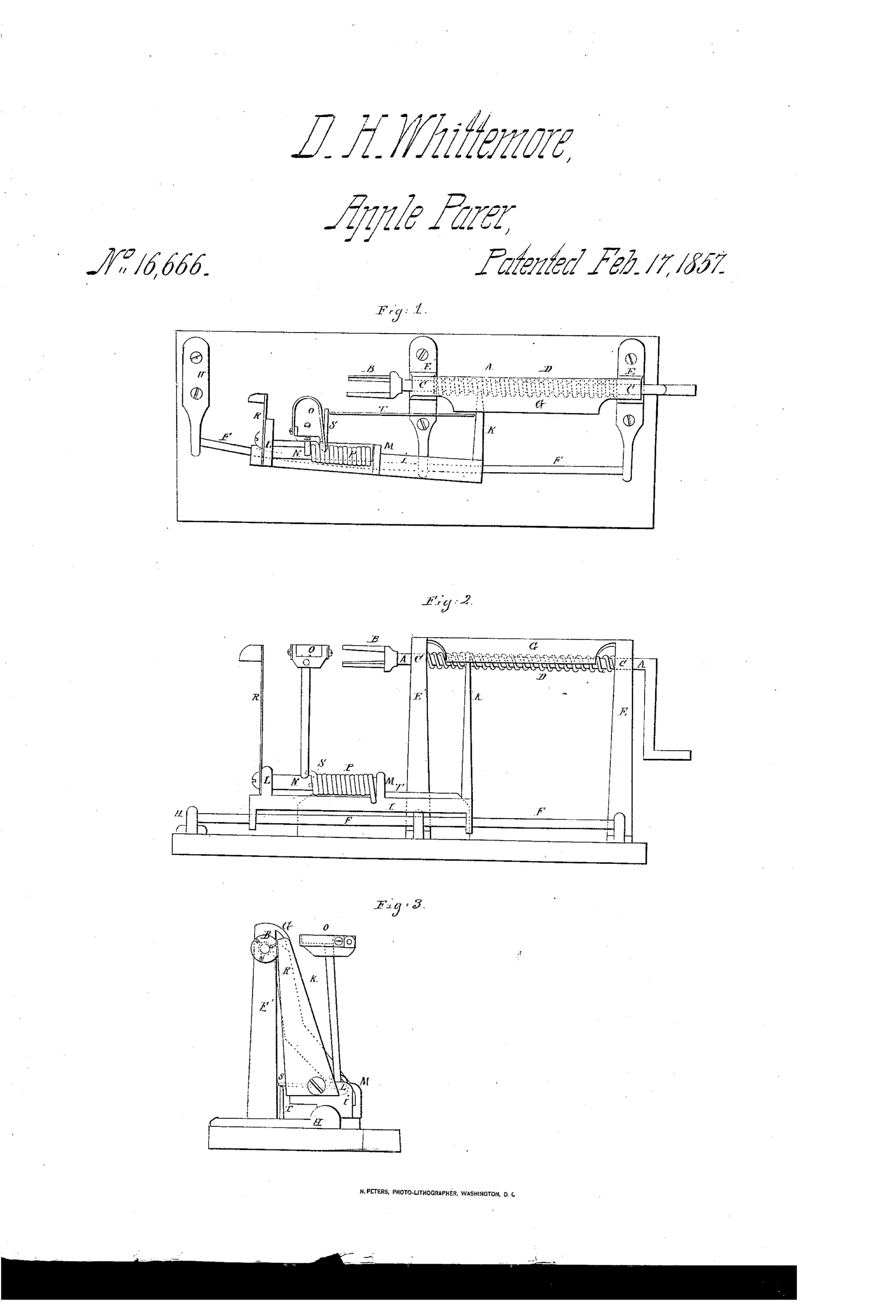
Hand-cranked apple paring, coring, and slicing machine
❧ How it works
A hand-cranked shaft rotates the fork holding the apple against a paring knife whose motion is guided by a curved slide instead of a straight one, allowing a semicircular knife to follow the apple's contour. The curved slide carries a carrier piece that rides in a groove on a screw, drawing the knife across the apple while a spring holds it firmly against the fruit's surface. A pin on the knife-holder passes over an elevator near the fork which lifts the knife clear at the end of the stroke. Slicing and coring knives follow behind the paring knife, cutting the apple into a slice from the core while leaving the core in a shape for easy removal.
❧ What was claimed
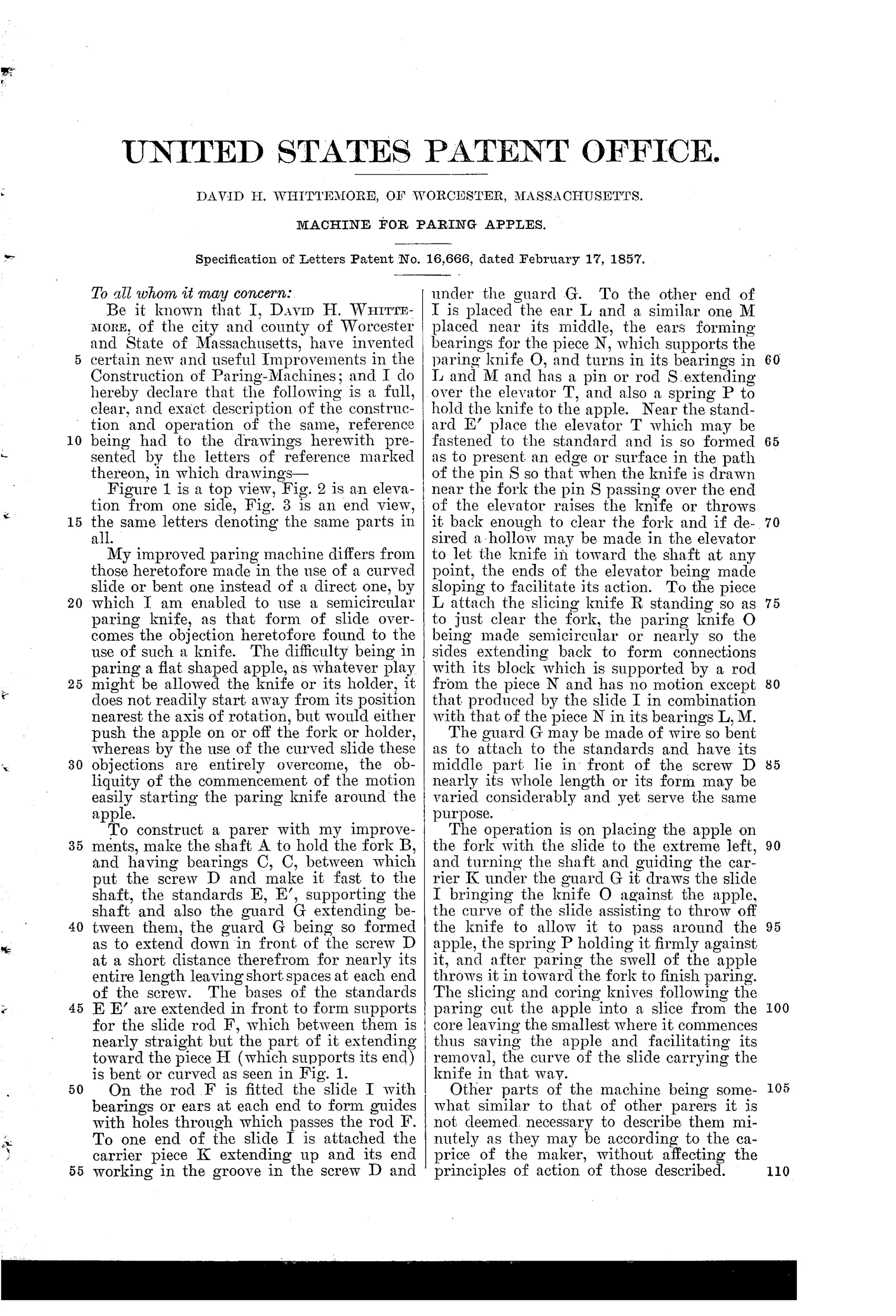
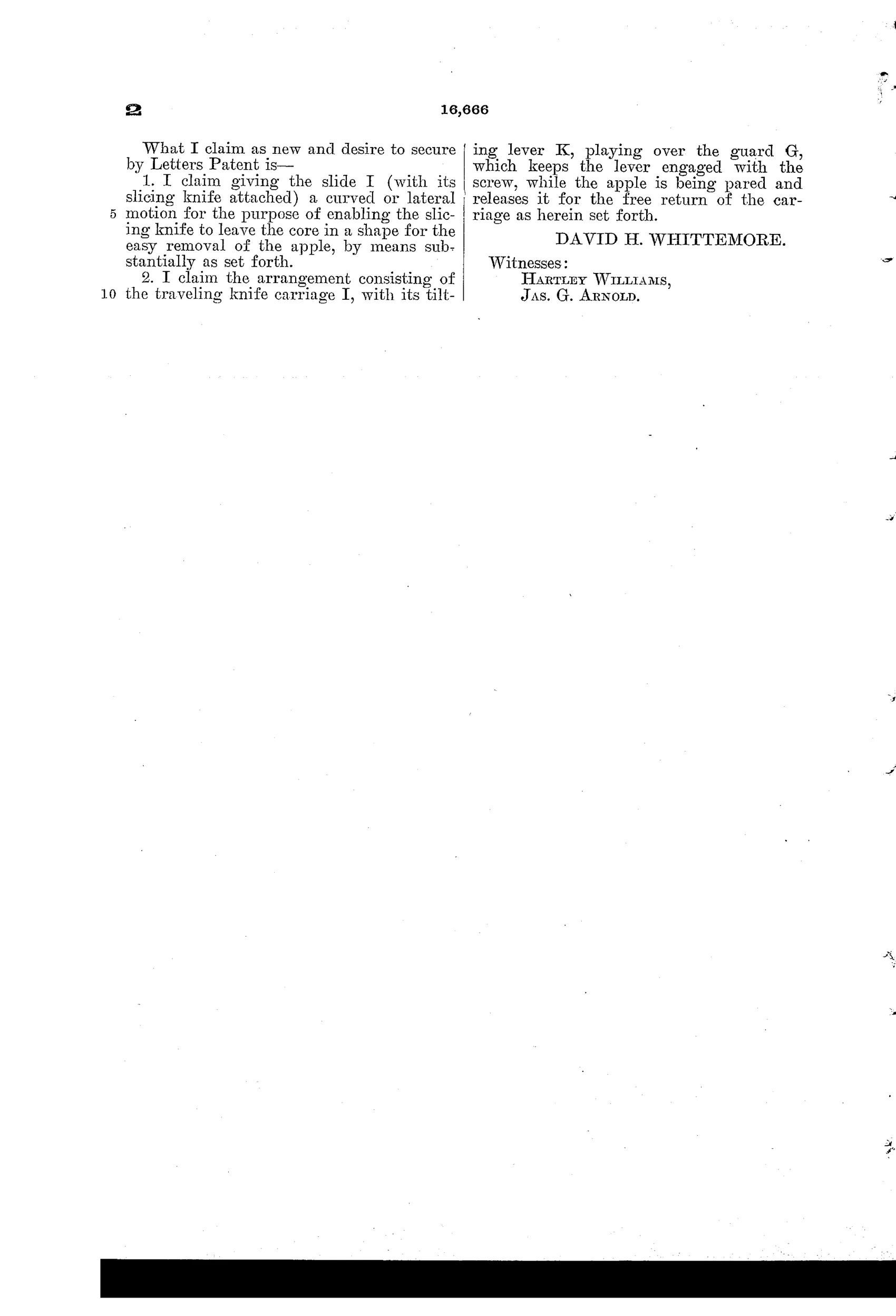
“I claim giving the slide I (with its slicing knife attached) a curved or lateral motion for the purpose of enabling the slicing knife to leave the core in a shape for the easy removal of the apple, by means substantially as set forth.”
In plain English: The inventor claims a sliding knife carriage that moves in a curved rather than straight path so the slicing knife shapes the core for easy removal.
❧ In the inventor’s words
“The difficulty being in paring a flat shaped apple, as whatever play might be allowed the knife or its holder, it does not readily start away from its position nearest the axis of rotation, but would either push the apple on or off the fork or holder, whereas by the use of the curved slide these objections are entirely overcome, the obliquity of the commencement of the motion easily starting the paring knife around the apple.”— David H. Whittemore, from the specification
Fate unknown
Whittemore was a genuine parer manufacturer, but I know of no surviving machine matching this 1857 curved-slide design; a marked specimen or DATAMP listing would settle it.
❧ Commentary
Whittemore is attacking a real defect of the early lathe-type parers here. On a straight slide, the knife arm has to start its traverse by pulling directly away from the fork's axis, and on a flat, squat apple that first move tends to shove the fruit off the fork instead of starting the cut. His fix is geometric rather than mechanical: bend the slide. The knife carriage rides a curved guide, so the opening of the stroke comes in at an oblique angle — the knife eases around the shoulder of the apple instead of prying against it. His own specification says it plainly: 'the obliquity of the commencement of the motion easily starting the paring knife around the apple.'
The rest of the machine is an ambitious combination for 1857 — a screw-driven traverse, a spring holding the semicircular blade to the contour, an elevator pin that lifts the knife clear at the end, and trailing coring and slicing knives. Note that the actual claim is narrow: it covers only the curved lateral motion of the slicing knife, so the core is cut to a shape that releases the apple cleanly. That is a modest claim wrapped around a fairly complete parer-corer-slicer, two decades before Sinclair Scott made that combination famous.
Whittemore of Worcester was no dreamer — he stayed in the parer business and his later machines are well known to collectors. This early effort reads like the workshop where he learned what apples actually do on a fork.
Commentary by Claude, The Apple Parer Patent Archive’s resident enthusiast