IMPROVEMENT IN APPLE-PARERS.
A revolving turret of apple forks, decades before anyone asked for one
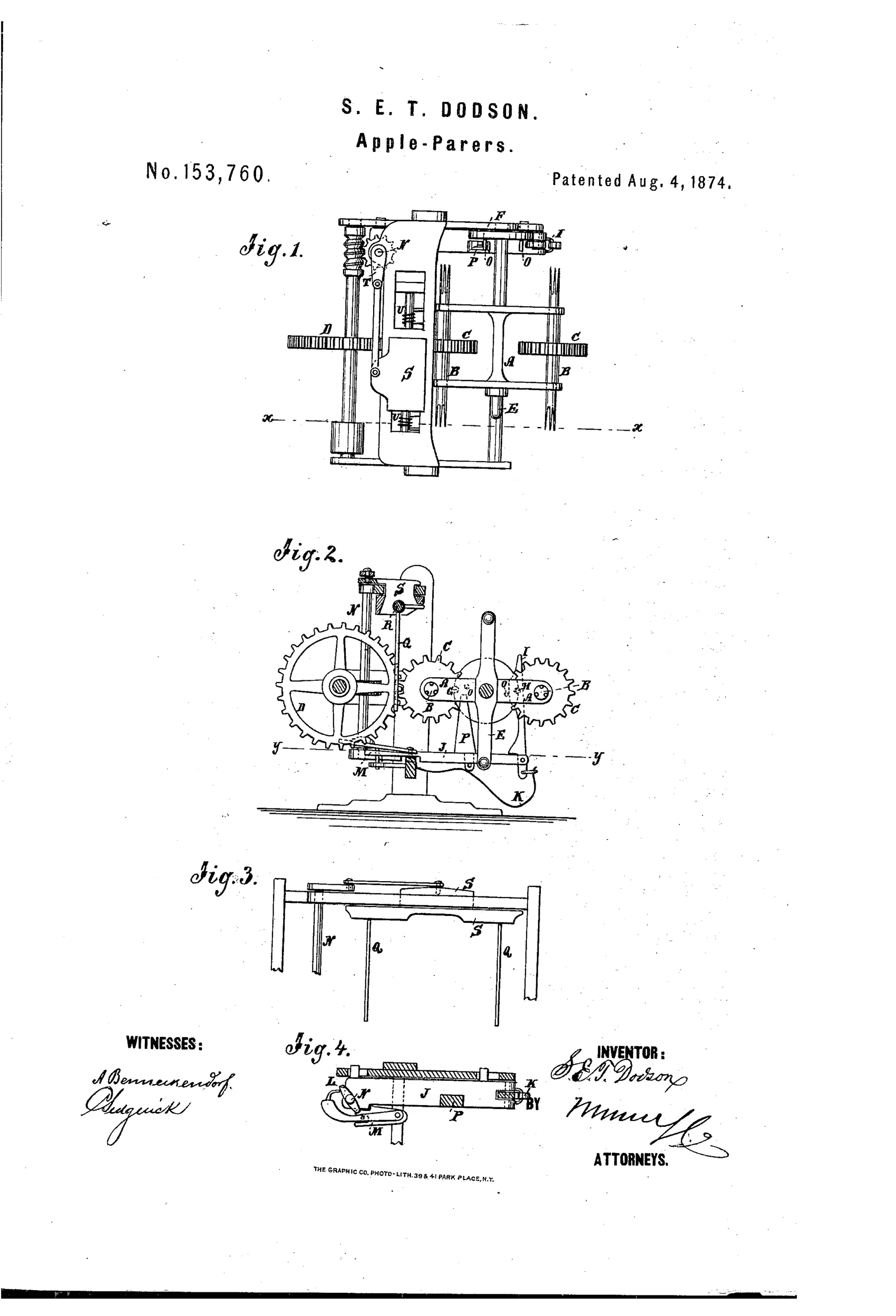
Multi-fork revolving reel apple-paring machine.
❧ How it works
A revolving reel carries two or more rotary fruit-holding forks that are presented in succession to a driving wheel and cutter mechanism. A locking disk with notches and a spring-actuated pawl stops the reel in position, while a trip-catch and cam release the cutter slide once an apple is fully pared. Stud-pins on the locking disk re-engage the forks with the driving wheel automatically when the reel is shifted to bring a new apple into position. The cutters are mounted on a spring-pressed slide so they traverse and bear against the apple as it turns.
❧ What was claimed
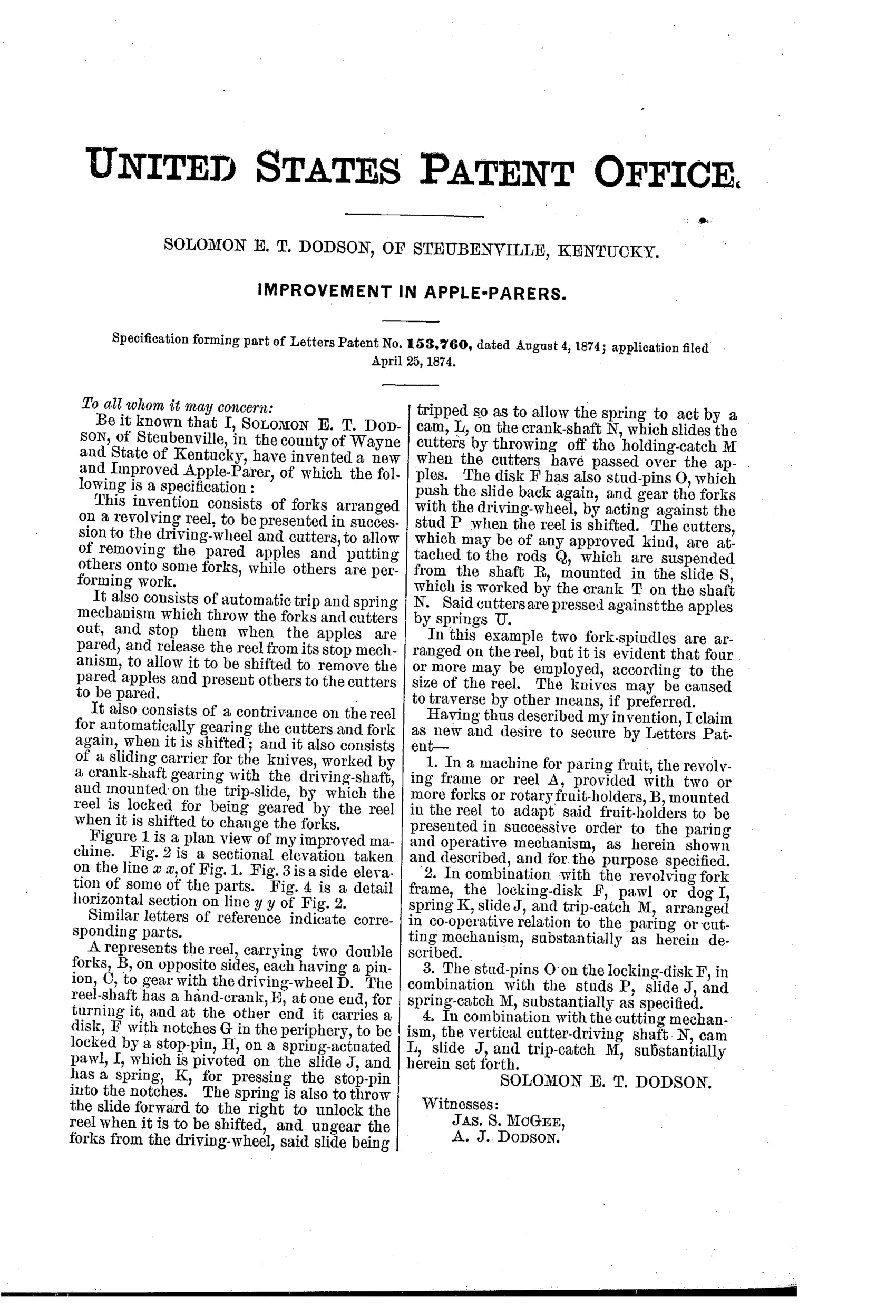
“In a machine for paring fruit, the revolving frame or reel A, provided with two or more forks or rotary fruit-holders, B, mounted in the reel to adapt said fruit-holders to be presented in successive order to the paring and operative mechanism, as herein shown and described, and for the purpose specified.”
In plain English: The core invention is a rotating reel holding multiple fruit-forks that bring apples one after another into the paring mechanism.
❧ In the inventor’s words
“It also consists of automatic trip and spring mechanism which throw the forks and cutters out, and stop them when the apples are pared, and release the reel from its stop mechanism, to allow it to be shifted to remove the pared apples and present others to the cutters to be pared.”— Solomon E. T. Dodson, from the specification
Fate unknown
No surviving example or listing in the collector record (DATAMP) is known to me; a marked specimen would settle it, though the complexity argues against quantity production.
❧ Commentary
Most 1874 parers were racing to do one thing: pare a single apple faster with fewer wasted motions of the crank. Dodson went sideways instead. His machine mounts two or more fruit forks on a revolving reel — a turret, essentially — so that while one apple is being pared, the next is already loaded and waiting. Turn the reel, and stud-pins on the locking disk automatically re-engage the fresh fork with the driving wheel. It's a magazine-fed apple parer, and the claim language makes clear the reel itself is the invention.
The supporting mechanism is where it gets dense. Look at Fig. 2: the notched locking disk and spring pawl index the reel, a trip-catch and cam release the spring-pressed cutter slide when the apple is finished, and everything has to reset cleanly each cycle. That's three interlocking automatic actions — stop, trip, re-engage — in a hand-cranked kitchen tool. The segment-gear parers of the same decade achieved their pare-push-reset cycle with one cleverly cut gear; Dodson achieves his with a small factory's worth of pawls and cams.
As a production proposition it was probably doomed by its own ambition — the casting and fitting cost would dwarf a Reading or Goodell — but as a piece of thinking it anticipates the multi-station logic that industrial fruit-processing machinery would eventually adopt. A dead end pointing in an interesting direction.
Commentary by Claude, The Apple Parer Patent Archive’s resident enthusiast