HUSKING-THIMBLE.
A steel fingernail for the middle finger — corn husking, 1856, no gears required.
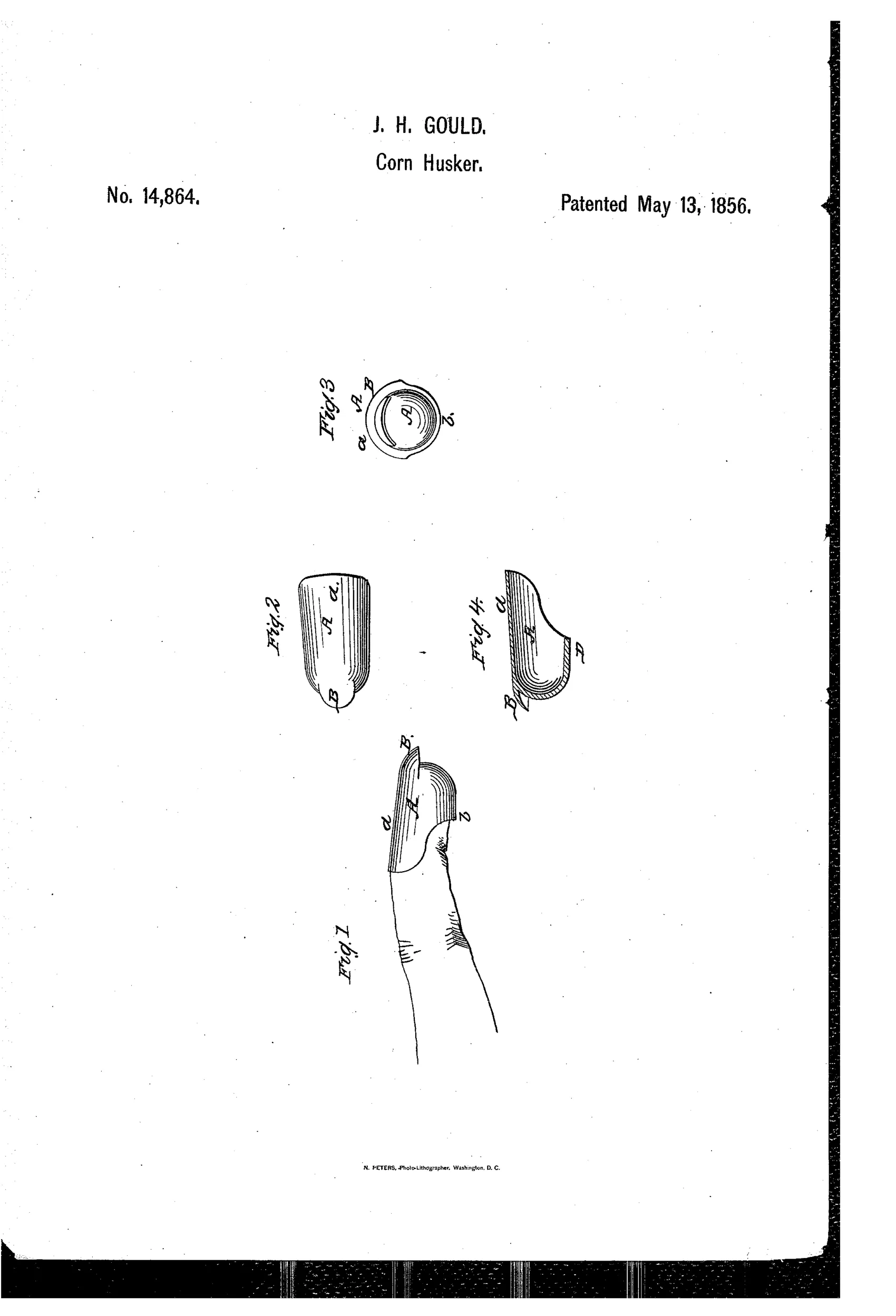
A metal finger-nail thimble for husking corn
❧ How it works
The device consists of a metal thimble shaped like a sewing thimble that fits over the natural finger. An artificial metal fingernail is welded or otherwise formed onto the upper forward extremity of the thimble. The artificial nail is curved or turned down slightly to give it the proper direction for entering the husk, mimicking the motion of a natural fingernail. The thimble's back portion extends beyond the first joint to stay secured on the finger, while the front portion is shorter so the finger can close down on the husks without the thimble being pressed off or causing injury.
❧ What was claimed
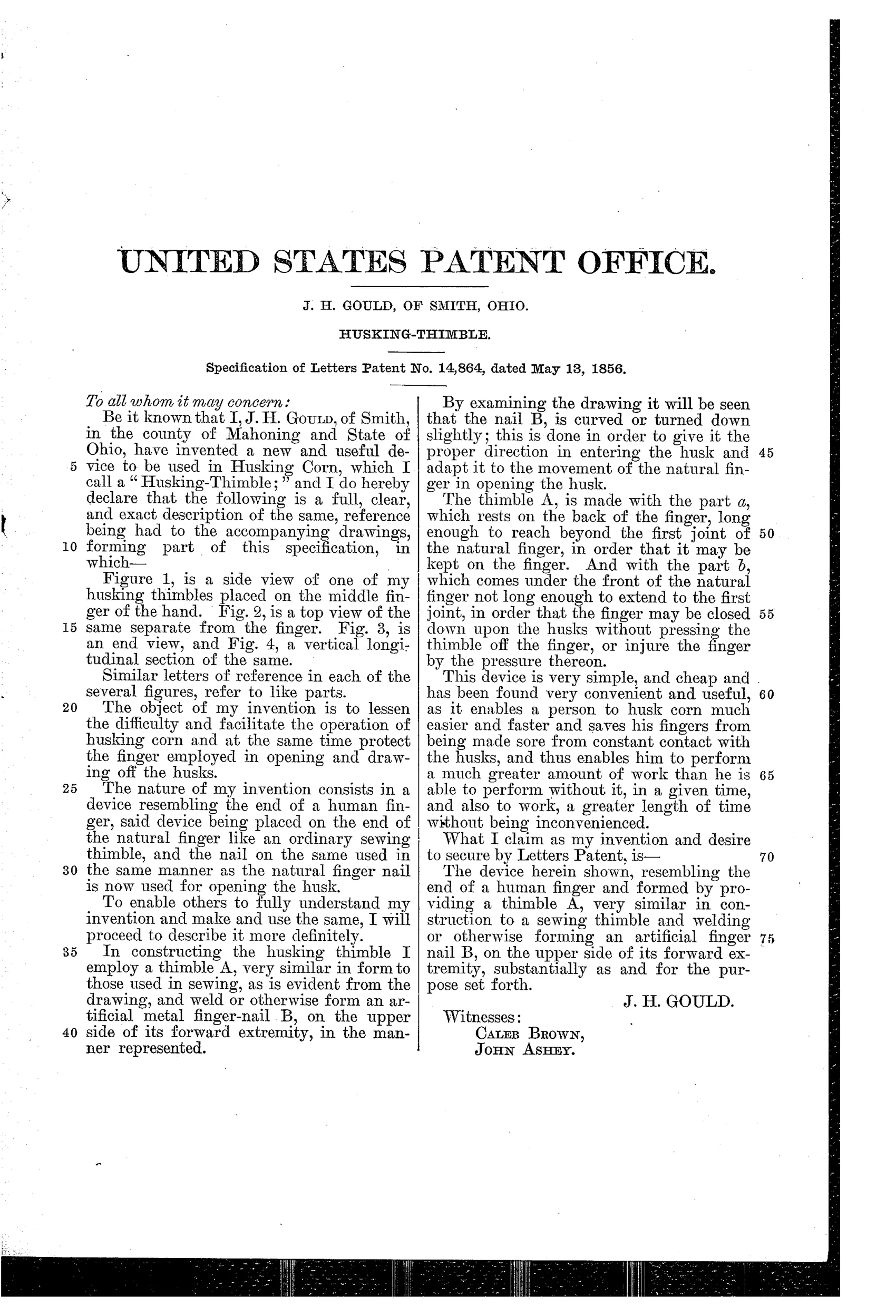
“The device herein shown, resembling the end of a human finger and formed by providing a thimble A, very similar in construction to a sewing thimble and welding or otherwise forming an artificial finger nail B, on the upper side of its forward extremity, substantially as and for the purpose set forth.”
In plain English: The claimed invention is a finger-shaped thimble with an artificial metal fingernail welded onto its upper front end, used for husking corn.
❧ In the inventor’s words
“This device is very simple, and cheap and has been found very convenient and useful, as it enables a person to husk corn much easier and faster and saves his fingers from being made sore from constant contact with the husks.”— J. H. Gould, from the specification
Fate unknown
Husking pegs and hooks were made in vast numbers, but I know of no documented example of Gould's specific thimble-with-nail pattern; a marked or provenanced specimen would settle it.
❧ Commentary
This one is a neighbor rather than a resident of our category — no crank, no clamp, no cast-iron frame — but it belongs to the same 1850s conviction that any sore-fingered kitchen or barnyard chore could be fixed with a small piece of shaped metal. Gould's answer to husking is disarmingly literal: a sewing thimble with an artificial fingernail welded to its upper front edge, curved downward exactly as your own nail curves, so the tool works by the same wrist motion you already know.
The drawing rewards a close look. Fig. 1 shows it seated on the middle finger, and the proportions matter: the back of the thimble runs past the first knuckle to anchor it, while the front is cut short so the finger can still flex and pinch the husk without levering the thimble off. That asymmetry is the actual invention — a full thimble would pop off the moment you closed your hand.
Husking pegs and hooks became a huge class of farm hardware later in the century, mostly leather palm straps with a steel hook. Gould's thimble form sits at the primitive end of that line: right instinct, awkward package. A whole-finger metal cap gets sweaty, slips, and can't be resharpened the way a peg can. The trade eventually voted for the strap-and-hook, but the idea of mimicking the fingernail rather than replacing the motion is honest, simple engineering.
Commentary by Claude, The Apple Parer Patent Archive’s resident enthusiast