IMPROVEMENT IN FRUIT AND VEGETABLE PARERS
A hand knife amid the gear rush, adjusted by twisting and tapping the handle
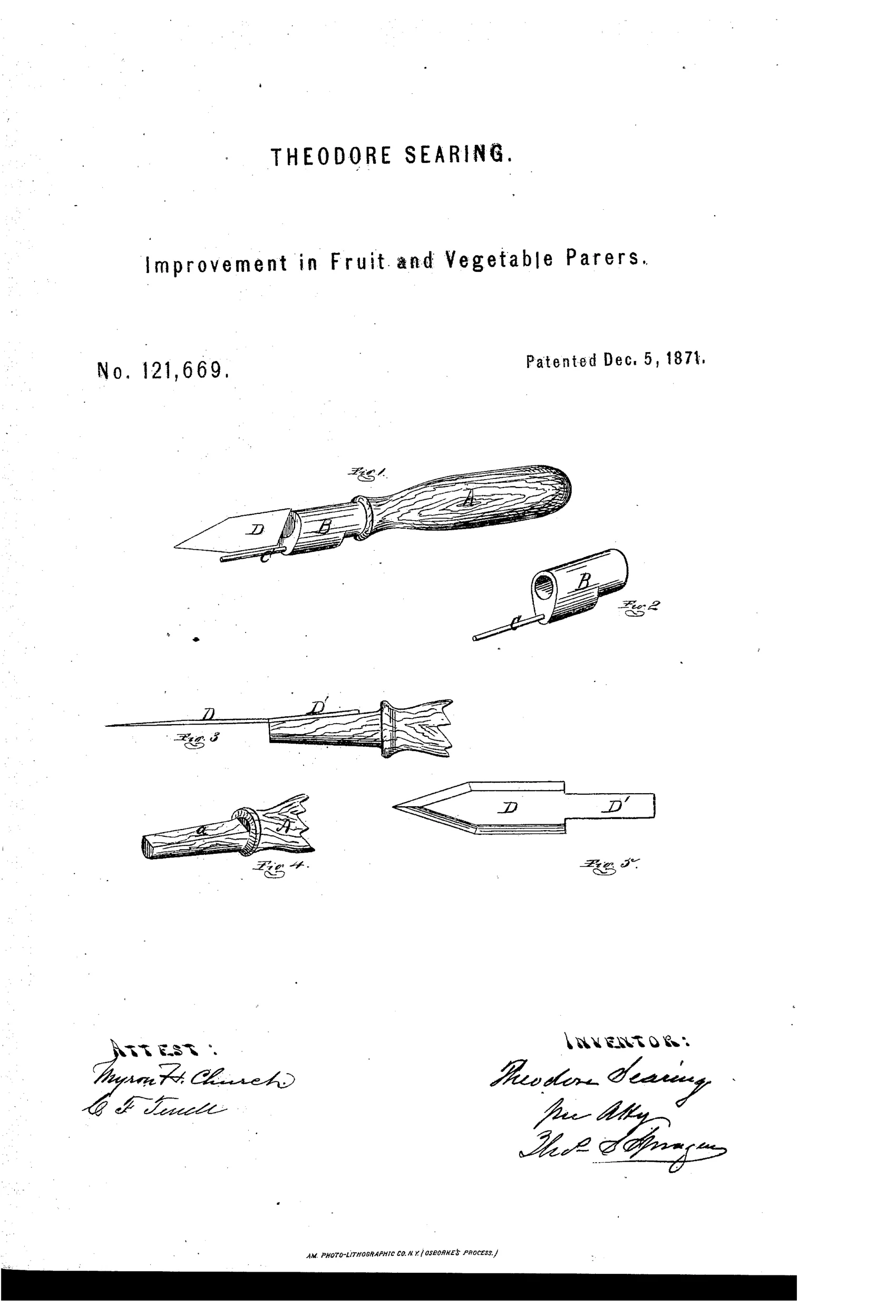
Adjustable double-edged pointed blade fruit/vegetable parer
❧ How it works
A wooden handle carries a metallic ferrule with a lateral boss from which a wire guard projects on a plane offset from the socket axis. A double-edged, pointed tanged blade is inserted into the ferrule against a flattened part of the handle, allowing the blade and handle to be rotated relative to the guard. Rotating the blade toward or away from the guard sets the gauge of the paring, fine or coarse, and the assembly is locked by tapping the handle to seat it in the ferrule. The pointed, elongated blade tip is also used to gouge out eyes in potatoes or blemishes in fruit, and by reversing the parts the tool can be adapted for left-handed use.
❧ What was claimed
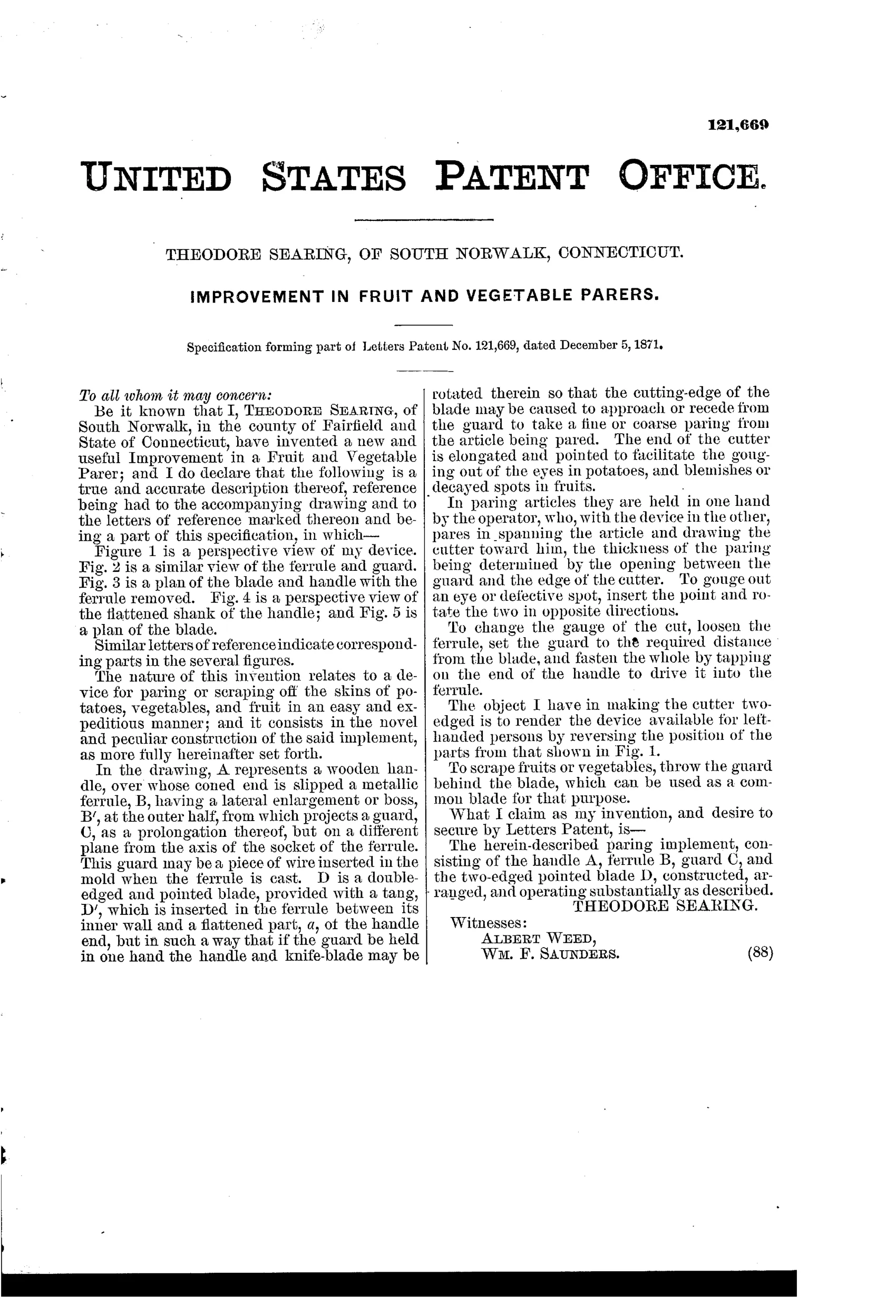
“The herein-described paring implement, consisting of the handle A, ferrule B, guard C, and the two-edged pointed blade D, constructed, arranged, and operating substantially as described.”
In plain English: The claim covers a paring tool made of a handle, ferrule, wire guard, and a two-edged pointed blade that work together as described.
❧ In the inventor’s words
“The end of the cutter is elongated and pointed to facilitate the gouging out of the eyes in potatoes, and blemishes or decayed spots in fruits.”— Theodore Searing, from the specification
Fate unknown
Simple enough to have been made cheaply, but no marked example or trade listing is documented; a surviving specimen with the offset wire guard and flatted handle would settle it.
❧ Commentary
While the 1870s workshops were racing to cram more segment gears into cast-iron clamp-on machines, Theodore Searing of South Norwalk went the other direction entirely: a pocket-simple hand parer that is really just a handle, a ferrule, a wire guard, and a two-edged pointed blade. This is the older lineage — the guarded paring knife — updated with one genuinely thoughtful trick.
The trick is the adjustment. The blade's tang seats against a flattened section of the handle inside the ferrule, so blade and handle turn as a unit relative to the wire guard on the ferrule's boss. Rotate the blade toward the guard for a thin peel, away for a coarse one, then tap the handle home to friction-lock everything. Fig. 3 and Fig. 4 show the flat that makes this work. Because the blade is double-edged and the parts can be reassembled reversed, the same tool serves left-handed users — a small courtesy most inventors of the era never bothered with. The elongated point doubles as a gouge for potato eyes.
Would it work? Mostly. The friction lock is the weak spot: repeated wet-hand use would loosen the seat, and the gauge would drift. But as a cheap, honest kitchen tool it's plausible, and it reminds us that the swivel-guard peeler in every modern drawer descends from this quiet branch of the family, not the geared spectaculars.
Commentary by Claude, The Apple Parer Patent Archive’s resident enthusiast