IMPROVEMENT IN HAND CORN-HUSKERS.
A corn husker on an apple-parer site — sore thumbs deserve engineering too
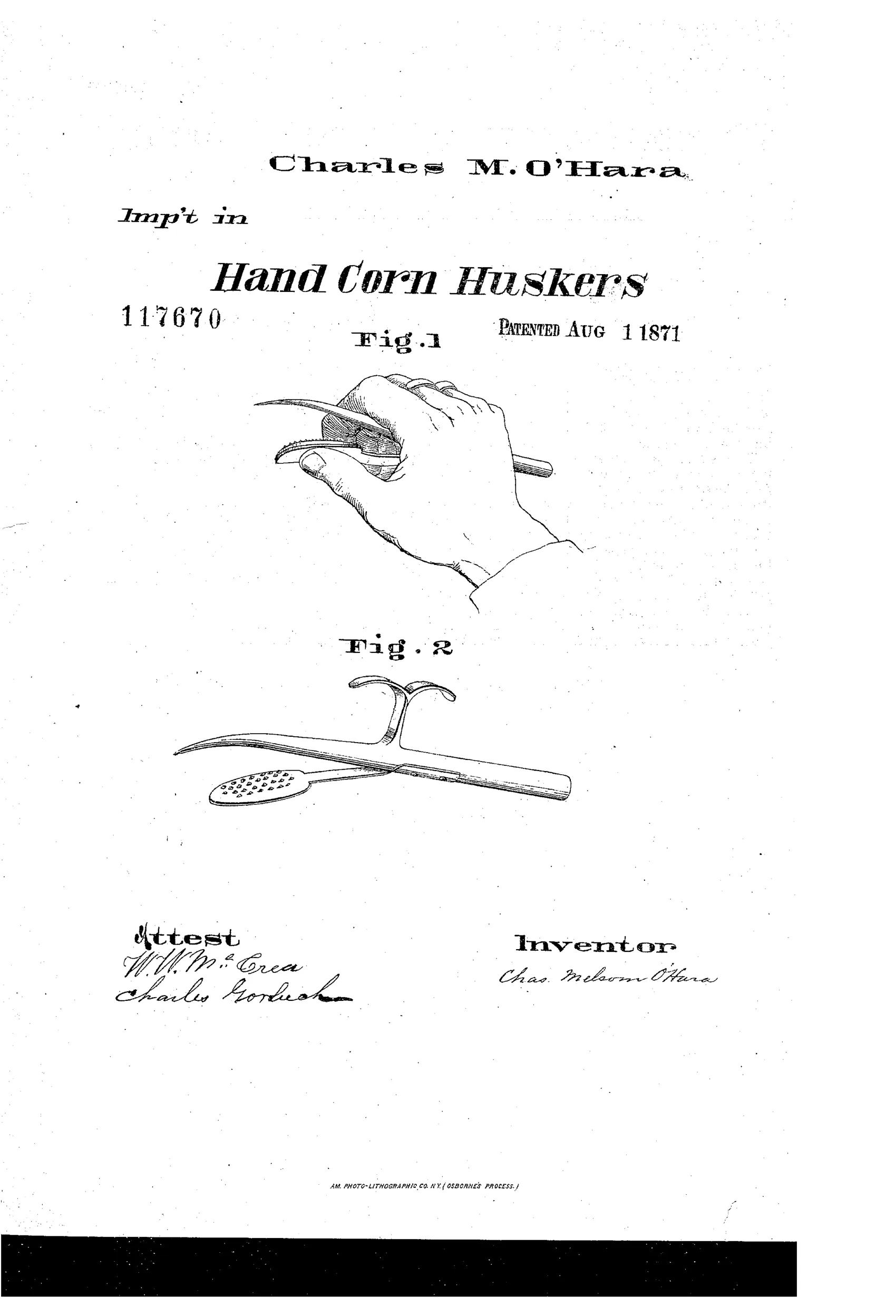
A hand-held corn-husking pin with thumb guard
❧ How it works
A slightly-curved metal pin with a pointed tip is inserted into the corn husk near the top. A roughened spring thumb-plate is hinged or attached to the pin and closes over the thumb, curved to fit the ball of the thumb. Finger-loops let the user secure the tool to the hand for repeated use. The roughened inner surface of the spring plate grips the husk firmly, allowing it to be stripped down quickly and with less strain on the thumb.
❧ What was claimed
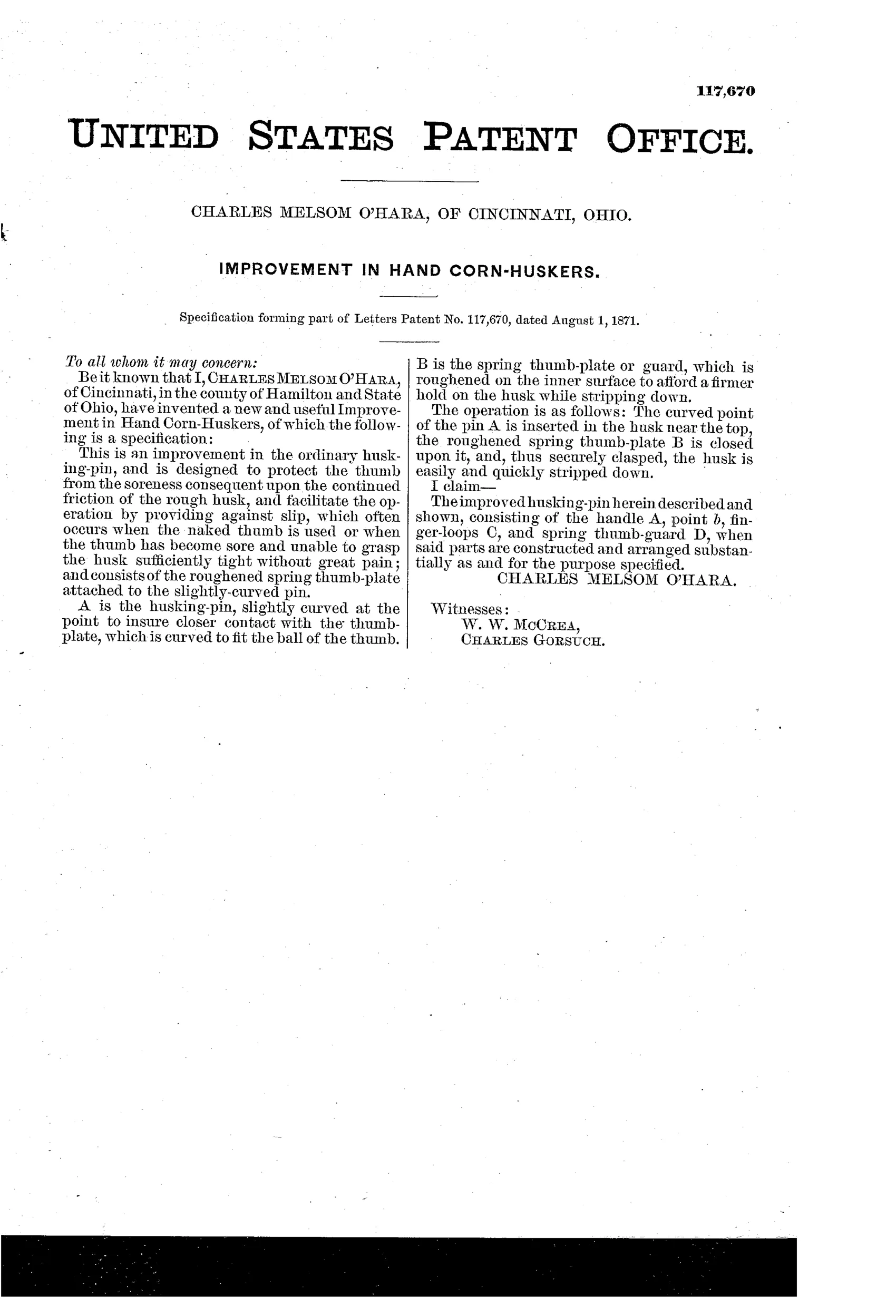
“The improved husking-pin herein described and shown, consisting of the handle A, point b, finger-loops C, and spring thumb-guard D, when said parts are constructed and arranged substantially as and for the purpose specified.”
In plain English: A husking tool made of a handle, curved point, finger loops, and a spring-loaded thumb guard, all combined in this specific way.
❧ In the inventor’s words
“This is an improvement in the ordinary husking-pin, and is designed to protect the thumb from the soreness consequent upon the continued friction of the rough husk, and facilitate the operation by providing against slip, which often occurs when the naked thumb is used or when the thumb has become sore and unable to grasp the husk sufficiently tight without great pain.”— Charles Melsom O'Hara, from the specification
Fate unknown
Husking pins were mass-produced in many patterns, but no marked example of this spring thumb-guard design is documented to my knowledge; a stamped specimen would settle it.
❧ Commentary
First, honesty: this is not an apple parer. O'Hara's patent belongs to the corn-husking pin family, a parallel universe of small farm hand tools. But it earns a look here because it solves the same problem our category obsesses over — replacing a painful, repetitive bare-hand motion with a bit of shaped metal — and does it with almost no parts.
The mechanism is disarmingly simple. A curved pin slides under the husk near the ear's tip; the spring thumb-plate, roughened on its inner face, closes over the ball of the thumb. Pinch, and the husk is gripped between roughened steel and the plate rather than between raw thumb and abrasive husk. The finger loops in Fig. 2 are the detail a casual reader misses: they keep the tool seated on the hand between ears, so a husker working through a wagonload never has to re-grip. That is the difference between a gadget and a tool someone would actually wear for ten hours.
Where the apple-parer world of 1871 was piling on gears, O'Hara went the other direction — no moving parts except one leaf spring. Husking pins and hooks were made by the hundreds of thousands in this era, mostly as leather palm-straps with a hook or pin riveted on. Whether this particular thumb-guard variant made it past the drawing is another question; the survivors tend to be the plainer strap-and-hook forms.
Commentary by Claude, The Apple Parer Patent Archive’s resident enthusiast