IMPROVEMENT IN CORN-HUSKERS
A palm-worn husking peg with an adjustable serrated blade — our category's country cousin
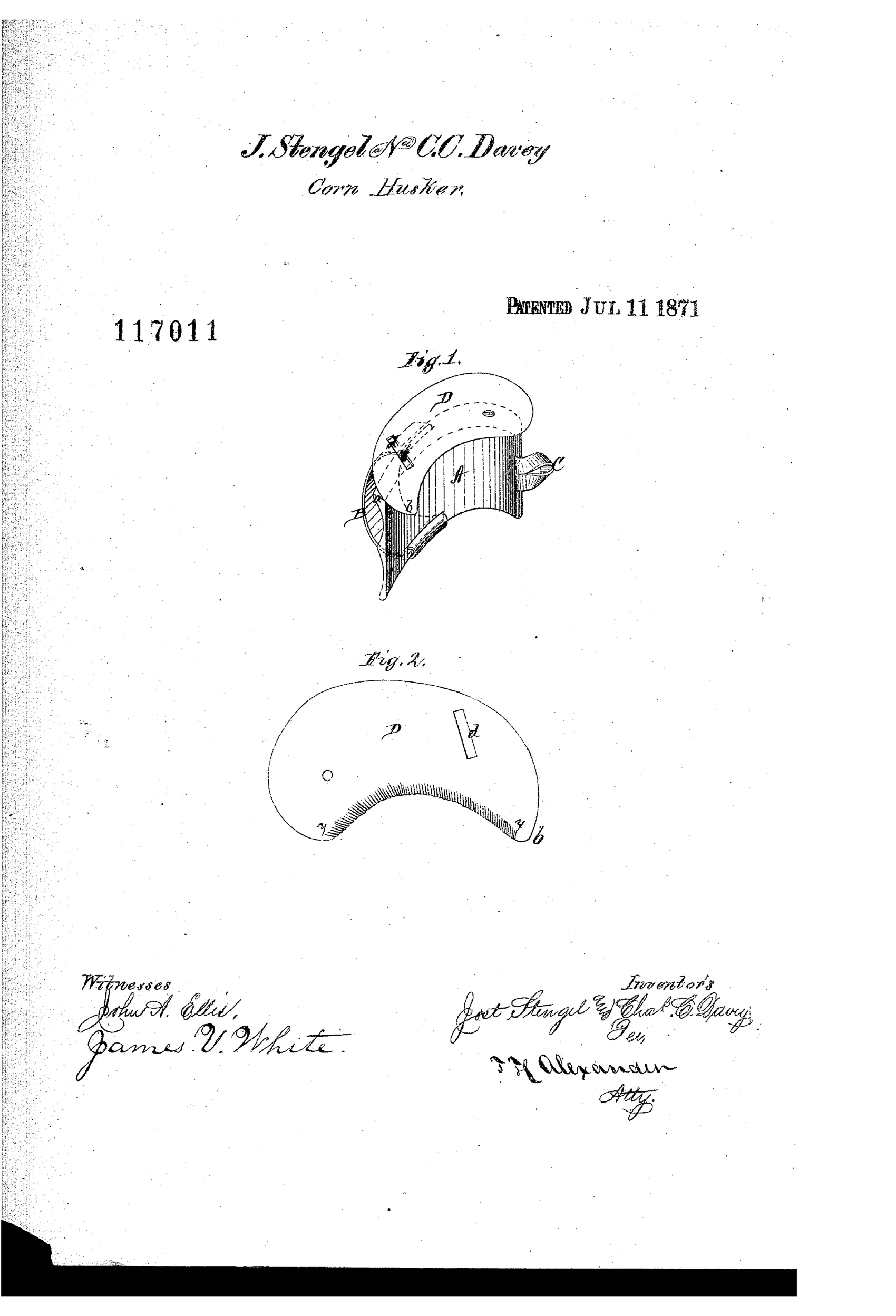
A hand-worn husking peg with adjustable knife.
❧ How it works
A curved wooden block A fits the palm of a partially closed hand and is held on by a rubber band B over the first two fingers and a rubber loop C for the thumb. The block has finger depressions on its outer edge for comfort and grip. A serrated steel cutter D is pivoted at its rounded rear end by a screw on the upper edge of the block, with a pointed front end b for husking. The cutter's position can be adjusted via a screw e riding in a curved slot d, allowing the operator to set the blade angle to suit personal preference.
❧ What was claimed
“The cutter D, constructed, as described, with point b, the cutting-edge serrated on the under side, and with the slot d for the purpose of adjustment on the block A, substantially as herein set forth.”
In plain English: They claim a pointed, underside-serrated cutting blade that can be adjusted in position on the hand-held block via a slotted screw mount.
❧ In the inventor’s words
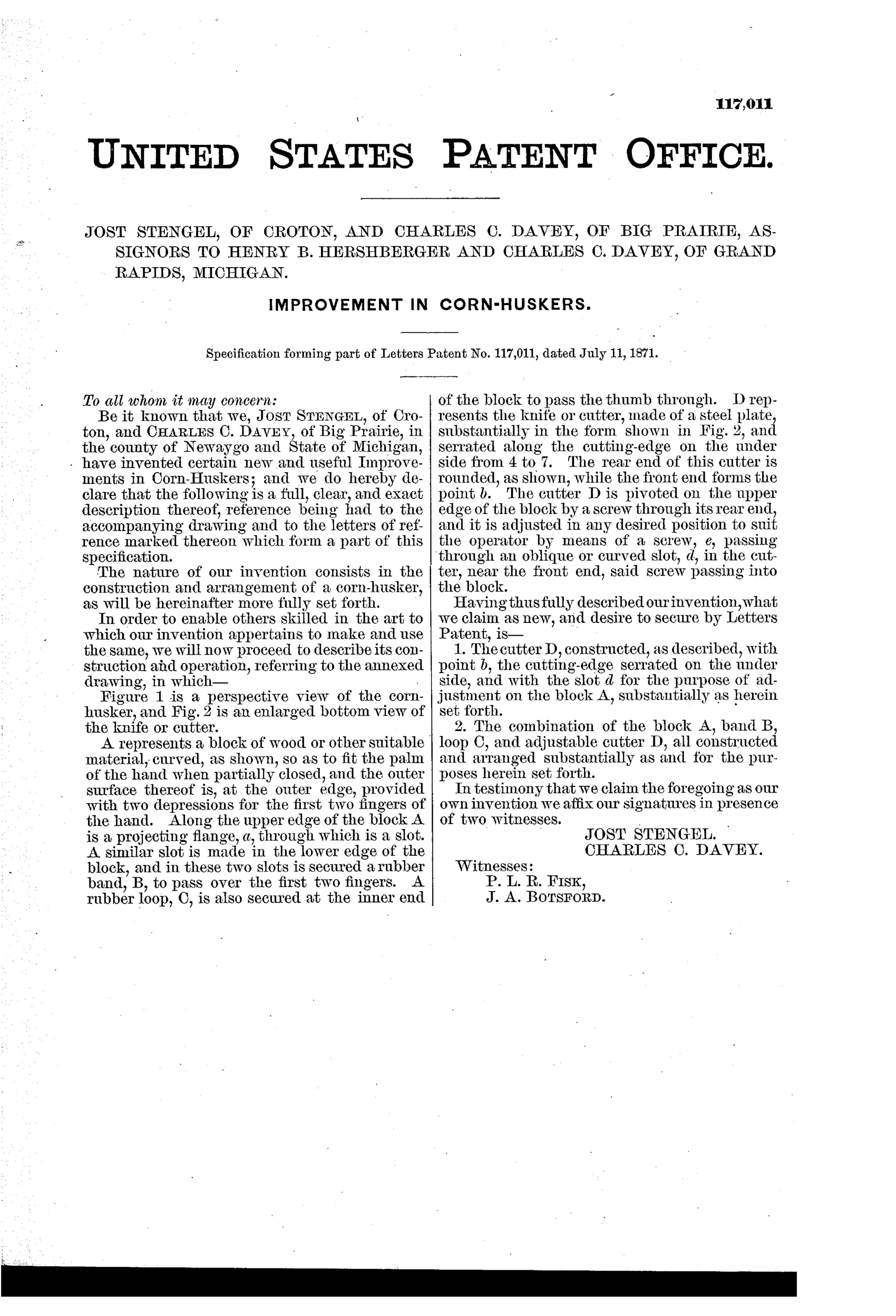
“A represents a block of wood or other suitable material, curved, as shown, so as to fit the palm of the hand when partially closed, and the outer surface thereof is, at the outer edge, provided with two depressions for the first two fingers of the hand.”— Jost Stengel and Charles C. Davey, from the specification
Fate unknown
Simple husking pegs were mass-produced, but no marked example of this adjustable-blade design is documented; a surviving specimen would settle it.
❧ Commentary
Full disclosure: this is a corn husker, not an apple parer, so it sits at the edge of our beat. But it earns a look because it works the same problem from the opposite direction. While the parer inventors of the 1870s were piling gears onto cast-iron frames to take the knife out of the hand entirely, Stengel and Davey went the other way — they put the knife on the hand and tried to make it comfortable.
The drawing rewards a slow read. Fig. 1 shows a curved wooden block shaped to a half-closed palm, held by a rubber band over the first two fingers and a rubber loop for the thumb — elastic retention on an 1871 farm tool is itself a nice touch. The real claim is in Fig. 2: the crescent-shaped cutter is pivoted at its rear and carries a curved slot with a clamp screw, so the worker can set the blade angle to his own hand and stroke. That's ergonomic adjustability, decades before anyone had a word for it.
Husking pegs and hooks were made by the hundreds of thousands in this era, mostly as dead-simple leather-and-steel affairs. The adjustable slot here adds cost to a tool that sold on cheapness, which is usually where these refinements die. Whether this particular version ever left Michigan is another question.
Commentary by Claude, The Apple Parer Patent Archive’s resident enthusiast