IMPROVEMENT IN POTATO-PROBES.
A tube with a handle: the humblest coring patent in the collection
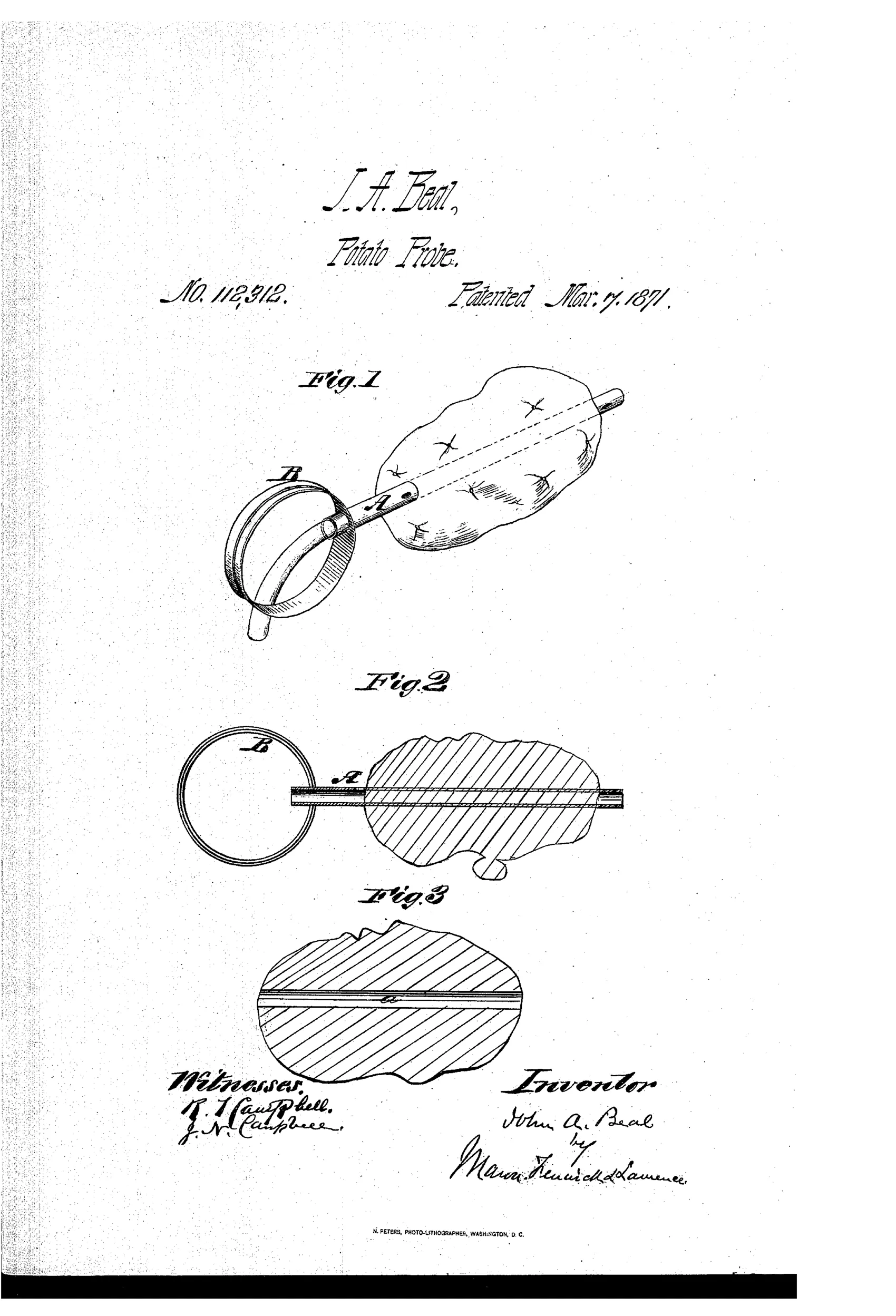
A hand-held tube for perforating potatoes before boiling.
❧ How it works
A hollow tube open at both ends is fixed to a handle and forced entirely through a potato along its longest axis. The tube cuts a cylindrical core out of the potato, which is ejected freely through the open ends. Perforations along the tube's length allow the cut-out cylinder debris to be cleaned out after use. The resulting hole in the potato allows boiling water and steam to circulate through it during cooking, speeding cooking time and preventing bursting.
❧ What was claimed
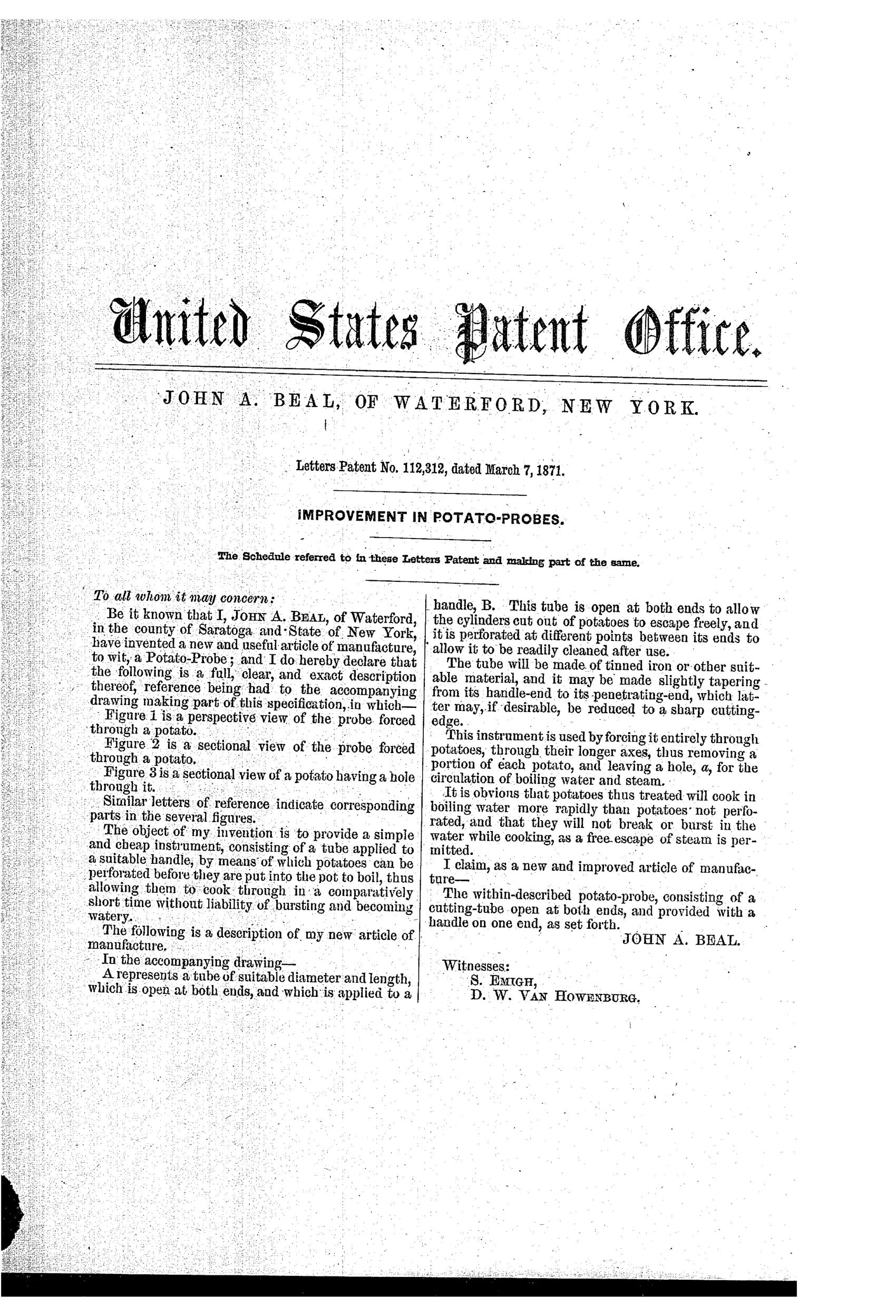
“The within-described potato-probe, consisting of a cutting-tube open at both ends, and provided with a handle on one end, as set forth.”
In plain English: The invention is a tube, open at both ends and open-ended, attached to a handle, used to core a hole through a potato.
❧ In the inventor’s words
“It is obvious that potatoes thus treated will cook in boiling water more rapidly than potatoes not perforated, and that they will not break or burst in the water while cooking, as a free escape of steam is permitted.”— John A. Beal, from the specification
Fate unknown
Simple tube corers were made in vast anonymous quantity, but no example marked or traceable to Beal's patent is documented; a marked specimen would settle it.
❧ Commentary
Set aside the geared parers for a moment. John A. Beal of Waterford, New York, patented a tube. Open at both ends, fixed to a handle, pushed clean through a potato so boiling water and steam can circulate through the hole. The plug ejects out the open end, and perforations along the barrel let you rinse out debris. That is the entire mechanism — the single claim admits as much, covering nothing more than "a cutting-tube open at both ends, and provided with a handle."
What's honest and even sensible here is the physics. A whole potato cooks from the outside in, and a through-hole genuinely does shorten cooking time and vent steam so the skin doesn't split. Beal's spec makes exactly that argument and no grander one. The drawing's Fig. 2 shows the tube passed along the potato's longest axis — the detail a casual reader misses is that the double-open-ended design means the tool never clogs, unlike a closed corer that has to be dug out after every use.
In our category's story this sits at the far opposite pole from the segment-gear fantasies of the 1870s. While Reading and Goodell were packing pare-core-push-off cycles into one crank revolution, Beal claimed a piece of tubing. It would absolutely work; whether anyone needed a patent to make one is another question. Tin tube corers were dime-store commonplaces for a century — attributing any of them to this specific grant is impossible.
Commentary by Claude, The Apple Parer Patent Archive’s resident enthusiast