IMPROVEMENT IN HAND CORN-HUSKERS AND SHELLERS
A corn husker on an apple-parer site — the hand-strap idea explains why
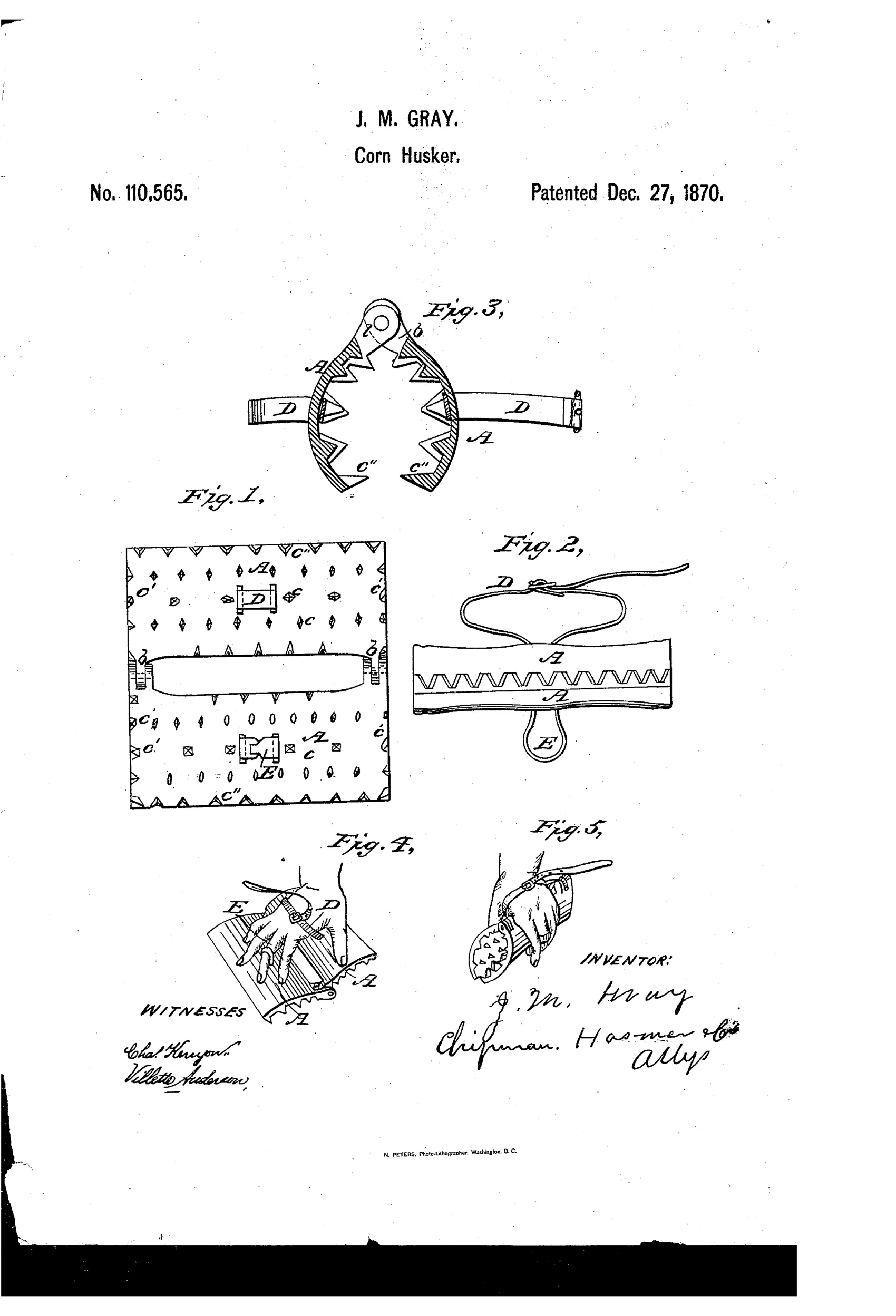
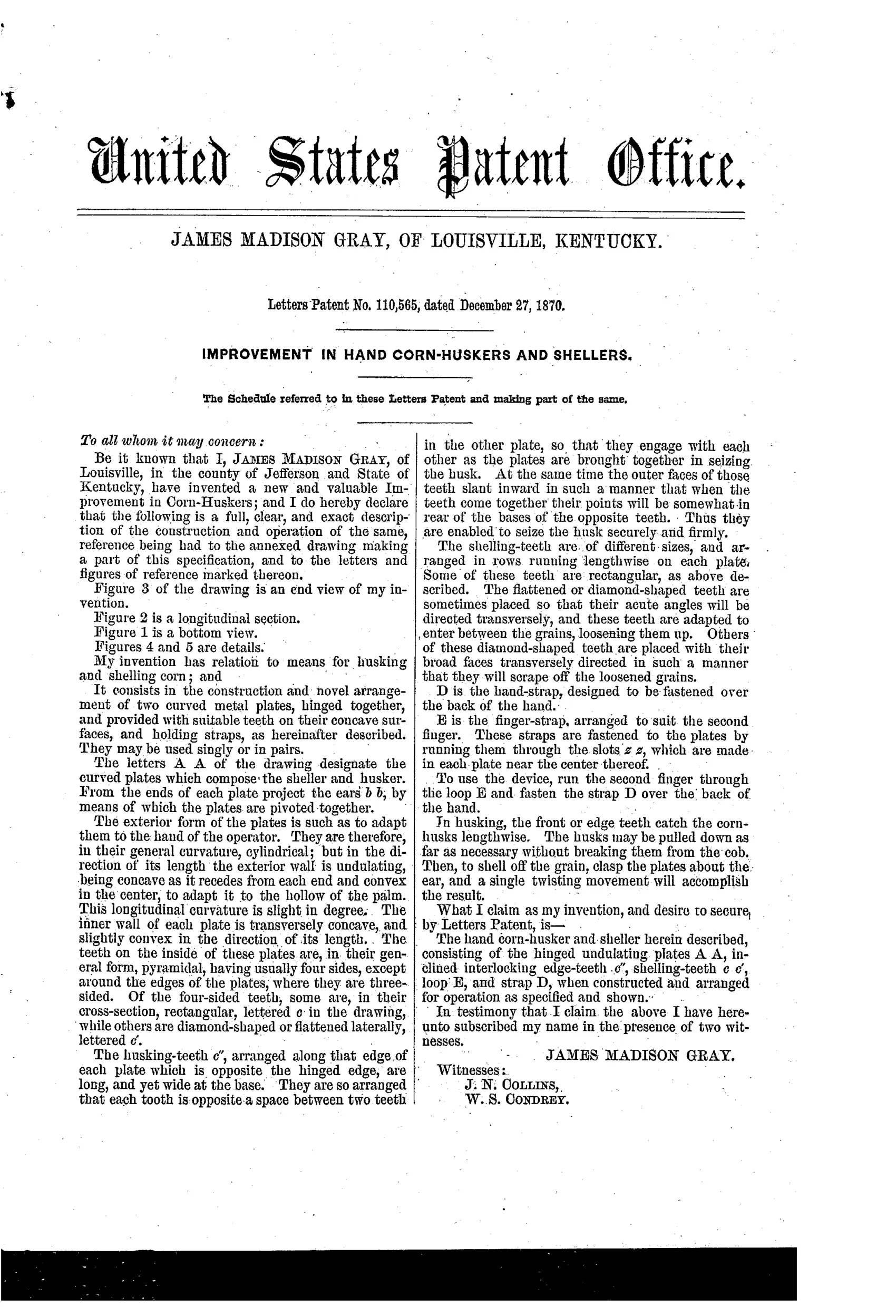
Hand-held hinged corn husker and sheller
❧ How it works
Two curved metal plates are hinged together at ears on their ends and lined on their concave inner faces with interlocking pyramidal and diamond-shaped teeth. Long edge teeth on each plate catch and pull down the husk lengthwise without breaking it from the cob, while inner rectangular and diamond teeth grip and loosen kernels. The device is strapped to the hand via a hand-strap D over the back of the hand and a finger-strap loop E for the second finger. To shell corn, the operator clasps the hinged plates around the ear and applies a single twisting motion to strip off the grain.
❧ What was claimed
“The hand corn-husker and sheller herein described, consisting of the hinged undulating plates A A, inclined interlocking edge-teeth c", shelling-teeth c c', loop E, and strap D, when constructed and arranged for operation as specified and shown.”
In plain English: The patent covers a hand tool made of two hinged curved toothed plates, held on with a hand strap and finger loop, used together to husk and shell corn.
❧ In the inventor’s words
“In husking, the front or edge teeth catch the corn-husks lengthwise.”— James Madison Gray, from the specification
Fate unknown
Simple hand huskers were widely manufactured, but I know of no documented example of Gray's hinged two-plate design; a marked surviving specimen would settle it.
❧ Commentary
First, honesty: this is not an apple parer. Gray's patent is a hand corn-husker and sheller, and it wandered into our files because it shares the family DNA of hand-worn fruit and vegetable tools that predate — and coexist with — the geared cast-iron machines we usually cover. It's worth a look precisely for the contrast.
While the parer inventors of the 1870s were piling on segment gears and cams to take the hand out of the work, Gray went the other direction: he armored the hand itself. Two hinged, undulating plates strap over the palm with a loop for the second finger. The teeth do two different jobs, and the drawing (Fig. 1) rewards a close look — the long inclined edge teeth catch the husk lengthwise and pull it down without tearing it free of the cob, while the interior diamond and rectangular teeth grip kernels so a single twisting motion shells the ear. That's a genuinely thought-through division of labor on one cheap piece of hardware.
Would it work? Probably, in the way husking pegs and pins worked — as a modest improvement to bare-handed drudgery, at the cost of a raw wrist by evening. Husking pegs and hooks were made by the millions; this particular hinged-plate variant is another matter. It sits at the fork in the road where one branch led to hand aids and the other, the one apple parers took, led to machines that cranked.
Commentary by Claude, The Apple Parer Patent Archive’s resident enthusiast