IMPROVEMENT IN FRUIT-PARERS
A spring-loaded knife that pares the blossom end first, from Goodell's hometown
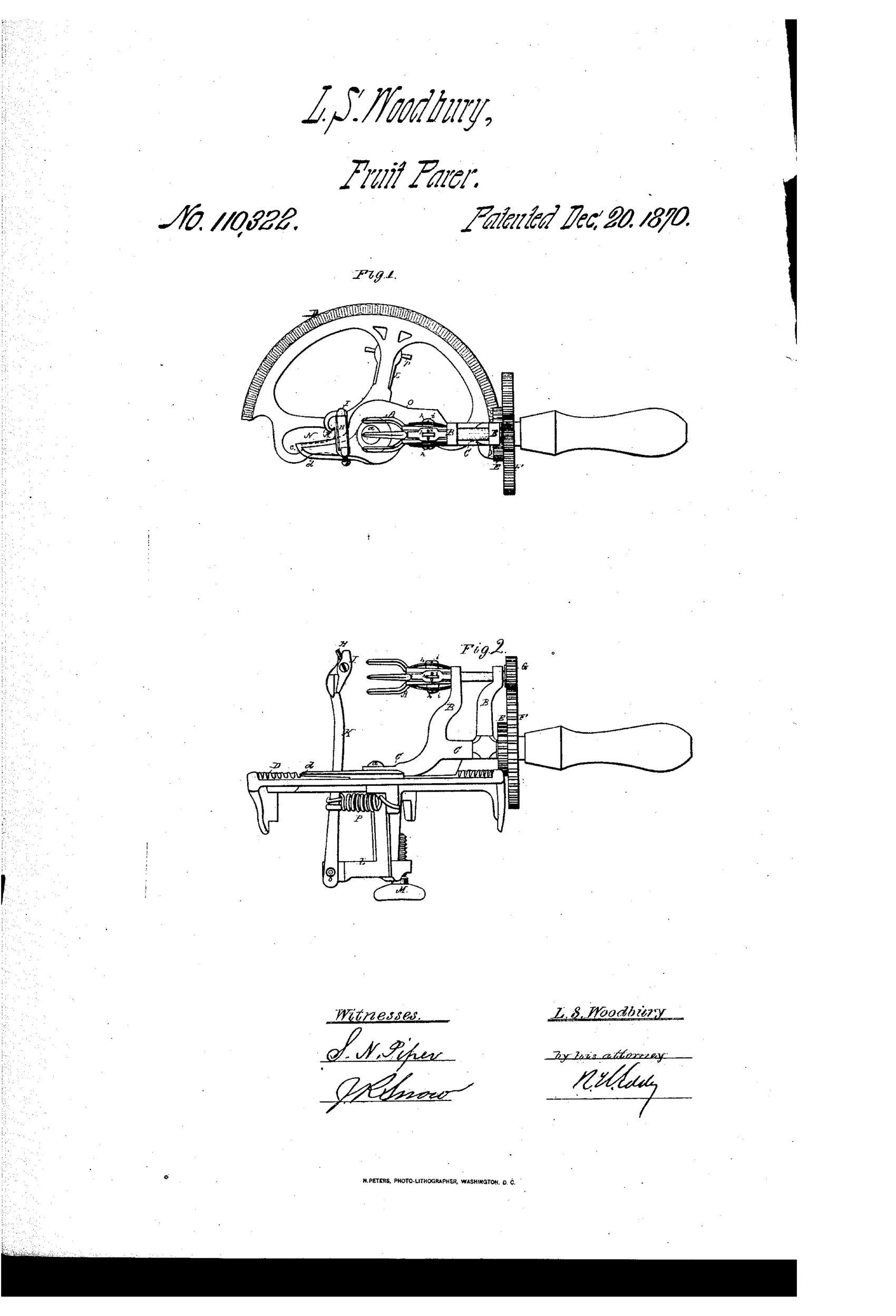
Geared hand-crank fruit-paring machine with rotary fork
❧ How it works
A fruit is impaled on a rotary fork A fixed to an arbor B, which is turned by a spur gear F meshing with a pinion G on the fork-arbor. The paring knife H is mounted on a pivoted lever C that carries a beveled sector D engaging a pinion E, so that turning the crank both rotates the fruit and swings the knife arm. A rod K supporting the knife runs through a slot N with a notch c; a cam O and a return spring P work together so the knife is retracted and held via the notch, then released and driven by the spring against the outer end of the fruit as the lever is worked. This arrangement forces the knife against the 'blow' end of the fruit first, tending to crowd the fruit onto the fork rather than eject it as in earlier machines.
❧ What was claimed
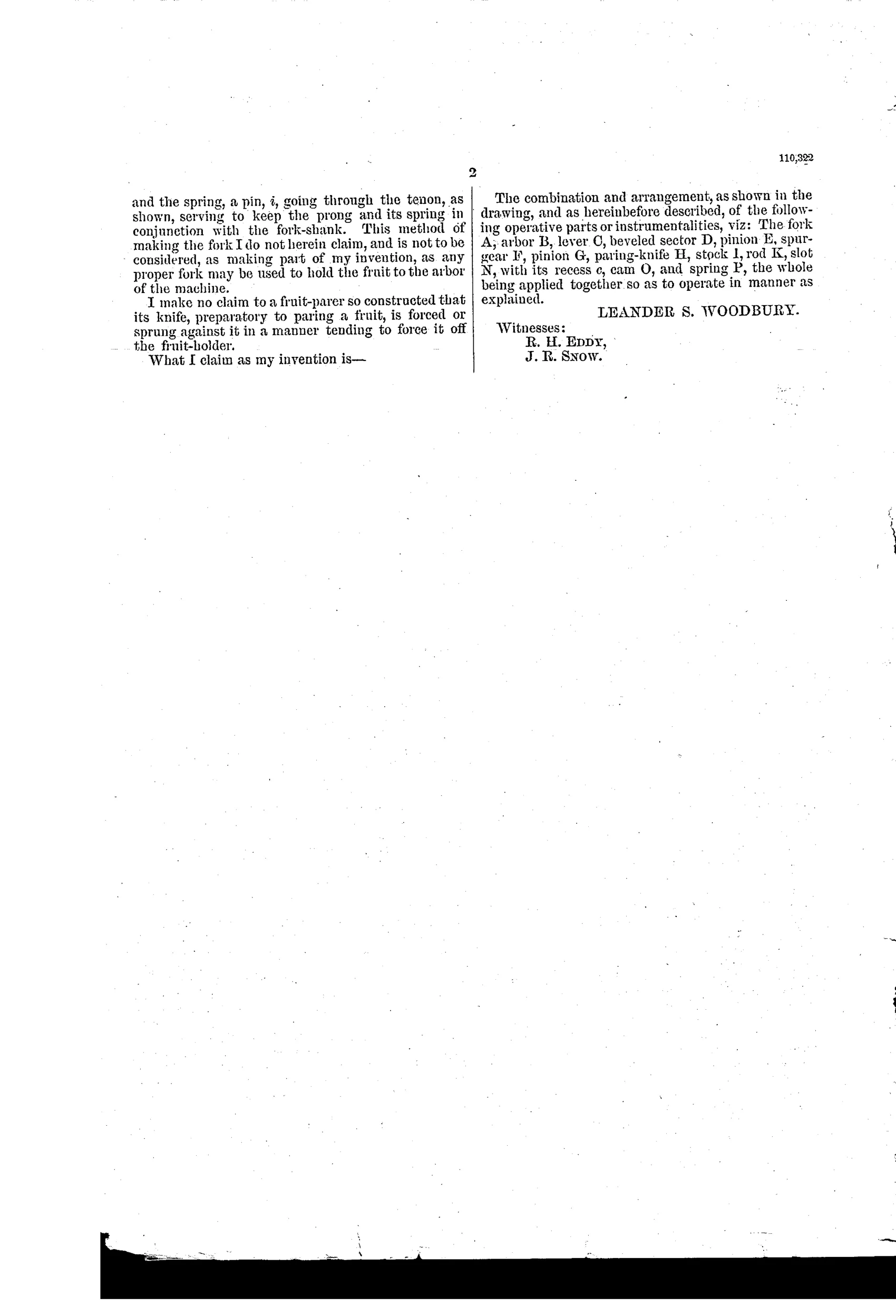
“The combination and arrangement, as shown in the drawing, and as hereinbefore described, of the following operative parts or instrumentalities, viz: The fork A, arbor B, lever C, beveled sector D, pinion E, spur-gear F, pinion G, paring-knife H, stock I, rod K, slot N, with its recess c, cam O, and spring P, the whole being applied together so as to operate in manner as explained.”
In plain English: The patent claims the specific combination of fork, arbor, lever, gears, knife, rod, slotted guide with notch, cam, and spring all working together as described.
❧ In the inventor’s words
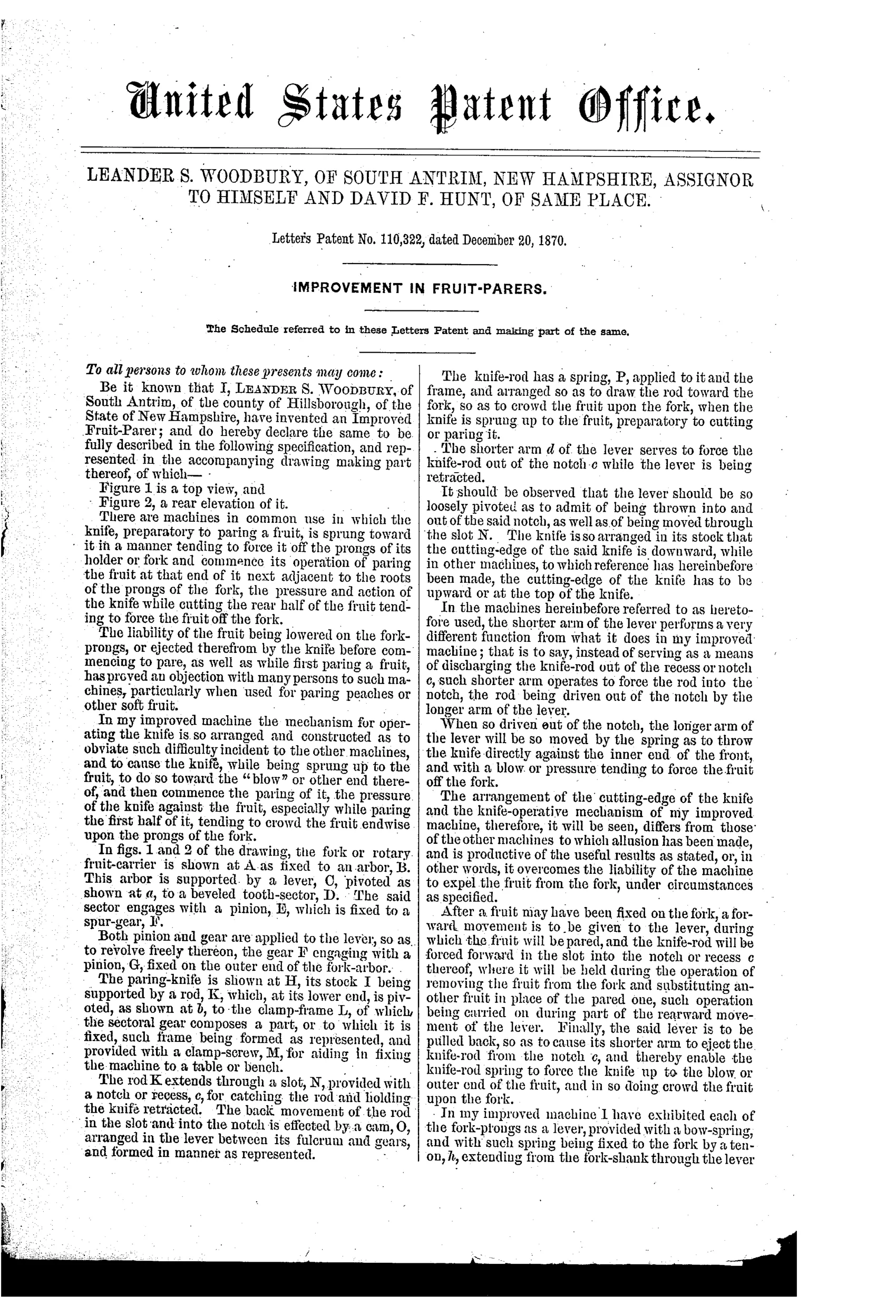
“The liability of the fruit being lowered on the fork-prongs, or ejected therefrom by the knife before commencing to pare, as well as while first paring a fruit, has proved an objection with many persons to such machines, particularly when used for paring peaches or other soft fruit.”— Leander S. Woodbury, from the specification
Fate unknown
The Antrim setting makes production plausible, but I know of no marked Woodbury machine; a documented specimen or a DATAMP entry tying this patent to a production parer would settle it.
❧ Commentary
Woodbury's problem statement is the honest part of this patent: on soft fruit — peaches especially — the first bite of the knife tends to shove the fruit down the fork prongs or knock it off entirely. His answer is a small choreography of cam, notch, and spring. The rod carrying the knife rides in a slot with a recess; the cam holds the knife retracted and cocked in that notch while you spear the fruit, then the spring drives the blade against the outer 'blow' end first, so the cutting pressure crowds the fruit onto the fork instead of prying it loose. That inversion of the usual starting point is the whole idea, and it is a genuinely thoughtful one.
The drawing rewards a second look. The big arc across Fig. 1 is a beveled sector on the pivoted knife lever, meshing with a pinion so that one crank both spins the fruit and sweeps the blade — the classic 1870s ambition of doing everything in a single motion, claimed here as one long combination of lettered parts rather than any single element.
The address matters too: South Antrim, New Hampshire, the town where D. H. Goodell built the parer industry. Woodbury and his co-assignee Hunt were working in the thick of it, and this patent reads like a local craftsman's answer to a complaint customers actually voiced.
Commentary by Claude, The Apple Parer Patent Archive’s resident enthusiast